

Congratulations flowers: what the venue will let in, and what the recipient can carry out
Congratulations flowers on Long Island, delivered to a home, office or stadium gate. Hand-wrapped in our Port Jefferson shop, ready with 8 hours’ notice.
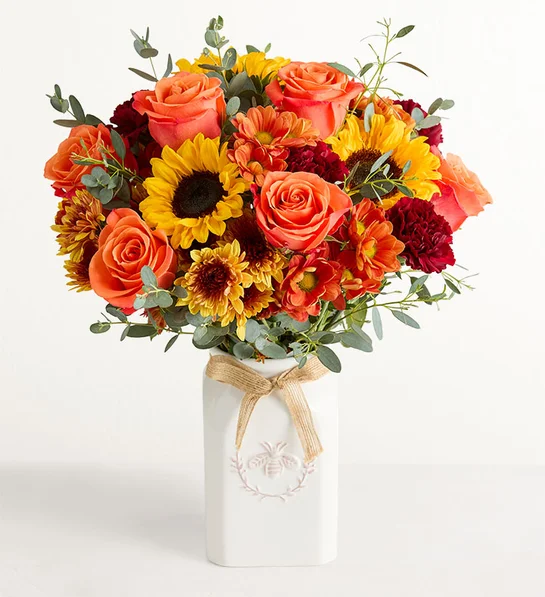
Tell us the threshold
A stadium gate, a nursing station, an unstaffed suite door and a front door each treat an arriving arrangement differently.
Built to travel home
These flowers leave with the person you sent them to, so we build them to lift in one hand rather than to dominate a desk.
You hear the problem first
Where a published rule or a locked lobby would turn the delivery away, we say so while you are ordering rather than afterwards.
Late works in your favour
Congratulations is the rare occasion where arriving after everyone else is an advantage, so a missed day is not a lost one.
Stony Brook publishes a list of what may not come through the gate at its commencement ceremonies: “outside food/beverage, thermoses, coolers, alcoholic beverages, backpacks, luggage, strollers, umbrellas, noise makers, balloons, weapons, laser pointers, fireworks, aerosol cans, and non-service pets.” Balloons and umbrellas are refused outright, at an outdoor stadium where the gates open at ten for an eleven o’clock start. Flowers are not named anywhere on it, which is exactly the point — nobody wrote that list thinking about gifts. It is a document about thresholds, about what may physically cross a line, and it was written by the place rather than by the giver.
That is the shape of this whole occasion. Good news gets announced somewhere other than home, so a congratulations order has to clear two tests that a bouquet sent to a house never meets. Can it get in — past a gate, a reception desk, a security post, or a rule somebody else published? And can it get out again, in one hand, on a train or across a parking lot, at the end of a day the recipient did not plan around carrying anything? Nothing about the celebration itself answers either question. The address answers both. So this page runs in that order: the gate, then the journey home, then the two addresses where a written document rather than a person gives you the answer, then home, and only then the five celebrations and the single decision each of them turns on.
Ceremony day: two venues, two completely different rules
Take the gate list at face value and the graduation delivery you had in mind falls apart in a useful way. A balloon bouquet does not get in at all. A wrapped arrangement is not prohibited, but at an outdoor stadium with gates an hour before the start it spends that hour in late-May sun, then sits through the ceremony on somebody’s lap. The venue five miles west behaves nothing like it: Nassau Coliseum publishes no prohibition on flowers or balloons, and its constraint is a size cap instead, with bags or backpacks larger than 14″x14″x6″ turned away. Two Long Island colleges hold their commencements in that arena on consecutive days, while another does the whole thing indoors. Same weekend, same graduating cohort, three different answers about what a guest may carry through a door.
The move that survives all three is to stop treating the ceremony as the delivery address. Flowers go to the house, timed to be there when the family gets back, and the photographs on the field happen without anyone holding a sheaf of wet paper. If you want the venue-by-venue comparison and the two separate Long Island graduation waves — the colleges in the third week of May, the high schools waiting for the June Regents window to close — that belongs on graduation ceremony flowers, which carries the dates and the prohibited-items lists in full.
The second journey: whatever you send has to leave with them
Flowers sent for most reasons finish their trip at the address on the label. These do not. A congratulations arrangement arrives at a place the recipient is visiting, working in or graduating from, and then has to be moved again by somebody who is already carrying a laptop bag, a mortarboard or a box of desk contents. That second journey is the constraint national gift guides never mention, and it quietly disqualifies the tall, dramatic, water-heavy arrangement that photographs best.
Three properties get an arrangement home intact. It should stand up without a vase, because an office kitchen does not have one and a stadium car park certainly does not. It should be light enough for one hand, leaving the other free for a door, a ticket or a rail. And it should be unscented, because open-plan air is shared and a strong fragrance becomes a decision imposed on people who did not order flowers. That combination is why orchids earn their reputation as the workplace gift — a potted orchid arrives finished, needs nothing from the building, and is still worth looking at weeks after cut stems would have been cleared away. Where the arrangement must be cut stems, ask for the long-lived end of the cooler; carnations outlast almost everything else in a warm room. The building’s own clock is a separate problem with its own answers — what time a lobby stops signing for deliveries, and which weekdays a Long Island office is actually full — and those sit on delivering to a Long Island office.
Two addresses where a document answers, not a receptionist
Thanking a care team is the one congratulation that an employer can formally stop. Hospital gift policies here treat flowers as a gift like any other, and the wording that matters turns on the label rather than on the contents: a token addressed to a facility department or office can be permitted while the same token addressed to one named member of staff has to be assessed, and can be declined and returned. So put the unit on the delivery label and the person’s name inside the card, where it reads as thanks rather than as a transfer of property. The policy language, the timing around shift changes and what to do when you never caught the name are all on thanking hospital staff.
Public employment is the other document, and Long Island runs on it — school districts, village and town halls, county departments, state agencies, public authorities. Each sets a ceiling on what an employee may accept from an outside party, and those ceilings are written to different standards, so you are not subject to one rule but to whichever attaches to that particular desk. You can sidestep the whole question with either of two moves: address it to the team, or send it to their home. Where the actual thresholds matter — a vendor congratulating a client, a contractor thanking a department — the employer-by-employer detail is on gift rules for Long Island workplaces, and it is worth two minutes before you spend anything.
Home is the one address with no gate and no commute
A house has no policy, no prohibited-items list and no closing time, and the flowers are already where they are going to live. That makes it the default whenever one of the other addresses raises a question you cannot answer from your desk. Its single weakness is that nobody may be in. Give us a mobile number for someone at that end — it does not have to be the recipient if you are keeping it a surprise — and a covered spot the driver may use if the door does not open, and the weakness mostly disappears. It is also the honest answer for any private celebration: a qualification passed at the fourth attempt, a citizenship, an offer accepted quietly. Sent home, the person can react however they actually feel instead of performing pleasure for an audience of colleagues.
Five celebrations, and the one decision each turns on
The arrangements barely differ across these five, and pretending otherwise would waste your time. What differs is one operational decision in each — a different address, a different direction, a different hour, a different pair of names. That decision is the whole of each section below.
New job: send it to the address they are leaving
The address already in your phone is the right one, and it stops being right the moment they start. Deliver before day one, to the home, while the leap still feels like a leap. A new employer’s building is the worst address on this page for it: the recipient is a stranger to the front desk, has no desk of their own to put anything on, and may spend the morning in an induction room two floors from where the flowers are standing.
Promotion: send it from the group, not up the ladder
This one genuinely is an office delivery, because the recognition is half the gift and the room already knows. The decision here is direction of travel. Flowers from a manager to a newly promoted report read as generous; flowers from a report to a manager can read as something else, particularly in a public-sector office where the acceptance question above is live. Sending from the team collectively removes the ambiguity, so name everyone on the card and let the arrangement be the group’s.
Retirement: any hour except Friday afternoon
Timing is the entire problem, and the obvious slot is the worst one. An arrangement that lands at four o’clock on a final Friday arrives after the desk has been boxed and the car loaded, so it becomes one more thing to carry out. Deliver on the morning of the last day, where it sits out through the goodbyes, or to the house the following week, when the calendar is suddenly empty and the flowers are the only thing that arrives.
Thank-you: the only one that can be handed back
A thank-you travels from the person who received a service to the person who provided it, which is precisely the direction employers write rules about. One question decides the order: does this person work somewhere with a published gift policy? If yes, the department goes on the label and the individual’s name goes in the card. If no, it is an ordinary delivery and the rest of this page is about where they will be standing when it arrives.
Engagement: two recipients, one doorway
The common mistake is addressing one of them as though the other were incidental, so put both names on the card. If the couple do not yet share an address, ask which household is fielding the phone calls this week and send there. Scale down rather than up if it is going to a small apartment that is already absorbing visitors, since floor space is the binding constraint in the week after an engagement.
Write the card for whoever ends up reading it aloud
Congratulations flowers get opened in front of the people who share the news, and the message tends to be read out. Write it for that. One specific line beats three general ones — the detail of the job, the length of the career being retired from, the fact that you knew before it was announced. Sign with your full name rather than a first name, because a busy recipient may be holding a stack of cards from people who all share it. If several of you are contributing, list every name; a card signed “from all of us” leaves the recipient thanking a fog. That is the sharpest difference between this and a birthday, where the sender is usually obvious before the envelope is open.
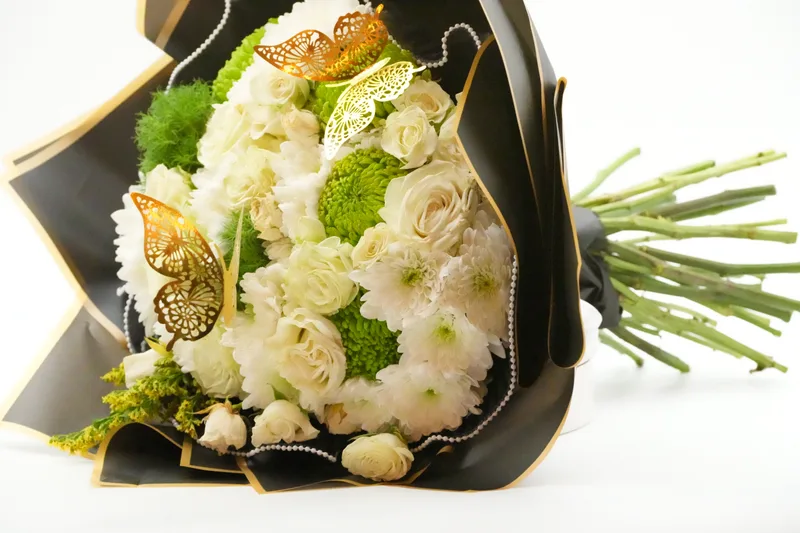
Roses at the door tonight
Call 8 hours ahead. Made in our shop and ready with 8 hours’ notice.
Common questions
Can you have flowers waiting for the graduate at the ceremony?
Sometimes, and it is usually the weaker plan. One Long Island commencement venue bans balloons and umbrellas outright at the gate; another allows both and caps bag size instead. Even where flowers pass, they wait through gates-open, the procession and the speeches before anyone can hold them. Delivery to the house, timed for the return, gets a better-looking arrangement into the photographs that people actually keep.
My friend works for a school district. Will she be allowed to keep them?
It depends on which district and on what you spend, because public employers set their own ceilings and those ceilings are not written to one standard. You do not have to find out. Send to her home, where no employment rule reaches, or send to the office addressed to the team rather than to her by name. Both routes end the question before it is asked.
I only heard about the promotion a week later. Is it too late?
No, and the delay is doing you a favour. Everything else lands in the first day or two while the news is fresh, and then nothing arrives at all. Flowers that turn up the following week get looked at properly instead of competing with a crowded desk. Acknowledge the delay in half a line on the card and say nothing further about it.
What actually survives a commute home?
Something self-supporting, light and unscented: no vase required, one hand free, no fragrance imposed on a shared carriage or a shared room. A potted plant clears all three at once. If it must be cut stems, keep it compact and ask for varieties with a long vase life, because the arrangement has to survive a journey before it has done any of its actual work.
Can you deliver into a retirement party or a farewell lunch?
We can, though flowers delivered into an event have to survive the event and then travel home with somebody already holding a card box, a framed photograph and a bottle. The desk that morning or the house afterwards nearly always serves the person better. If the party address really is the right one, give us a named contact who will be there before the guests are.
Do you need to know what we are celebrating?
Yes, but second. What we need first is the address type — ceremony venue, hospital, public office, private workplace or home — because that decides whether the order is straightforward or needs a phone call before anything is cut. Tell us the occasion after that, and it shapes the card, the colour and the size rather than the logistics.