

Sending flowers for no reason: how to choose when the calendar is not choosing for you
Just because flowers, hand-wrapped in our Port Jefferson shop and delivered today. Roses in red, white or yellow, ready with 8 hours’ notice.
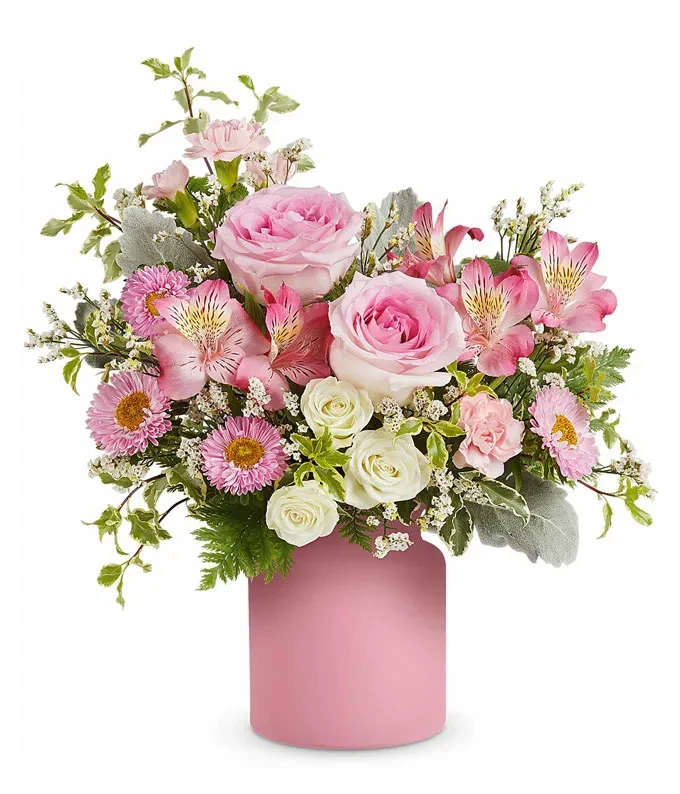
Let the cooler choose
Tell us to pick and you get the stems that came in strongest that morning, rather than the ones a date demanded.
Nothing here can be late
There is no hour to hit, so if another morning suits the recipient better we move it and nobody is any the wiser.
Tell us it is friendly
Note on the order who this is going to and the stems that read as courtship stay out of the bunch.
Small is not stingy
An unprompted gift does not need size to land, and a modest bunch of something long-lived often lands harder.
Walk into a flower shop on an ordinary Tuesday and there is a bucket in the cooler that hardly anybody buys from. It holds whatever came in best that week — the stems the shop would take home itself. Almost every customer through the door that morning walks straight past it, and not because they have poor taste. They are buying against a date, and the date named the flower before they left the house. February wants red roses. A funeral wants white, and it wants them by a fixed hour. An anniversary quietly settles the colour while you are still typing. You turned up with no date at all, which makes you the one customer of the week who can buy out of that bucket.
Something still has to do the choosing, though, and with the calendar out of the job there are only three things left. The week decides which flower. Vase life decides how much flower your money actually buys. You decide what it means, because that last part normally arrives free with the occasion and here it does not. The page runs in that order, and if you work down it in that order there is very little left to get wrong.
Two windows in the year will make this decision for you
Long Island grows flowers, and the seasons here are narrow and specific rather than decorative marketing language. Two windows matter more than the rest of the calendar put together, and if your impulse to send something happens to land inside one of them, the choice has already been made on your behalf.
If it is late May or June, you can stop reading here
The local peony window runs roughly late May into June and then it shuts. Outside those few weeks every peony in the region has been flown in and carries the premium that implies. Inside them, send peonies and stop shopping. They arrive as tight balls and open over several days into something faintly ridiculous, which means the gift keeps changing on the recipient’s table all week instead of starting at its best and going downhill from there. Ants on the buds are normal and harmless; they are after the sugar, not the flower, and they do not travel indoors.
In August and September the fields out east take over
Late summer is when sunflowers peak, and it is the one thing Long Island florists merchandise hardest in their own copy for a reason. They are also, by some distance, the least ambiguous flower you can put in a friend’s hands. Nobody has ever received sunflowers and wondered whether they were being asked out. The heads are heavy and thirsty, so they want deep water and a vase with some weight in the base, and they will not hold as long as a rose will — but in late summer that is a trade worth making, because a flower at its peak beats a flower that has crossed an ocean.
The rest of the calendar has no local peak to chase
For most of the year there is nothing in the ground here worth waiting for, and this is where an honest answer parts company with a pretty one. In February or March you are choosing among imported stems whatever you do, so stop paying for the appearance of seasonality and start buying time instead. Change the question from what looks best today to what will still look like something on the eleventh day, and the rest of this page falls out of it.
Day eleven is the number that matters, and carnations win it
Carnations have a reputation problem. They are the stem people associate with garage forecourts and with padding out a supermarket bunch, and a fair number of buyers rule them out before they have thought about it for a full second. What the reputation leaves out is the arithmetic. They hold for two to three weeks in water, against the seven to ten days you get from a rose. Roughly triple the lifespan, for less money, on a gift with no deadline behind it.
Now set that beside the situation you are actually in. There is no event this bunch has to survive until. There is no table it has to look correct on at four o’clock on Saturday. Its entire job is to sit on somebody’s counter and keep reminding them that you thought of them on a day when nothing made you, and it does that job for precisely as long as it stays alive. Judged on that rather than on prestige, carnations beat almost everything else in the cooler. Buy them in a single strong colour rather than a mixed handful and the cheapness people think they see disappears entirely — a dense bunch of one shade reads as deliberate, which is exactly the reading you are after.
Red roses, when the reason is romance
A dozen red roses is the least ambiguous thing in any flower shop, which is exactly why it works when the message is love. No card has to explain it. Send them to a partner for no reason at all and the lack of a reason is the point. A dozen is enough; two dozen if you want it to land as an event.
For a friend, a colleague or a parent, red says more than you probably mean. Tell us who it is for when you call — mother, neighbour, the friend who drove you to the airport — and we will make a small mixed bouquet in the shop instead, or order white or yellow roses online. Those are not in the online store yet, so call 631-612-6156.
Nothing on an ordinary Thursday explains the delivery except your card
Here is the failure specific to this category and to no other. Flowers turn up unannounced at somebody’s door with no card, and the recipient’s first emotion is not delight, it is a fast mental audit: what is today, what have I forgotten, has something happened. On a birthday the flowers explain themselves before the door has closed. On a Thursday in October they explain nothing, and an unexplained delivery can genuinely worry somebody who lives alone.
One line fixes it, and the line does not need to be any good. “No reason, just thinking of you.” “Saw these and thought of your kitchen.” “Thanks for last Sunday.” What matters is that it names the absence of an occasion out loud, because that absence is the entire content of the gift — you sent flowers on a day that demanded nothing. Sign with the name they call you, and if the recipient is elderly or knows several people who share your first name, use the surname too. A card reading only “Dave” has caused more confusion than any wilted stem ever has.
Who is worth sending to precisely because nothing prompted it
The people this suits best are the ones no category covers. A neighbour, to start with: no date in the year says send something to the person two doors down, which is exactly why it registers when you do. The friend six weeks past a funeral, when the sympathy flowers went in the bin a month ago and the casseroles have stopped and everybody else has gone back to their own lives — that is the strongest use of this whole idea, because the calendar of condolence is short and the loss is not. The same holds for somebody halfway through a long course of treatment, weeks after the get-well flowers reached the ward and months before anyone throws a party about it. Or a friend in a long, unremarkable stretch: no diagnosis, no funeral, nothing that qualifies for a category at all, just a hard few months that nobody has sent anything for because there is no card aisle for that. Then the plainer cases — a parent on a random Wednesday, which gets talked about far longer than flowers arriving on the one Sunday in May when they were expected, and whoever did you the favour, meaning the neighbour who took the delivery, the colleague who covered a shift, the friend who did the airport run at five in the morning, all of whom flowers outperform a text message by roughly the margin you would expect. Keep the stems friendly rather than romantic for any of them, and send to the house.
Your own kitchen counts too, and buying flowers for yourself is the least discussed and least embarrassing purchase on this page. It is also the cheapest way to learn how long a particular stem really lasts in your own house before you send it to anybody else.
Send it early in the week, and send it to the house
No deadline does not mean no strategy. Early in the week is quietly better: flowers landing on a Monday or Tuesday morning have the whole week in which to be looked at, whereas a Friday afternoon delivery to a workplace can sit in an empty office until Monday and lose four of its days to nobody at all. If the recipient works away from home or travels, ask before you order rather than after, because the one true constraint on this gift is that somebody has to be there to put it in water.
The address is really a privacy decision. Flowers delivered to an office are a public event — the desk gets visitors, people ask who sent them, and the recipient answers that question ten times before lunch. For a straightforwardly friendly gesture that is often half the fun. Where the reading is at all uncertain, or where the recipient keeps their life to themselves, the house is the kinder address. Nobody has to explain a bunch of flowers that arrived at home.
Roses at the door tonight
Call 8 hours ahead. Made in our shop and ready with 8 hours’ notice.
Common questions
Is it strange to send flowers when there is no occasion?
It reads as strange for about four seconds, and then it reads as the nicest thing that happened that week. The only thing that makes it awkward is silence, so put a line on the card saying there is no occasion. Once the recipient knows nothing is expected of them in return, the gesture does what you wanted it to do.
How do I make sure it is not taken romantically?
Leave red roses out of it entirely, keep the arrangement mixed rather than a dozen matching stems, and write a card that names the reason — thanks for the favour, thinking of you, no occasion. Sunflowers, daisies and bright mixed bunches are read as warmth rather than courtship by almost everybody. Tell us who it is going to and the shop will build to that reading.
What lasts longest for the money?
Carnations, comfortably, at two to three weeks against a rose’s seven to ten days. Chrysanthemums and alstroemeria are also strong on longevity. Whatever arrives, the care is the same: trim the stems at an angle before they go in, keep the vase out of direct sun and away from the fruit bowl, and change the water every couple of days rather than topping it up.
It is February and nothing is in season here. What should I send?
Everything is imported at that point, so drop seasonality as a criterion and buy on vase life and colour instead. A dense single-colour bunch of long-lasting stems is the honest answer in midwinter, and a flowering plant in a pot is the other one — it outlives anything cut and it does not pretend to be local. If the February date you have in mind is actually the fourteenth, that is a different page with a different set of rules.
Can I just tell you to pick something?
Yes, and this is the occasion where it works best, because nothing on the order has to match a theme or a date. Give us the recipient, a rough budget and the reading you want — cheerful, calm, thank-you, definitely-not-romantic — and we build it in our shop from what came in strongest. Say so if there is a colour they hate or a scent that bothers them.
Should I send to their home or their workplace?
Home, unless you actively want it to be public. An office delivery is seen by everyone and asked about all day, which is fine between friends and unhelpful when the gesture is easy to misread. Home also means somebody can get them into water quickly, and it avoids a bunch spending the weekend on a locked reception desk.