

A calla lily is not a lily — and for a cat in the house, that is the whole answer
Calla lilies are not true lilies, which changes the pet-safety answer. What Poison Control, ASPCApro and NC State Extension actually say.
Call 631-612-6156 with the town, the date and what the flowers are for, or order red roses by phone. We make the order in our Port Jefferson shop and settle the details on that call.
The name is borrowed, and the botany underneath it is different
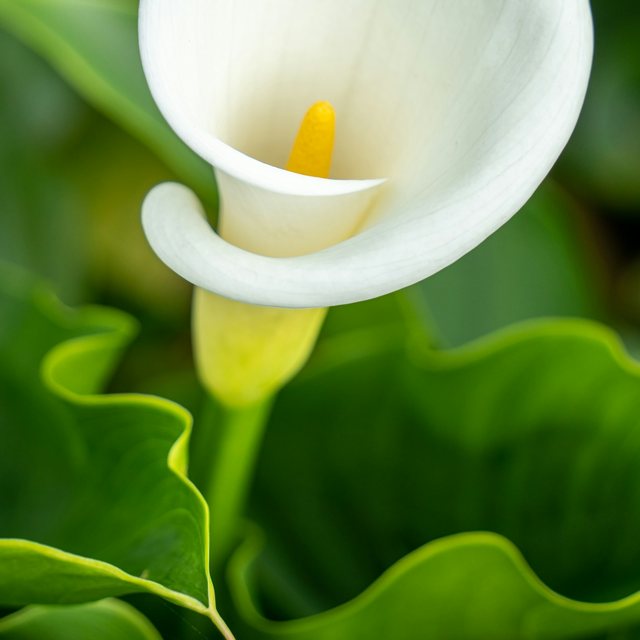
USDA Agriculture Handbook 66 disposes of the question in one line: “Although often called calla lilies, these flowers are not related to the true lily.” The plant is Zantedeschia, and the Missouri Botanical Garden puts it in the arum family, adding that the common name comes from the Greek kallos, beauty. The white funnel everyone photographs is not a set of petals at all. It is a spathe, a modified leaf wrapped around the spadix, the yellow spike that carries the actual flowers.
This matters because of what a true lily does. ASPCApro names two genera that cause acute kidney injury in cats — Lilium and Hemerocallis, the daylilies — and for Lilium states that all parts of the plants are toxic, with documented cases where exposure to the pollen alone has caused AKI, and treatment needing to begin within 18 hours of exposure. That is the emergency described on our lilies page. Zantedeschia is not among the two genera on that list. The same ASPCApro page sorts the oxalate-crystal plants that borrow the word lily — it names peace lily, Spathiphyllum — into the oral-irritant category instead.
What a calla does instead, and where the two authorities part company
Every part of a calla carries microscopic needle-like calcium oxalate crystals. The National Capital Poison Center describes what follows a bite: painful burning of the lips, mouth, gums, tongue and throat, and it occurs immediately. Eye or skin contact brings immediate pain, burning, tearing, swelling and light sensitivity. SANBI, the botanical authority in the plant’s native South Africa, gives the same picture from the other side of the world — raw plant material causes swelling of the throat because of those sharp crystals.
On how far it goes, two acceptable sources disagree and it would be dishonest to pick one. Poison Control writes that the calcium oxalate crystals in calla lilies do not break down in the body, so whole-body poisoning would not occur unless an unusually large amount is ingested, and that severe or life-threatening symptoms are rare. NC State Extension’s plant toolbox rates Zantedeschia poison severity HIGH, all parts poisonous, and prints the line “HIGHLY TOXIC, MAY BE FATAL IF EATEN!” Both agree on the toxic principle. They do not agree on the tone, and a household with a chewer in it should hear the harder version.
The correction therefore runs in both directions. A calla is not the kidney emergency that a true lily or a daylily is for a cat. It is also not a harmless flower to leave within reach of an animal or a small child, because the burning starts on contact rather than after digestion. Tell us if there is a cat in the house and the arrangement gets built around that.
A calla is not cut, and it keeps moving after it leaves the field
Handbook 66 records that calla stems are not severed at harvest: the flowers are normally pulled from the rhizome and recut to ensure adequate water uptake. The stem is snapped free of the plant and then trimmed. What arrives is a fleshy scape rather than a woody one, and it behaves accordingly — Handbook 66 warns packers to avoid direct contact with cleats, which may damage the fleshy stems, and tells buyers to watch for bruising of the fleshy stems due to packaging. A bruise on a calla scape is permanent, and shows as a dark sunken mark.
The stranger property is that the stem is gravitropic. Handbook 66: standard callas may bend in response to gravity unless held at the proper storage temperature. The Wageningen grower manual gives the same instruction as a rule of the packhouse — always place the flowers upright to prevent them from growing crookedly. A calla laid flat lifts its tip and sets a permanent curve, which is why a box that travelled on its side produces stems that will never stand straight again.
And a calla dies from the stem rather than from the flower. In a peer-reviewed vase-life trial on Zantedeschia aethiopica, the end of vase life was defined as the floral scape folding in a curvature greater than or equal to 90 degrees, together with wilt of the spathe and spadix. There are no petals to drop and no anthers to pull. The neck folds, and that is the end.
Vase life, and the things that do not extend it
The published figures are narrower than the numbers that circulate. In that trial, control inflorescences in plain water lasted about 11.1 days at 20.1 to 22.9 degrees Celsius and 50 to 60 percent humidity, and the best treatment tested reached 13.44 days, 28 percent longer than the control. An earlier Acta Horticulturae postharvest study put Z. aethiopica at 6 to 7 days and Z. elliottiana, the yellow parent of the coloured hybrids, at 7 to 8. Across the sources read for this page, calla vase life runs roughly 6 to 13 days depending on species and conditions. The Wageningen manual’s two weeks is a different measurement — cold-chain keeping from harvest, not days in a warm room.
The sachet does very little here. In the Acta Horticulturae trial, 100 ppm 8-HQC, 8-HQC with 2 percent sucrose, and vase solutions adjusted to pH 3, 5 and 7 all failed to improve longevity. The Wageningen manual reaches the same conclusion independently: adding cut-flower nutrients to the water will have very little effect on increasing keeping quality, although the sugar can sometimes prevent the stems from splitting open. Clean water is worth more — that manual requires clean pails, clean water and a chlorine tablet to prevent bacterial growth resulting in slimy stems.
One thing we will not tell you is the advice you have already read everywhere: that a calla wants only an inch or two of water. Splitting stems are real, and the manual names sugar as something that sometimes helps them. The shallow-water remedy could not be traced past florist blogs, and neither Handbook 66 nor the Dutch grower manual specifies any vase water depth for callas. What the postharvest work does document is a species difference in where the water goes: in Z. aethiopica the spathe carries fewer stomata per unit area than the scape, so more water is transpired through the stem than through the flower, while in Z. elliottiana the ratio is reversed. Scapes held in water became occluded in both.
Questions we get asked about callas
Is a calla lily the flower that puts cats in the emergency room?
No. The genera ASPCApro names for acute kidney injury in cats are Lilium and Hemerocallis, and for Lilium it records documented cases where the pollen alone was enough, with treatment needing to start within 18 hours. Zantedeschia is not on that list; it sits with the calcium oxalate irritants. That is a different problem, not an absent one — Poison Control describes immediate burning of the mouth and throat, and NC State Extension rates the genus HIGH for poison severity. Keep it off the floor and out of reach.
The calla arrived shut. Will it open in the vase?
Not reliably. Handbook 66 sets the harvest point at the moment the spathe has opened enough that the spadix can be seen, and says of stems taken before that point: “if cut too tight, flowers will usually not open properly.” The spadix should already be visible when you buy. A calla is one of the few stems where a tightly furled bud is a warning rather than the promise of a longer show.
My pink calla is turning green at the edges. Has the dye run?
It has not. Re-greening is documented ageing in this genus. In postharvest trials Z. elliottiana spathes turned green as they aged, while Z. aethiopica spathes lost turgidity and browned at the edges instead. The Dutch grower manual warns storage handlers of the same thing, that as the flower ages it will gradually turn green. Green creeping into a pink or yellow spathe is a clock, not a fault.
Should I put the flower food sachet in?
It will not do harm, and on the evidence for this genus it will not do much good either. The Acta Horticulturae work tested 8-HQC, 8-HQC plus sucrose and three vase-solution pH levels, and none of them improved longevity. The Wageningen grower manual says the same in plain words. The sugar earns its place for one narrow reason only: it can sometimes stop the stems splitting open.
Are callas a wedding flower or a funeral flower?
There is no sourceable convention either way, and we went looking for one. What is traceable is linguistic and art-historical: “altar lily” is one of the common names the Missouri Botanical Garden records for Z. aethiopica, and the flower’s twentieth-century fame is a gallery story rather than an etiquette one. Anyone who tells you a calla is wrong for a wedding, or reserved for a casket, is repeating a habit rather than a rule.
What a calla means, and how little of that is traceable
The calla has exactly one Victorian meaning with a primary source behind it. Kate Greenaway’s Language of Flowers (1884) carries the entry “Calla Aethiopica — Magnificent Beauty”, and its reverse index lists “Beauty, magnificent — Calla Aethiopica”. Set that beside the Missouri Botanical Garden’s note that the name descends from kallos, beauty, and the flower turns out to say the same thing twice: the Greek and the Victorian entry agree with each other.
It arrived late to the vocabulary. Henrietta Dumont’s earlier and widely circulated American floriography dictionary has no calla entry at all — only Arum arisarum and Arum maculatum, and those appear in a saints’-day floral calendar rather than as sentiments. That absence is the reason the colour code you will find on hundreds of florist pages — white for purity, yellow for gratitude, purple for royalty — has no primary source we could find. Greenaway’s one entry is for the white species. The coloured callas are twentieth-century interspecific hybrids, so there was nothing pink or black in a vase for a Victorian dictionary to assign a meaning to.
Two other well-worn stories thin out under checking. The reading of the calla as the flower of the Virgin Mary and an Easter emblem of resurrection is repeated widely, including in secondary writing about Diego Rivera; the LACMA curatorial record for the Rivera painting does not carry it. Nor could the Greek myth of Hera’s spilled milk be traced to a primary or scholarly source. What survives is smaller and more interesting: the ecclesiastical association is embedded in one of the plant’s own recorded names, altar lily, which sits in the Missouri Botanical Garden’s list beside African lily, arum lily, Egyptian lily, lily of the Nile, richardia, trumpet lily and white arum lily.
The modern reputation is museum-made. “Six Small Paintings of Calla Lilies by Georgia O’Keeffe” was shown at the Intimate Gallery in New York in May 1928 — a one-flower exhibition in a Manhattan gallery. Three years earlier Diego Rivera painted Flower Day, which LACMA describes as one of his earliest and most accomplished depictions of a seller of calla lilies; it took first prize at the First Pan-American Exhibition of Oil Paintings in 1925 and was the first major Rivera painting to enter a public collection in the United States. In its own country the flower keeps working names rather than romantic ones: wit varkoor, white pig’s ear, in Afrikaans, intebe in Xhosa, ihlukwe in Zulu. SANBI also records that it was traditionally boiled and eaten, and that the leaves were used as poultices and to treat headaches.
The two kinds of calla you can actually be sent
The trade recognises two classes and they are easy to tell apart. Handbook 66 records that the white blooms of Z. aethiopica have long been an important cut flower, with new green-tinged and differently shaped variants increasingly important, while the hybrid minicallas, with their elegant shape and wide range of colours, continue to increase in importance as cut flowers and potted plants. The split is not only visual. Minicallas have fewer postharvest problems and are generally easier to handle and use because of their smaller size, whereas it is the standard callas that may bend in response to gravity unless the storage temperature holds them. If a delivery has to travel, the mini is the more forgiving of the two.
Underground, the two classes differ as well. The white species grow from rhizomes and sit in the Zantedeschia section of the genus, two species with white spathes; the coloured ones grow from tubers and belong to the Aestivea section, six species, and the commercial hybrids are drawn mainly from Z. elliottiana, Z. pentlandii, Z. albomaculata and Z. rehmannii. That is also the difference between a plant you divide and a plant you lift and store dry.
Cultivar names are where the evidence gets thin, so this page names two. SANBI records ‘Green Goddess’, green and white, and ‘Marshmallow’, creamy pink, as selections of Z. aethiopica itself rather than hybrids. The coloured cultivar names a buyer meets in a shop could not be traced past retailer, nursery and garden-blog listings for this page, so we will not present them as though a botanical authority had described them. Breeding itself is concentrated: a genetic-diversity study genotyped 117 accessions of coloured calla — 52 from New Zealand, 35 from the Netherlands, 30 from the USA — and notes that hundreds of cultivars have been bred in those three countries. Yield shapes what reaches the market. Each main shoot can produce two flower stems, the number of shoots depending on bulb size, cultivar and season, and at the same tuber size a small-flowering cultivar produces more flowering shoots than a large-flowering one — so the big-headed coloured callas are structurally scarcer per square metre of glasshouse.
One footnote for anyone hoping for scent. SANBI notes that the flowers of Z. aethiopica are only faintly scented and are pollinated by crawling insects and bees, with a white crab spider hunting inside the spathe and using the white background as camouflage. The one genuinely fragrant member of the genus, Z. odorata, with its moderately sweet scent and much shorter spadix, is listed as Rare and endemic to a small area of the Bokkeveld Escarpment. It is not a flower anyone is going to sell you.
The colour range, and why it stops where it does
The white is the species, not a bleaching. SANBI gives Z. aethiopica a spathe to 25 cm around a spadix to 9 cm; the Missouri Botanical Garden describes a bright white funnel-shaped spathe of about 9 inches with a 3-inch yellow spadix, on scapes to 3 feet. Pink is a species colour too. Z. rehmannii is distinguished by its spotless lance-shaped leaves, magenta to pink flower colour and smaller stature, with flowers to about 3 inches, often with a creamy blush at the edge of the spathe — its recorded common names include pink calla and red calla. NC State Extension summarises the whole genus as roughly 8 species and numerous cultivars, spathes in white, green, yellow, pink, red and purple, on plants 1 to 3 feet tall.
The chemistry behind that range is short. A pigment survey of commercial hybrid spathes found one anthocyanin, cyanidin 3-glucoside; the carotenoids lutein and beta-carotene; and 7-methylated luteolin C-glycosides among the flavonoids. Red and pink cultivars are anthocyanin-dominated, yellow cultivars carotenoid-dominated, and orange cultivars carry both — anthocyanins in the epidermis and sub-epidermis, carotenoids through the sub-epidermis and mesophyll. Across the sampled colour range, the variation was attributed primarily to changes in the pigment group produced and the pigment concentration rather than to the production of different individual pigments. The calla palette is two pigment families turned up and down.
That is where the ceiling comes from. Cyanidin gives reds, pinks and purples, and no delphinidin-type pigment appears in that identification — which is the reason the range runs white, cream, yellow, orange, pink, magenta and on to a near-black, and stops there. Green and blush are not hybrid tricks either: ‘Green Goddess’ and ‘Marshmallow’ are variants of the white species itself. And no calla colour is fixed for the life of the stem, because the spathe re-greens as it ages.
When callas flower, and why that is not when they arrive
Left in a garden in the northern hemisphere, the Missouri Botanical Garden gives Z. aethiopica a bloom time of June to July and Z. rehmannii July to September — early to late summer, not spring. In its native South Africa the flush runs from August to January, which lands in our autumn and winter, and Z. odorata keeps a third calendar again, winter-growing and summer-dormant, flowering late July into August. New Zealand is a serious counter-season origin: its exports of coloured calla flowers and tubers have ranked within the top four over the past 23 years, at NZ$1.9 to 7.7 million and NZ$0.5 to 5.4 million respectively.
What spreads calla flowering across the calendar is tuber storage. The Dutch schedule runs short-term storage at 3 to 4 months, medium-term at 4 to 6 months with one month at 17 degrees Celsius and then 13, and long-term at 4 to 8 months with one month at 17 and then 9, each after two weeks of drying at 17 to 23 degrees. Growers stagger the wake-up rather than the season. If a date is firm and the stem matters more than the shape, our notes on how substitutions are handled set out what happens when a particular colour is not on the truck that morning.
One local note. A calla is not a hardy Long Island garden plant. The Missouri Botanical Garden rates Z. aethiopica to USDA Zone 8 to 10, winter hardy to Zone 8 and able to survive Zone 7 winters with protection, with rhizomes planted 3 to 4 inches deep and 12 to 18 inches apart in spring after frost and lifted in fall for storage in a damp medium. Z. rehmannii is Zone 8 to 10 as well, its tubers dug before first frost. Anyone in Nassau or Suffolk who wants callas in the ground is signing up to lift them every autumn.
What people assume about callas, and what the sources say
| The assumption | What the sources say |
|---|---|
| It is a lily, so it is one of the flowers that destroys a cat’s kidneys. | Handbook 66: not related to the true lily. ASPCApro names Lilium and Hemerocallis as the acute-kidney-injury genera and does not include Zantedeschia, which it places with the oxalate irritants. |
| Not a true lily, therefore harmless. | Poison Control: immediate burning of the lips, mouth, gums, tongue and throat, though severe symptoms are rare and whole-body poisoning does not occur. NC State Extension: HIGH severity, all parts poisonous. Both name calcium oxalate crystals. |
| Each calla colour carries its own Victorian meaning. | Greenaway (1884) has one calla entry, “Magnificent Beauty”, for the white species. Dumont has none. The coloured callas are twentieth-century hybrids, so no colour code could have been written for them. |
| A tight bud will open in the vase and last longer. | Handbook 66 puts the harvest point at the spadix becoming visible, and warns that a stem cut too tight will not open properly. |
| Flower food, or an inch of water, will extend them. | 8-HQC, sucrose and pH 3, 5 and 7 all failed to improve longevity in trial, and the Dutch manual agrees, crediting sugar only with sometimes stopping the stems splitting. The water-depth rule could not be traced to either reference. |
| A coloured calla going green has faded, or the dye has washed out. | Re-greening is documented ageing: Z. elliottiana spathes turned green in postharvest trials, and the grower manual warns storage handlers of the same drift. |
| Callas belong at funerals, or conversely are wrong for a wedding. | No authoritative source states a convention either way. The traceable record is a name — altar lily, among the Missouri Botanical Garden’s common names — plus O’Keeffe in 1928 and Rivera in 1925. |
| A crooked stem means careless handling somewhere down the line. | The scape is gravitropic. Handbook 66 records that standard callas may bend in response to gravity at the wrong storage temperature, and the grower manual instructs handlers to keep them upright so they do not grow crookedly. |
Roses at the door tonight
Call 8 hours ahead. Made in our shop and ready with 8 hours’ notice.