

Chrysanthemums read as a cheerful bunch here and as a grave flower on All Saints’ Day in France, Spain and Italy
In France, Spain and Italy chrysanthemums decorate graves on All Saints’ Day. Across Europe they sell all year, often as presents. The sourced record.
Call 631-612-6156 with the town, the date and what the flowers are for, and mention it if the person receiving them has a European connection you want taken into account. Or call 631-612-6156 and we will take the order down and confirm it by phone.
The funeral association is real, and narrower than the internet says
The exporter guide published by CBI, part of the Netherlands Ministry of Foreign Affairs, is specific about where the association sits. In France, Spain and Italy chrysanthemums — the disbud and pompon types above all — are treated as an autumn flower and used heavily as grave decoration on All Saints’ Day, 1 November, the day it is customary to visit family graves. Three countries, one date, two flower types.
The association is visible in the production calendar and not only in etiquette: European cut chrysanthemum production is timed around All Saints’ Day. The Netherlands is the exception, supplying cut chrysanthemums year-round from high-tech glasshouses, which is why this is one of very few stems with no off-season in the supply chain at all.
What we could not trace is the absolute version — that handing anyone in France, Italy, Belgium or Spain a chrysanthemum is a social offence with no exceptions. That claim travels on flower blogs. The CBI guide states the reverse plainly: across Europe chrysanthemums are sold all year in bouquets, mono-bunches and single stems, and it describes them as often bought as a present. The mourning use is occasion-bound, not a blanket ban.
Sweden settles the argument in one line. White chrysanthemums are in high demand there for Midsummer’s Eve and Midsummer’s Day in June — the exact colour that reads as mourning further south, wanted there for a national celebration.
The other half of the split: the world’s number two cut flower
The bunch that looks unremarkable in a supermarket sleeve is the top-selling cut flower on earth after cut roses. On the European market chrysanthemum is number two by auction turnover and import statistics, with an estimated 10 to 30 per cent share of total cut flower sales depending on the country, and around 1.2 billion stems of spray chrysanthemum came into the Dutch auction from the Netherlands alone in 2015.
On the American side the numbers point the same way. Chrysanthemums are 9 per cent of Colombia’s total flower export value in 2025, third behind roses at 18 per cent and carnations at 14 per cent and ahead of hydrangeas at 5 per cent, and Colombia supplies roughly 60 per cent of the flowers sold in the United States. Ocean freight accounts for about 8 per cent of Colombian export volume against 92 per cent by air, and the USDA names chrysanthemums alongside carnations as the hardier types that tolerate the longer sea transit. The toughness of this stem is a logistics fact somebody wrote down, not a sales line.
What has gone is the domestic cut crop. USDA figures for operations with $100,000 or more in sales show cut pompon chrysanthemum producers falling from 26 in 2018 to 10 in 2019, quantity from 6.880 million bunches to 3.668 million, and value from $10.459 million to $5.535 million, at a wholesale price of $1.51 a bunch in 2019.
Why any of this matters on Long Island
American Community Survey figures for 2020 to 2024 put 314,782 Suffolk County residents reporting Italian ancestry out of a total 1,530,146 — 20.6 per cent. Nassau County reports 228,564 of 1,389,591, or 16.4 per cent. One of the three countries where the graveside use is documented is the ancestry roughly one in five Suffolk residents claims.
That is a reason to ask, not a reason to assume. Nobody at this end knows which associations a particular household carries, and the documented custom attaches to a date and to two forms of arrangement rather than to the flower in every context. Say on the call if you would rather not risk it and we will build the order around something else; the note on substitutions covers how that works when a stem is swapped out.
This is a stem that fails from the leaves down
In a peer-reviewed trial, untreated cut Chrysanthemum morifolium ‘Arctic Queen White’ held in distilled water at 21 C and 65 per cent humidity — no preservative of any kind — lasted 18.09 days in the first season and 17.22 days in the second. That is an honest baseline for one cultivar under stated conditions.
The interesting failure is elsewhere. In untreated control stems of the cultivar ‘FenDante’ at 21 C, the leaves yellowed by day 17 in the vase. The foliage gave out before the flowers did.
Ethylene hits the same weak point. Dosed with 200 mg/L ethephon, ‘FenDante’ leaf yellowing moved forward from day 17 to day 7, chlorophyll in the ethylene group measured 50.9 per cent of the control at day 7, and the leaves were completely withered by day 17.
Whether that applies to the bunch in front of you depends on the cultivar, and the literature openly disagrees with the trade here. The published trade postharvest manual states flatly that chrysanthemums are not sensitive to ethylene; the peer-reviewed work above describes ethylene-sensitive cultivars whose leaves yellow ahead of the florets. Sensitivity is a cultivar property, not a fixed property of the species.
Cold, and the month in a box
Chrysanthemums are stored at 0 to 1 C. Leaf yellowing occurs at 5 C in darkness and is much less likely at 1 C, so a four-degree difference between two coolers shows up in the foliage rather than in the petals — the same weak point again.
The tolerance that sits alongside that is one almost no other cut flower has. Fully mature chrysanthemum blooms can be stored dry, wrapped in polyethylene, for three to four weeks at 0 C. Bud-cut stems store by bud size instead: 1.2 cm buds keep up to two weeks, 1.6 cm buds up to three.
Flowers can also be finished off the plant. Inflorescences about 5 cm across open to full size in a 2 to 3 per cent sugar solution at 15 to 20 C with 16 hours of light a day.
Cut open, not cut tight
Everything a buyer learns from roses and lilies says a tight bud is a fresher flower. Chrysanthemums invert it: stems harvested two-thirds to three-quarters open last longer than the same flowers cut tighter.
Commercial harvest stages follow that logic and vary by type. India’s National Horticulture Board sets standard varieties at 40 to 50 per cent of the bloom fully open, sprays at 40 to 50 per cent, dwarf varieties at 80 to 85 per cent, and anemone types before the central cushion of the topmost flower is fully developed.
Daisy-form singles are cut by a different signal altogether: at the maximum number of open flowers, but before pollen sheds from the outer row of disc florets. The pollen stage, not the petal stage, closes that window.
Colour: there is no blue one, and the green is not dye
Blue is genetically off the table
Chrysanthemums lack flavonoid 3′,5′-hydroxylase activity, so they cannot synthesise the delphinidin-based anthocyanins responsible for bluish colour in other plants. They make cyanidin-based anthocyanins, which read red. A naturally blue chrysanthemum does not exist.
One was built in 2017. Researchers inserted two genes — CamF3’5’H from Canterbury bells and CtA3’5’GT from butterfly pea — and the resulting flowers fell into the blue and violet-blue groups of the RHS Colour Charts, with hue angles below 290 degrees. It is not commercially available: NARO, the Japanese national research organisation behind the work, stated that work on reducing biodiversity risk from possible crossing with wild species was still being pursued before any domestic cultivation or commercialisation.
Green mums are green on their own
In green-flowered cultivars chlorophyll is the main colour-forming pigment, maintained by continuous chlorophyll synthesis and suppressed degradation in the ray florets. White cultivars are white because the chlorophyll biosynthesis genes are down-regulated and the degradation genes up-regulated in that same tissue. Named green cultivars in the research literature run from ‘Chunxiao’ at light green through ‘Green Anna’ at dark green, with ‘Lv Dingdang’, ‘Green Peony’, ‘Green Gemstone’ and ‘Greenlizard’ among them; chlorophyll and carotenoid content rises across them in step with the deepening green.
What the colour mix on the market looks like
On the European market the split is roughly 60 per cent white, 30 per cent yellow and 8 per cent pink — three colours account for close to the whole crop. Among Santini chrysanthemums specifically, green runs to roughly half of total supply at the Dutch auction, so the small-flowered type is where the green ones live.
How well a colour holds is a cultivar question rather than a chrysanthemum question. In UMass Extension trials the Fleurette cultivar ‘Cherry Papillon’ faded rapidly indoors while others held, which means the same mum in two cultivars can behave differently on the same windowsill.
Questions we get asked about mums
Is it a mistake to send chrysanthemums to an Italian family here?
The documented custom is grave decoration on All Saints’ Day, 1 November, in France, Spain and Italy, using the disbud and pompon types. The same trade source records chrysanthemums selling across Europe all year as bouquets, mono-bunches and single stems, often as presents. If the association would land badly in a particular household, tell us on the call and we will build the order from something else.
Why did the leaves go yellow before the flowers did?
That is a normal failure mode for this stem rather than a sign of a bad bunch. In untreated control stems of one cultivar at 21 C the leaves yellowed by day 17 in the vase. A dose of 200 mg/L ethephon in the same trial pulled it forward to day 7.
Are the green chrysanthemums dyed?
Not the true green cultivars. Chlorophyll is the main pigment in green-flowered chrysanthemums, held there by continuous synthesis and suppressed degradation in the ray florets. Blue is the colour to be sceptical about, because the plant cannot make it.
How long should a vase of chrysanthemums last?
We will not give you a single number, because the published figures depend on cultivar and conditions. One cultivar in plain distilled water at 21 C ran 17 to 18 days across two seasons; another yellowed at the leaves by day 17; a ten-day vase life is treated as the minimum commercial requirement on the European market. Retail claims of 20 to 25 days are not something we can trace.
Are chrysanthemums safe around a cat or a dog?
No. The ASPCA lists Chrysanthemum spp. as toxic to dogs, cats and horses, naming sesquiterpene lactones, pyrethrins and other irritants as the toxic principles, with vomiting, diarrhoea, hypersalivation, incoordination and dermatitis among the signs. Tell us if there is a pet in the house and we will keep them out of the arrangement.
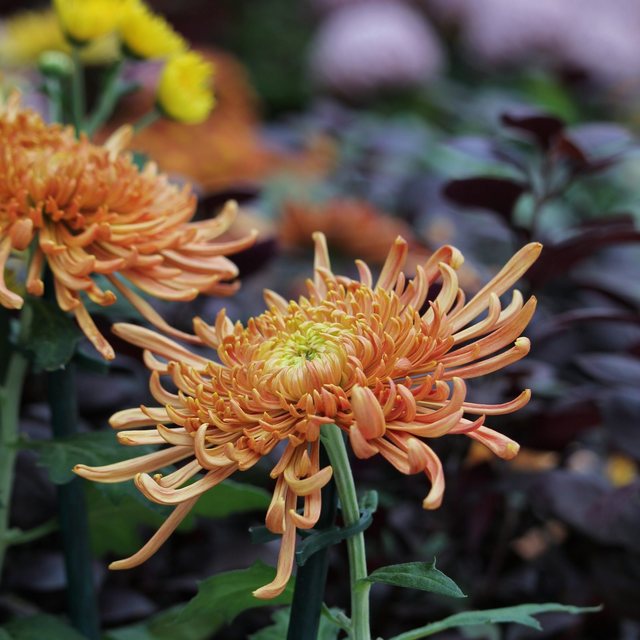
The forms, from a sleeve of sprays to a six-foot ogiku
The three the cut trade recognises
Spray carries several flowers per stem with blooms 4 to 12 cm across. Disbud has all side shoots removed for one large flower per stem. Santini blooms are no larger than 4 cm and sit in the top 5 cm of the stem. On the EU market sprays are 70 per cent of all chrysanthemums, Santini 20 per cent and disbud only 10 per cent — the big single-headed bloom people picture first is the rarest of the three.
Dutch auction minimum maturity rules differ by type as well: disbud must be at stage 1, a half-opened bud; spray and Santini must show three half-opened buds; a Santini branch must carry at least six flowers or buds, and a fully open Santini flower may not exceed 40 mm. Everything traded through that auction must also be 95 per cent free of leaf miner, a tolerance written into the product specification for this stem.
Thirteen classes, and the sizes behind the names
The National Chrysanthemum Society divides bloom forms into 13 classes. Irregular Incurve runs 6 to 8 inches, Reflex 4 to 6, Regular Incurve 4 to 6 and Pompon 1 to 4, with Decorative, Intermediate Incurve, Single and Semi-Double, Anemone, Spoon, Quill, Spider, Brush and Thistle, and Unusual filling out the rest.
Kiku, and what eleven months of training buys
The New York Botanical Garden’s Kiku exhibition, running 20 October to 18 November, has to fool its first group of plants into early flowering with black cloth, because kiku buds only form as the autumn nights lengthen. Japanese ogiku, the single-stem form, reaches six feet with one perfect flower balanced on top and takes six months to grow from cuttings, with the large incurved atsumono type the favourite for it.
Ozukuri, the thousand-bloom form, carries hundreds of simultaneous blossoms in a domed array from a single plant, needs a minimum of eleven months of care, and is planted in purpose-built display containers called sekidai. Kengai, the cascade, trains small wild-type flowers to fall more than six feet from the stem on the same eleven-month minimum. NYBG’s display came out of a five-year exchange with Shinjuku Gyoen National Garden in Tokyo, where masters have refined the techniques since the 1880s.
The pot on the porch is a different product
Garden mums in the Northeast are planted the first week to mid-June and flower between 10 September and 10 October depending on cultivar — a one-month natural window in this region. Chrysanthemum is a short-day plant with a critical daylength of 12 hours, and Northeast greenhouses need black cloth from mid-March to mid-September to induce flowering at all. For garden mums temperature outweighs daylength: very cool June nights cause premature budding and around 85 F or above causes heat delay, and UMass names the first two weeks of short days as the vulnerable period.
Among New York operations with $100,000 or more in sales, 89 sold hardy garden chrysanthemums in pots in 2019, down from 103 the year before, moving 347,000 pots under 5 inches and 2.70 million pots of 5 inches or larger. Cornell Cooperative Extension of Nassau County recommends early and mid-season types for Long Island specifically because of the unpredictability of the frost date here, and says the sandy soils are fine for growing them. That fact sheet is credited to Richard C. Heeseler of the Long Island Chrysanthemum Society, which is still active and offers free cuttings and mentoring to new members.
One local hazard is worth naming. Chrysanthemum white rust is a quarantine-significant pest in the United States under 7 CFR 319.37-2, regulated federally by USDA APHIS, and a detection triggers state and federal regulatory action. It infects between 40 and 73 F with an optimum of 63 F, needs 96 to 100 per cent relative humidity plus a film of free water on the leaves, and shows symptoms 5 to 14 days after infection — conditions a cool, damp Long Island autumn meets easily. If autumn stock is the question, what is in season now is the page that tracks it.
One more thing, for florists and for anyone with a pet
The ASPCA lists Chrysanthemum spp., family Compositae, as toxic to dogs, cats and horses. The toxic principles are sesquiterpene lactones, pyrethrins and other irritants, and the signs are vomiting, diarrhoea, hypersalivation, incoordination and dermatitis. That is the listing as written, neither softened nor sharpened.
The same plant family sits behind Compositae allergy, a delayed-type contact allergy to sesquiterpene lactones that can produce serious occupational dermatitis in florists, gardeners and greenhouse workers; the standard patch-test screen is a sesquiterpene lactone mix containing alantolactone, dehydrocostus lactone and costunolide. Where a stem has to suit a room — a wake, a hospital bedside — our sympathy and funeral guidance covers which settings take what.
Seven things said about chrysanthemums, against the sources
“Never give chrysanthemums anywhere in Europe, it is a hard taboo”
Traceable to flower blogs and no further. The CBI exporter guide places the graveside use in France, Spain and Italy around All Saints’ Day, and separately records chrysanthemums selling across Europe all year in bouquets, mono-bunches and single stems, often as presents.
“White mums are the mourning colour”
Not in Sweden, where white chrysanthemums are in high demand for Midsummer’s Eve and Midsummer’s Day in June. The same colour, the same continent, the opposite occasion.
“Chrysanthemums are not sensitive to ethylene”
That is what the published trade postharvest manual says. The peer-reviewed work on ‘FenDante’ shows an ethylene-sensitive cultivar whose leaf yellowing moved from day 17 to day 7 under 200 mg/L ethephon, with chlorophyll at half the control level on day 7. Sensitivity varies between cultivars.
“You can buy a blue chrysanthemum”
The plant lacks flavonoid 3′,5′-hydroxylase activity and cannot make the delphinidin-based blues. The 2017 engineered blue exists in the literature, and NARO stated that biodiversity-risk work was still being pursued before any domestic cultivation or commercialisation.
“Green mums are dyed”
Chlorophyll is the main colour-forming pigment in green-flowered cultivars, maintained by continuous synthesis and suppressed degradation in the ray florets. Named research cultivars run from ‘Chunxiao’ to ‘Green Anna’ by depth of green.
“Buy them in tight bud, the way you buy roses”
The trade postharvest source says the opposite: chrysanthemums harvested two-thirds to three-quarters open last longer than the same flowers cut tighter. Daisy-form singles are cut before pollen sheds from the outer row of disc florets.
“Chrysanthemum is the November birth flower”
Repeated everywhere, sourced nowhere we could find — no primary or institutional source we reached carries it. Almanac folklore, which is a fine thing to enjoy and a poor thing to plan a gift around.
Roses at the door tonight
Call 8 hours ahead. Made in our shop and ready with 8 hours’ notice.