

Your roses arrive with ugly outer petals on purpose – peel them off before you judge the bouquet
Red, white and yellow roses, hand-wrapped in our Port Jefferson shop and ready with 8 hours’ notice. Peel the guard petals for about ten days in the vase.
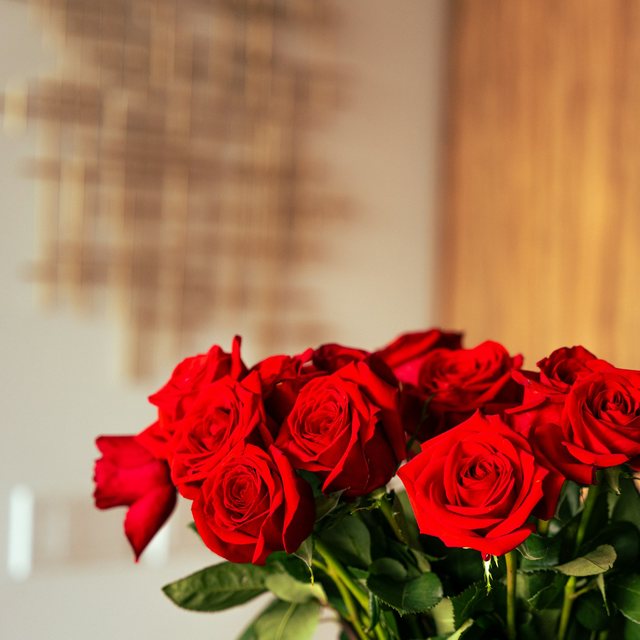
Peel before you judge
The scuffed outer petals are guard petals, and the bloom underneath them is unmarked.
Order roses today
Call 631-612-6156 with the town, the date and the colour, or order red roses by phone.
Asking costs nothing
Ask what the roses actually look like this week before you commit to anything – no order attached to an answer.
Roses are not always right
If the occasion calls for something else, we would rather say so than sell you a dozen red stems by default.
Guard petals are not damage
Growers and florists deliberately leave the outermost petals on every rose in place. Those petals take the abrasion of the box, the bucket, the van and the last hundred yards to the door, so that the petals beneath them do not. They arrive papery, creased, sometimes browned at the edge – and that is the job being done correctly. Pinch each one at the base and pull it away, one at a time, until the outline of the bloom is clean. What is left is the rose you thought you ordered.
This is the single most common complaint we hear about roses, and almost every time the description is of guard petals. People bin the stem instead of peeling it. A few seconds a rose is the difference between a bouquet that looks tired on arrival and one that does not.
The ten minutes that decide the next ten days
Recut the stems under water
Take an inch off the bottom at a slant, with the cut happening below the surface of a bowl or under a running tap. Cut a rose in open air and a plug of air travels up the stem’s water columns; that stem will not drink properly afterwards however clean the vase is. Sharp shears or a knife – blunt blades crush the channels you are trying to open.
Strip every leaf below the waterline
Submerged foliage rots within a day and turns the vase into bacteria soup, which is what actually shortens vase life in most homes. Leave the upper leaves alone; they are part of the look.
Change the water, do not top it up
Fresh water every couple of days, with another short recut each time. Roses treated this way run the full seven to ten days. Roses left standing in the water they arrived in often fold around day four, and then the flowers get blamed.
Keep them off the windowsill
Heat and direct sun age a rose fast, and ripening fruit in the same room gives off ethylene, which does the same thing invisibly. The dullest, coolest corner of the room is where roses last longest – which is annoying, because it is not where anyone wants to put them.
Bent neck is the rose’s own way of failing
Roses have a failure mode named after them. The neck just below the flower – the peduncle – wilts, and the bud never opens. Extension horticulture describes bent neck as a water-transport failure caused by blockage in the xylem vessels rather than by the petals ageing. It matters because it looks like age and is not: a drooping neck on a bud that never opened is plumbing, not time.
Controlled work has put a number on the plumbing. Cavitation – air blocking the stem – began in rose stems once bacteria in the vase water reached ten to the eighth per millilitre, and it is the bacteria, the polysaccharides they excrete and the debris of dead cells that occlude the xylem. That is the argument for changing the water rather than topping it up, made in a laboratory rather than behind a counter.
The under-water recut is worth doing, not guaranteed
We give that advice above and we stand behind it. The evidence for it is narrower than the advice, though, and it is worth knowing that before you blame yourself. In one trial, taking 25 cm off the stem end under water eliminated cavitation entirely in ‘Madelon’ roses and made no difference at all to cavitation in ‘Cara Mia’. Same procedure, two cultivars, opposite results. Do it anyway – it costs nothing – but do not read a failure to rescue a bunch as proof you did it wrong.
Ten days is a ceiling, not a promise
The UC Davis postharvest sheet puts a properly handled commercial rose at about ten days in the vase. Controlled trials show how much room sits inside that figure: ‘Matador’ held 4.7 days in a plain control solution while ‘Dolcetto’ held 9.6 days under identical conditions. Roughly double, on cultivar alone.
Ethylene has a measured cost too. Twenty-four hours at one microlitre per litre, at 21C, cut the longevity of 27 rose cultivars by between 0.8 and 8.4 days – an 18 to 47 percent loss – by accelerating petal wilting and shedding. That is the arithmetic behind keeping the vase out of the room with the fruit bowl in it.
How they travel before they reach water
Cut roses are stored dry rather than standing in water: 0 to 1C, packed in polyethylene-lined cartons and pre-cooled, and they can be held that way for up to two weeks if the temperature stays steady and close to freezing. That is the condition a rose is in before it meets a vase.
Prickles, thorns, and the pet question
Roses do not have thorns. The New York Botanical Garden’s reference desk is firm about it: what a rose carries are prickles – superficial outgrowths of the stem surface, without vascular material, appearing irregularly between the nodes. A true thorn is a modified branch and sits at a node; a spine is a modified leaf. A morphological survey of 110 rose genotypes found 98 of them bearing nonglandular prickles, with the prickle primordia measuring 100 to 500 micrometres, and records prickles as unvascularised and generally easy to remove.
The other question we are asked constantly: the ASPCA lists Rosa species as non-toxic to dogs, non-toxic to cats and non-toxic to horses, with the toxic principles recorded as non-toxic.
Colour is doing more work than you think
No other stem carries meaning as settled or as widely understood as a rose does, and that cuts both ways: the person receiving them reads the colour whether or not you meant anything by it. Choose it on purpose.
Red
Romantic love, unambiguously, to almost everyone. That is why red drives Valentine’s Day flowers and why it is the conventional choice for an anniversary. It is also why a dozen red roses to a colleague lands wrong no matter how kindly it was meant.
Pink
Gratitude, admiration and warmth without the declaration. Pink is the rose to send when you do not want to overstate the relationship – a thank you, a congratulations, a first gesture, a mother’s birthday.
White
Reverence, remembrance and sincerity, and the traditional wedding rose. White reads formal, which makes it right for sympathy and a little cool for romance on its own.
Yellow
Friendship, cheer and good news in modern use – excellent for a get-well, a new job, a long friendship. Worth knowing that in Victorian flower language yellow carried jealousy and infidelity, and a minority of recipients still hold that reading, so it is a poor choice for an apology to a partner.
If you would rather choose a finished arrangement than a colour and a stem count, the bouquets we build show what roses look like mixed with everything else.
Blue is the one colour a rose cannot make
The gap is genetic rather than a failure of effort. Roses do not carry flavonoid 3′,5′-hydroxylase, the enzyme behind delphinidin, which is the blue anthocyanin pigment. The enzyme is simply absent.
Suntory and Florigene engineered their way past that and released ‘Applause’ in 2007, after a programme of roughly twenty years. It does produce delphinidin. It comes out mauve, because the acidic environment inside the petal cell and the co-pigments alongside it redden the pigment. In 2018 a Tianjin University team took a different route, injecting two bacterial genes into rose petals to make indigoidine, a genuinely blue bacterial pigment less troubled by pH. The colour faded within one day, because the genes were not stably integrated. There is still no true-blue rose on the market.
Green is the colour that exists without any of that. Rosa chinensis ‘Viridiflora’ reaches about a metre on twiggy, almost thornless stems and flowers from early summer into late autumn, and the RHS profile describes blooms with no petals at all – a mass of green and brown bracts that turn purplish-brown as they age. Black is the opposite case. The Halfeti roses of Turkey, and the tidy explanation that travels with them, turn up on aggregator sites, and we could not trace either to a botanical authority. Read “black rose” as a description of a very dark red until somebody can point at a source.
Tinted, dipped and sprayed are three different things
The florist trade separates them, and the difference shows up in your vase. Uptake tinting has dehydrated stems draw the dye up through the xylem, so the stems and the leaves colour along with the petals. Dip tinting immerses only the head, and the leaves are untouched. Spray is water-based colour applied at the shop, usually over white roses.
Which one you have changes what to expect. Vase water turning colour within a day is normal. Dye can seep out through the leaves and stain clothing or a tablecloth, which is why the trade advice is a container that is not clear glass. The foliage is slightly compromised by the salts and oils in the dye. And in a mixed arrangement, the other flowers can take up a subtle tint from the water. If an exact colour is the whole point of the gift, say so when you order – that is what custom colour work is for.
Availability by colour does move with the calendar, and there is one measured figure for it: the chief executive of Avianca Cargo told the Associated Press in February that more than 50 to 60 percent of the flowers moving for Valentine’s Day are red roses. A local footnote to close on – New York’s state-flower statute names the rose in any colour or combination of colours common to it, an unusually broad designation next to state flowers that name a single wild species. What a colour signals once it arrives is a separate question, and it has its own page.
Every rose you can buy is dated from 1867
The American Rose Society splits the entire genus three ways and no further: Species roses, meaning the wild ones; Old Garden Roses, meaning classes in existence before 1867; and Modern Roses, meaning classes that were not. The hinge is one plant. In 1867 the French breeder Guillot introduced ‘La France’, the first hybrid tea, combining the general habit of a hybrid perpetual with the elegant bud shape and free-flowering character of a tea rose. Every rose you will ever be offered is dated relative to that single cultivar.
The classes also describe what is physically in front of you. Hybrid Tea and Grandiflora carry 30 to 50 petals on long stems – that is the classic long-stemmed florist rose. Floribunda and Polyantha bear their flowers in large clusters, which is the form sold as spray roses. Miniature and Miniflora grow 15 to 30 inches tall. Shrub roses reach 5 to 15 feet and beyond.
The cultivar decides the vase life
Across nine cultivars held in distilled water, vase life ran from 7.1 days for ‘Queen 2000’ to 15.3 days for ‘Forever Young’. ‘Black Baccara’, ‘Classy’ and ‘Charlotte’ were the ones most prone to bent neck and to blackening at the petal tips. Ethylene sensitivity sorts along the same lines: among the cultivars tested, ‘Grand Gala’ was the most sensitive and ‘Konfetti’ the most resistant.
Which is where a warning belongs. You will read that ‘Freedom’ is the most popular red rose in the world, and the identical claim made for ‘Explorer’, ‘Mondial’ and ‘Playa Blanca’. Every source we could find for it is a farm or a wholesaler describing its own stock – no trade body, no extension service, no trade-press figure. The specification that travels with those names deserves the same caution: a vase life of up to three weeks is longer than any peer-reviewed trial we found has produced, including one where a combined chemical treatment took a cultivar to 14.3 days.
The long-stem rose that smells of nothing
Roses build their scent by a route that no other studied plant uses. An enzyme called RhNUDX1, a Nudix hydrolase, cleaves a phosphate off geranyl diphosphate to produce geraniol, where other plants use a geraniol synthase. The gene was identified in Science in 2015, and heavily scented roses express it at much higher levels than less fragrant ones. Four molecules carry the signature: 2-phenylethanol, which reads as honey; geraniol, sweet and rose-like; rose oxide, green and herbal; and dimethoxytoluene, earthy and spicy. Damask roses and the wild European species carry the strongest scent, and Chinese roses are where the dimethoxytoluene and cis-3-hexenol come from.
So the imported long-stem rose that smells of almost nothing is not a stale rose. The scent literature is blunt about the cause: fragrance was put at a disadvantage in rose breeding, which has concentrated for centuries on longevity and on the visual attributes of cut flowers. Scent is a variety question, which makes it a question to ask before the order goes in rather than after – call 631-612-6156 and tell us it matters, and we will check what is actually in our cooler that week. If a rose is not the right stem at all, the other flowers we write about are here.
February is a different flower market
Roses are the highest-volume cut stem in the country and it is not close: roughly 2.5 billion stems a year, somewhere between 30 and 35 percent of every cut flower sold in the United States. Most of that is steady year-round demand. A startling share of it lands in one week.
Growers commit their February crop months ahead and cool the plants to time the bloom for a single date, and from that point the whole chain – farm, freight, wholesaler, local shop – is running at capacity. Three practical consequences. Order earlier than feels necessary. Be flexible on variety rather than on colour, because colour is what the recipient reads. And if the February market does not appeal, an unannounced delivery in March carries more weight anyway.
Where this page stops
This is the short version. Two of the longer guides are written and live: what the colours have actually meant, historically and now, and when roses are genuinely in season. Care, the colour range and the named varieties are on this page rather than on pages of their own. If there is something here you want more of, ask and we will answer directly.
Roses at the door tonight
Call 8 hours ahead. Made in our shop and ready with 8 hours’ notice.
Common questions
The outer petals look bruised. Were my roses old?
Almost certainly not. Those are guard petals, left on deliberately as packaging. Peel them off at the base and look at what is underneath before deciding anything – if the bloom under the guard petals is also marked, that is a different conversation and we want to hear about it.
How long do roses last in a vase?
Seven to ten days with a recut under water, clean vase water changed every couple of days and no leaves below the waterline. Four or five is common without that. Variety and how far the stems travelled both move the number.
Do the flower food sachets actually do anything?
Yes – they carry sugar for the bloom, an acidifier to help the stem draw water and a biocide to slow bacteria. Use the whole sachet in the water volume printed on it. A pinch in a large vase is close to doing nothing.
Should the thorns be stripped off?
Our preference is to leave them unless someone will be handling the stems repeatedly. Every prickle pulled off leaves a wound on the stem, and each wound is somewhere bacteria can get in. Tell us if the recipient needs them removed and we will pass that on.
Can you deliver roses on Valentine’s Day itself?
Yes, and we take those orders early because 14 February is the most concentrated delivery day in the year. We will not pretend a particular hour is within our control on that date. Ordering ahead buys better choice of colour and variety, not just a calmer day.
Are roses appropriate for a funeral?
Often, but the colour decides it. White and soft pink read as reverent and are widely used in sympathy work. Red roses read as romantic love, which is right from a spouse and can be jarring from anyone else – so say who they are from when you order and we will steer the colour.