

Lay a snapdragon flat and it starts bending upward within the hour
Laid flat, a cut snapdragon bends its tip upward within the hour. What that means at the door, plus colours, vase life and how to ask.
Call 631-612-6156 with the town, the date and what the flowers are for, and say if you want snapdragons in the vase. Or order red roses by phone for same-day delivery.
The spike is still moving when it reaches the door
A cut snapdragon does not sit where you put it. Lay a spike on its side and it registers which way is up and corrects itself, on a clock you can almost set a watch by. In the study of gravistimulated snapdragon shoots abstracted by Michigan State’s botany library, the tip began to bend after a lag of only 30 to 60 minutes, then curved at a steady 28 degrees an hour until it reached a maximum angle of about 140 degrees.
The bend does not form at the base of the stem. It forms in a zone just below the first open floret.
This is not wilting, and watering it harder will not undo it. Philosoph-Hadas and colleagues, writing in Advances in Space Research in 2001, describe asymmetric growth: the upper side of the stem shrinks first, the lower side then elongates, driven by reoriented amyloplasts and an uneven distribution of free auxin. An earlier paper from the same group in Plant Physiology found that the extra ethylene a horizontal spike produces comes exclusively from the lower half of the stem, and that blocking ethylene action with silver thiosulfate or cobalt chloride significantly inhibits the bending. Those are treatments for the grower and the packing house, not for a kitchen counter.
Which leaves handling as the whole of the answer at your end. Mississippi State Extension’s guidance for farmer florists is unusually blunt about how little it takes: stems twist their tips upward after even a short period lying on their side, and “even leaning the stems against the side of a half-empty bucket will result in a significant bend.” Store them straight, at all times.
A bent spike is scored as a dead one
That sounds like an overstatement until you read a postharvest protocol. In NC State Extension’s specialty cut flower trials, a snapdragon stem was terminated — counted as finished, its vase life over — when more than 50 percent of its flowers were desiccated or the stem had bent to less than a 90-degree angle. Bending and dying are the same event in the scoring sheet.
Some of the tendency is bred in rather than handled in. In work published by Naing and colleagues in Frontiers in Plant Science in 2021, 70 percent of ‘Asrit Red’ stems and 65 percent of ‘Asrit Yellow’ had bent past 45 degrees by day nine in water, against 20 percent of ‘Merryred Pink’. Same vase, same water, three very different outcomes.
If a spike does arrive with a curve in it, the news is mixed. Kept upright, the tip bends back toward vertical, but the correction is far slower than the bend: it runs over roughly 30 hours.
How long the spike holds, and how it ends
Cornell’s guidance for New York growers gives cut snapdragon a vase life of seven to ten days, with colour fading by day five. NC State measured individual cultivars under trial conditions of 68 degrees Fahrenheit give or take four, under 200 foot-candles of light twelve hours a day: ‘Chantilly Purple’ ran 9.7 days, ‘Calima Pure White’ 7.2, ‘Chantilly Yellow’ 6.3. Utah State Extension puts snapdragon vase life at ten days, out to two weeks with floral preservative, fresh stem cuts and daily water changes.
A holding preservative is worth more to snapdragon than to most of the stems NC State tested. NC State recorded ‘Chantilly Deep Orange’ reaching 7.5 days in a holding solution against “just 4 to 5 days” without one, and a holding solution added three to four days to ‘Chantilly Yellow’. The same trials noted that the species wilted readily.
The ending looks different too. Snapdragons shatter: individual florets abscise and drop rather than the whole head slumping. Ethylene decides much of the pace, and it is cultivar-specific — some modern cultivars are naturally ethylene-resistant and respond little to 1-MCP or silver thiosulfate, while on a sensitive one the older florets low on the spike go before the younger ones higher up. A USDA-ARS study found that packaging snapdragons with 0.5 microlitres per litre of 1-MCP at 5 degrees Celsius significantly reduced electrolyte leakage and abscission over 14 days, which is again a packing-house intervention rather than a household one.
One more thing worth knowing before you judge a delivery: snapdragons are cut with only the bottom third to half of the florets open, and the rest of the spike opens in the vase. Utah State specifies harvesting when the bottom third of the inflorescence is open, Mississippi State the lower third to half. A spike that looks half-finished on day one is a spike cut to standard.
Questions that come up about snapdragons
Why did my snapdragons arrive with a curve in the top of the stem?
They travelled lying down. The bend starts after a lag of 30 to 60 minutes flat, forms just below the first open floret, and adds about 28 degrees an hour. Stand them upright and the tip works back toward vertical over roughly 30 hours, so give it a day before deciding what you think.
How long should a snapdragon spike hold in the vase?
Cornell’s New York figure is seven to ten days, with colour fading by day five. Utah State Extension gives ten days, extendable to two weeks with floral preservative, fresh stem cuts and daily water changes. NC State’s measured cultivars ran from 6.3 days for ‘Chantilly Yellow’ to 9.7 for ‘Chantilly Purple’.
My snapdragons are dropping single florets instead of wilting. Is something wrong?
No, that is how they finish. Snapdragons shatter, meaning individual florets abscise and drop rather than the head wilting as one. On an ethylene-sensitive cultivar the older florets low on the spike drop before the younger ones higher up, so the spike empties from the bottom while the tip is still opening.
Are snapdragons safe to have in a house with a cat or a dog?
The ASPCA lists Garden Snapdragon, Antirrhinum majus, as non-toxic to dogs and non-toxic to cats. NC State Extension separately records the flowers as edible but bitter, so best used as a garnish.
Where does the name come from?
It is literal rather than romantic. Antirrhinum comes from the Greek anti, meaning like, and rhis, a nose or snout, in allusion to the flower resembling a dragon’s snout. The snap is the two-lipped corolla closing over a convex palate.
Snapdragon colours: everything except blue
There is no true blue or violet snapdragon, and no amount of breeding will produce one. Antirrhinum majus lost the F3’5’H gene after diverging from its relative Antirrhinum kelloggii, so it cannot make the delphinidin-based anthocyanins that give other flowers blue and violet. A. kelloggii, which kept the gene, does have violet flowers.
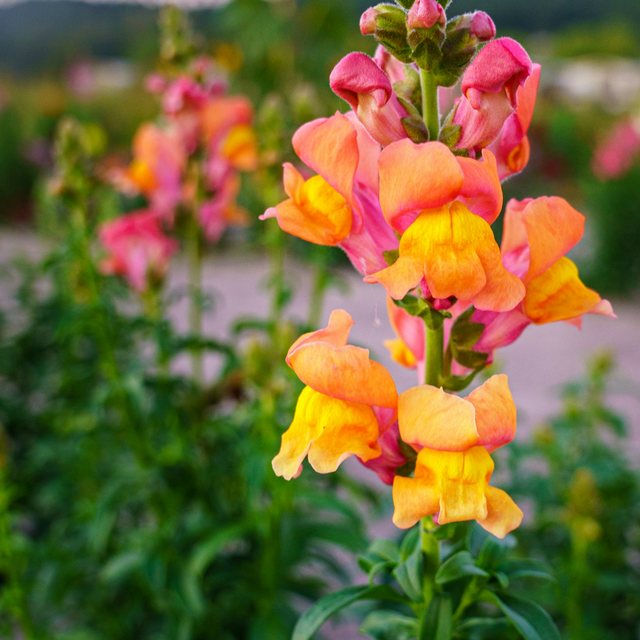
What is left is still wide. NC State’s plant toolbox lists the natural range as white, pink, purple and lavender, orange and gold or yellow; Clemson adds red and bicolors, describing light to dark shades of pink, red, orange, yellow and white along with colourful bicolors. Bicolor is a bred category with named cultivars behind it rather than a description — ‘Floral Showers Apricot Bicolor’ is apricot with a contrasting pastel, and there is a ‘Kim Purple and White’. Bronze is a real colour class too, not a marketing word: the Madame Butterfly series sells in Bronze and in Bronze-with-White alongside Yellow, Ivory, Pink, Red and Rose, and Chantilly sells in Bronze and in Velvet.
The Potomac cut-flower series alone runs to nine colours — Red, Cherry Rose, Orange, Royal, Yellow, Appleblossom, Lavender, White and Pink. Some ranges exist in one series and nowhere else: Utah State’s cultivar evaluation notes ‘Monaco’ is grown specifically for a pink-purple range not available elsewhere, and ‘Chantilly’ for unique colours plus fragrance. Ask for a shade and you are, underneath, asking for a series — which is why it helps to name the colour on the order and let the florist tell you what a nearby grower or wholesaler actually has. Our note on substitutions covers how that call goes when the exact shade is not there.
Two more things about colour on a snapdragon. It goes before the flower does — Cornell records colour fading by day five of a seven to ten day vase life, so if a specific shade is the point of the gift, the first half of the week is the half that counts. And the scent runs on a body clock rather than on the light: methyl benzoate, the most abundant scent compound in the flower, is emitted rhythmically with maximum emission during the day, coinciding with bumblebee foraging, and the rhythm free-runs in continuous darkness. A snapdragon on a hall table is at its most fragrant in the middle of the day, not the evening.
What to ask for, and what not to picture
The snapdragons in a garden centre in May are a different class of plant from the ones that go in a vase. Dwarf and trailing series — Snapshot at six to ten inches, Floral Showers at eight, Candy Showers trailing to twelve — are bedding plants, and only intermediate and tall types are suited to cut flower production. Florist-grade stems run a minimum of 18 inches, with 24 to 30 inches preferred; Clemson gives Potomac up to 60 inches and Rocket 36.
The floret itself comes in three forms you can see across a room: open-face, double, and the traditional closed dragon-mouth. Chantilly is the open-face type; Madame Butterfly is the double. Utah State rated the cut series bluntly in its trials — ‘Legend’, ‘Liberty’ and ‘Sonnet’ had lower marketability from short or thin stems and low-quality blooms, ‘Potomac’ was highly desirable with tall thick stems, and ‘Chantilly’ highly desirable for early blooming, unique colours, open florets and fragrance. If you want to set the spike against the nine other stems written up here, start at flowers by type.
Why the month decides which snapdragon exists
Cut snapdragon cultivars are sorted into four response groups by their light and temperature requirements. Groups 1 and 2 bloom earliest under lower light and cooler temperatures; Group 4 flowers only under high light, long days and night temperatures above 60 degrees Fahrenheit. Which snapdragon exists in a given month is decided by the group, not by the colour — and the group order shows up as calendar order. From one early-March high tunnel planting in Utah State’s trial, ‘Chantilly’ from group 1-2 began blooming on 4 May, ‘Potomac’ from group 3-4 on 23 May, and ‘Rocket’ from group 4 on 4 June.
Heat is the limit at the other end. Snapdragon is a cool-season crop that needs temperatures below 80 degrees for optimal germination and growth, and marketable stem production declined in late July under high temperatures in the same trials. The late-summer snapdragon is a second crop off the same plants: cutting back to three to five nodes after the midsummer heat produced a fresh flush in late August and early September and raised total marketable yield by 30 to 66 percent depending on cultivar.
In this state the stem also overwinters under cover. In Chris Wien’s Cornell trial at Ithaca, in zone 5b, plants sown the previous June and July came through a winter whose January-to-March average was 17 degrees, ten below the site’s long-term average, and were harvested again from mid-May — about a month before new transplants in the same tunnel came into flower. Two footnotes from NC State’s plant record explain why the field crop is less predictable than the tunnel one: snapdragon carries significant rust susceptibility along with mold, fungal leaf spots, downy mildew, wilt and root rots, which moves quality year to year in a humid coastal climate, though it is seldom damaged by deer, which counts for something on the East End. All of that is about growing rather than about any given delivery; what is cut and available in a given week is a question for the phone call, or for what is in season now.
What snapdragons are supposed to mean, and what the record says
The modern florist readings — graciousness, strength, resilience, fascination — trace only to retailer and florist blogs. There is no primary-source basis for any of them. Kate Greenaway’s Language of Flowers of 1884, the most widely cited Victorian floriography dictionary, gives snapdragon exactly one meaning: “Presumption.” It is the only snapdragon entry in the book. Henrietta Dumont’s earlier American dictionary, The Language of Flowers: The Floral Offering, published in Philadelphia in 1851, carries no snapdragon entry at all under any spelling.
The flower’s real distinction is mechanical, which suits it. The snap is a pollination lock: the corolla is occluded, two lips held shut by a convex palate, so a visitor has to force it open. Field surveys totalling 304 hours across the Iberian range of the genus found more than 85 percent of flower visits made by just 11 species of large, long-tongued bee — bumblebees, Anthophora, Anthidium, Chalicodoma, carpenter bees and the honeybee. Antirrhinum is also generally self-incompatible, so it needs them.

The first day, hour by hour
Hour zero: the box comes off the step
Assume the spikes have been horizontal. The lag before bending starts is 30 to 60 minutes, and that lag is your entire window — the clock has been running since the box was last set down flat.
The first half hour: upright before anything else
Unwrap, cut the stems fresh and stand them up in water with flower food. Utah State’s ten days out to two weeks rests on exactly three habits: preservative, fresh cuts, daily water changes. Do not park the bunch leaning against the side of a half-full bucket or sink while you look for a vase; Mississippi State Extension singles that out as enough to produce a significant bend.
Hour one: read the tips
If a curve is already there, look at where it sits — just below the first open floret, not at the base. That tells you it is travel, not damage. Standing upright, it will work back toward vertical over about 30 hours, so the honest verdict on the arrangement is tomorrow’s, not tonight’s.
Hours two to six: what you are looking at
Only the bottom third to half of each spike will be open, because that is when snapdragons are cut. The rest opens in the vase over the days that follow, so the arrangement is meant to be at its fullest later in the week rather than on arrival. Midday is also when the scent is strongest, methyl benzoate emission peaking during the day on a circadian rhythm.
Evening: set expectations for the week
Colour goes before the flower does, fading around day five of a seven to ten day life, and the spike will empty from the bottom as older florets drop. Fallen florets on the table are the normal ending for this stem, not a fault, and the tip can still be opening while the base is shattering.
Roses at the door tonight
Call 8 hours ahead. Made in our shop and ready with 8 hours’ notice.