

Custom flower arrangements on Long Island: which kind of custom you are asking for, and what decides whether it can be built
Custom flower arrangements from our Port Jefferson shop. Tell us the occasion, colours and date, and we will tell you what we can make for that day.
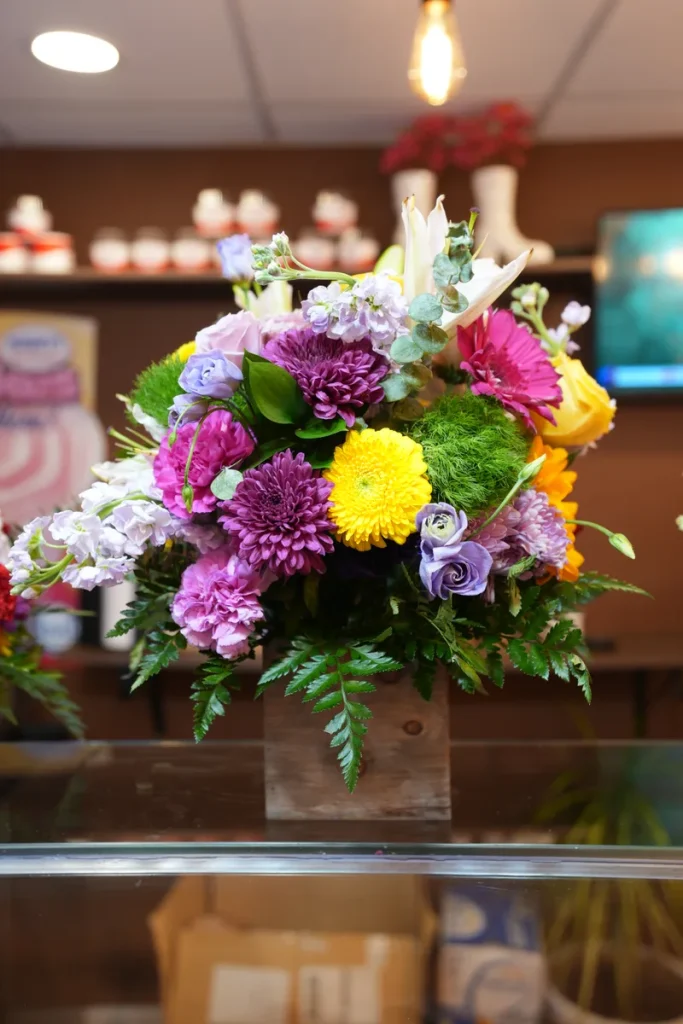
Ask before you order
Describe what you have in mind and we will tell you what we can actually build for that date. Nothing is committed by asking.
Say what cannot bend
Tell us which single part of the request is load-bearing – the stem, the colour, the shape or the date – and the rest gets designed around it.
The vessel counts too
Height, footprint, container and scent are all part of a custom order, and they are the requests most reliably granted at short notice.
Delivered across Long Island
Call 631-612-6156 with the town, the date and the brief, and we will make it in our Port Jefferson shop.
Four different requests are wearing the same word
Every florist page on the internet says custom arrangements are welcome. That is true, and it is close to useless, because it answers a question nobody was asking. Willingness is not the variable. Which of four quite different requests you are actually making is the variable, because the four are held up by different things and they carry wildly different odds – one of them is granted almost every time, one of them is a purchasing instruction dressed as a design brief, and the gap between those two is where disappointed customers come from.
Sorting out which one you want can be done before you speak to anybody, and it is most of the job.
A brief rather than a recipe
“Something wild and loose in rust and cream, nothing that looks like a supermarket bunch” is a custom request, and it is the version most likely to be granted on the day, because it hands the designer a goal and lets them hit it with what is genuinely in the cooler. This is what designer’s choice actually buys you, and it is chronically undersold.
A named variety
“Coral charm peonies”, “Juliet garden roses”, “white anemones with the black centres”. Naming the variety quietly converts your order from a design brief into a purchasing instruction: if that stem is not already in the building, somebody has to buy it before anybody can arrange it. Whether that is possible for your date is a timetable question with a checkable answer rather than a question of effort, and the timetable is the entire subject of same-day and custom pulling against each other.
A specific colour
Colour requests sound simpler than variety requests and are often harder, because a colour can be unavailable this week, unavailable this season, or unavailable in that species full stop. The colour question deserves its own page and has one.
Everything that is not the flowers
Height, footprint, one-sided against all-round, the vessel, the scent, the wording on the card, the hour of the day. This fourth kind of custom is the one nothing else in this silo covers, the one most reliably granted at short notice, and the one people are shyest about asking for – so it gets the next section rather than a line.
The half of an order that is not a flower at all
An arrangement is a shape before it is a species. A designer working without instructions still makes a set of decisions you never see: whether the thing is meant to be walked around or looked at from one side, how tall it can stand before it stops working on the surface it lands on, how far it can spread before it stops sharing that surface with anything else, whether the vessel is glass or ceramic or a basket nobody has to give back. Every one of those is specifiable in a sentence, none of them depends on what came off a truck, and almost nobody specifies them.
Two are worth naming outright, because they decide more than people expect. An all-round arrangement is seen from every side and therefore spends the budget in every direction, which is why it thins out visibly sooner than a one-sided design built to stand against a wall – the same flowers, the same money, a different amount of them facing the person looking. And a vessel is a constraint on the flowers rather than a container for them: a narrow neck holds stems exactly where you place them and takes fewer of them, while a wide low bowl needs enough heads to close the surface or the mechanics show through.
The negative instructions live here too, and they decide more deliveries than any stem does. Nothing scented, because the room has a rule about it. No lilies, because there is a cat in the house. Nothing that needs a vase to be hunted down and filled, because the recipient will not be up to hunting. Say those and they are simply honoured. Leave them unsaid and nobody can guess them.
Three constraints that decide which version you get
The trade substitutes to a written standard
Substitution is not a shrug and it is not improvised per order. There is a mechanical standard the trade works to, with a stated order of priority about what may be swapped for what, and it can override the very thing you thought you were specifying. Knowing the rule in advance is the difference between a surprise and a decision, so we have set out what the substitution standard permits in full.
Some colours do not exist in some species
No amount of notice produces a true blue rose or a true black one. The pigment is not in the plant, so anything sold under those names is white stock that has been dyed, tinted or airbrushed. That is a legitimate product with real drawbacks – it marks the vase water, and it wears at the petal edge – but it is a different thing from the flower you pictured. Other species carry the pigment perfectly well; delphinium is genuinely blue, which is why the honest answer to a colour request is often a change of flower rather than a change of colour. That choice is yours to make, and it can only be made if somebody puts it in front of you.
Two supply calendars that do not overlap
Long Island runs on two calendars at once. Local growing has a hard stop at frost, after which anything from a field within driving distance is finished until spring. The import pipeline that covers the rest of the year has documented gaps of its own, when a growing region is between crops or a holiday has stripped it. The two do not neatly hand over to each other, which is why the correct answer to “can I have that in November” depends on which pipeline the flower comes down, not on how far ahead you ask. What is actually in season now is the page that tracks it, and the individual stem guides cover how each flower behaves once it is in the vase.
How to ask so that the answer is useful
Lead with the date and the town, then the constraint you cannot bend, then the picture in your head. Say which part is load-bearing: “it has to be peonies” and “it has to feel like the garden she used to have” are different orders even when they start from the same photograph, and only one of them is at the mercy of a purchase. If there is a hard reason behind the request – a wedding bouquet being echoed, a flower the person grew, an allergy, a rule in the building it is going to – say it, because a designer who knows why you want the stem can hit the same target by another route when the stem is not there. An answer that comes back as a constraint rather than a yes is the process doing its job, not a shop declining to try.
One boundary, stated plainly. This is the gift lane. A wedding, a large event, or anything wanting a sit-down consultation, a mood board, a mock-up or somebody installing flowers at a venue is a different trade, done by a shop with a door and a designer you meet by name over several weeks. It is not what a same-day order can honestly offer, and saying so early costs everyone less than discovering it late.
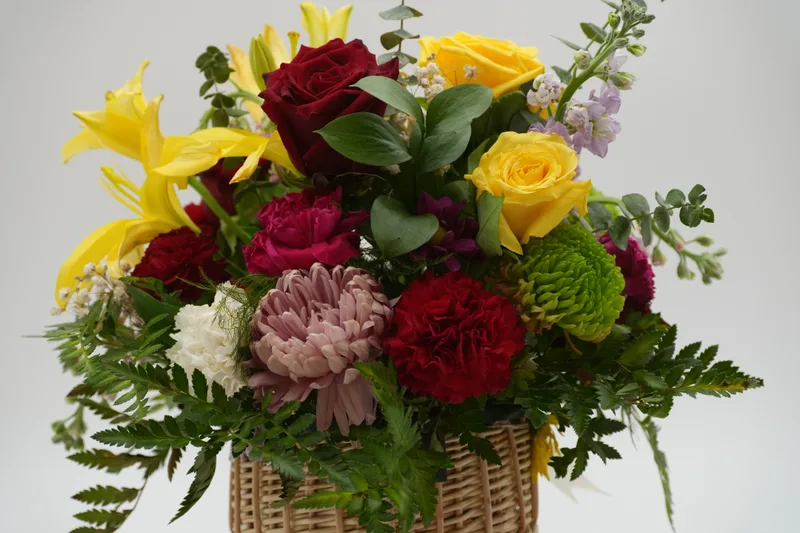
One order, from a photograph to a hallway
An order came in recently that started as a photograph and ended as a completely different arrangement, and not one thing about the flowers themselves was the reason.
The caller wanted to mark a friend getting the keys to a first house – a straightforward congratulations delivery – and she had a picture saved from a restaurant table. Wide, low, all-round, dense enough that no mechanics showed anywhere in it, small heads packed shoulder to shoulder. She also had a figure in her head she did not want to go past, and she said so at the start, which is the only reason the rest of this went well.
The binding constraint was arithmetic, not availability. A design like the one in that photograph is read from every side, and the count of heads is doing all of the work; take out a third of them and you do not get a smaller version of the picture, you get the same picture with holes in it, because there is no back to hide the thin patch in. So the real choice was never about which flowers. It was about shape. The same money buys either that silhouette at a density it cannot carry, or a full density in a form that only has to face one way.
So we asked the question the photograph could not answer: where is it going to sit. Not a table anybody would sit around, as it turned out – a console in a hallway, flat against the wall, the first thing you see through the front door, lit from one side by the window over the stairs. That settles it. A one-sided design puts every stem into the arc the viewer actually stands in and spends nothing on the half of the arrangement nobody walks past; against a wall it can also stand taller than a dining arrangement is allowed to, because nobody needs to see over it to talk to the person opposite; and the vessel could be the heavy ceramic one that would have looked wrong on the restaurant table and looks right in a hall.
What arrived did not match the picture. It matched the wall. Same flowers, same density she had admired in the photograph, arranged for the room it was going into instead of the room it had been photographed in – and the fact that made all of that possible was the one she nearly did not bother to mention, which was where in the house she wanted it put.
Roses at the door tonight
Call 8 hours ahead. Made in our shop and ready with 8 hours’ notice.