

Orchids are a living plant, not a bouquet, and that changes where you are allowed to send one
Orchids are a living plant, not a bouquet, and some buildings bar potted plants. What to know before you send one on Long Island.
Tell us the address
Buildings and wards, not florists, decide whether a potted plant gets in. We check before it leaves.
We will swap it
If the destination bars potted plants, we send cut flowers to the same room instead. You do not reorder.
Nothing to arrange
It arrives finished, in its pot. No vase to find, no stems to trim, no water to change on Thursday.
Ask us first
Tell us who it is for and what is going on. If an orchid is the wrong call, we will say so.
Almost every orchid sold as a gift is a living plant, roots and all, sitting in a pot. Not cut stems in water. That one fact rewrites the rest of this page: there is no vase life to quote, nothing to recut, no cloudy water to tip out on day four. It also drops an orchid on the wrong side of a rule that cut flowers sail straight past. Several Long Island hospitals publish that potted plants are not allowed in patient rooms while floral arrangements are welcome. Send an orchid to one of those rooms and it gets stopped at the door. Send a vase of flowers to the same room and it goes up.
The rule that stops an orchid at the ward door
Nobody selling orchids warns you about this, so here it is in detail. Stony Brook University Hospital’s visitor guidance permits floral arrangements in most areas of the hospital but states plainly that it does not allow potted plants, citing CDC guidance as the reason. Stony Brook Southampton Hospital lists potted plants alongside balloons, scented candles and incense among the items it does not permit, while allowing flower arrangements outside its intensive care units. Stony Brook Eastern Long Island Hospital allows arrangements and rules out potted plants in the same sentence. Stony Brook Children’s Hospital is stricter again: live plants and flowers are both barred from patient rooms, and Mylar balloons are what gets through instead.
Whether a plant is allowed in the room is a separate question from whether the hospital will accept an outside delivery at all, and the two answers do not always agree. We record what each hospital publishes, quoted from its own visitor pages, on the Long Island hospital guide. If you are sending for a recovery or a new arrival, get well and new baby covers what actually reaches a bedside.
Call the unit, not the main switchboard
Every hospital named above closes its own guidance with a version of the same instruction: check with the nurse or unit staff before bringing anything in. Restrictions attach to the ward and sometimes to the individual patient rather than to the building. Intensive care, oncology and transplant units are the usual exclusions, and a plant that is fine on a maternity floor can be refused two floors up.
One orchid does nearly all of the work
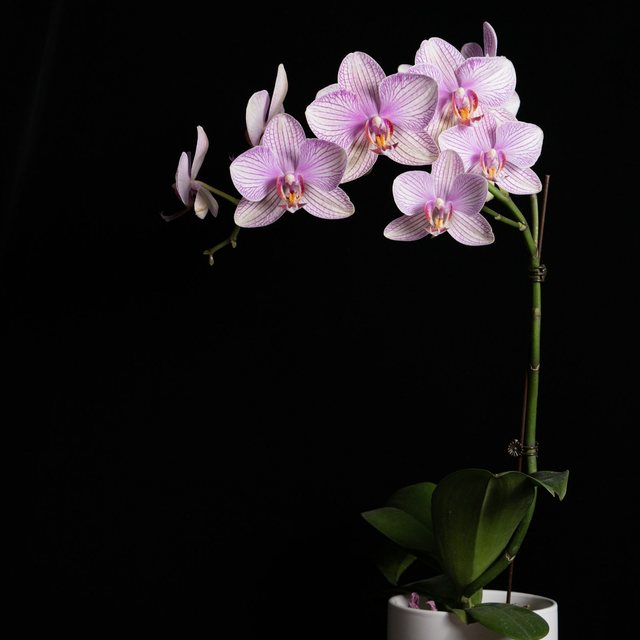
When someone orders “an orchid” they almost always receive a Phalaenopsis, the moth orchid: an arching spike of flat, rounded flowers rising out of a rosette of thick leaves. It travels upright, it tolerates a heated living room, and it holds its bloom longer than anything else we sell. Cymbidium, dendrobium, oncidium and cattleya are genuinely different plants, and cut orchid stems do exist and turn up inside mixed arrangements, but that is not what lands on most doorsteps. The genera themselves are set out below.
The other genera, and what separates them
The moth orchid is one plant out of a very large family. The New York State Department of Environmental Conservation’s 2010 article on the orchids of New York puts Orchidaceae at more than 21,000 known species, second in size only to the aster family. Secondary botanical sources give a higher number, somewhere around 28,000 accepted species in about 763 genera, which is better read as an estimate than as a count. The four or five names a florist says out loud are the commercial end of that.
They also divide along an Old World and New World line. Phalaenopsis, Dendrobium, Cymbidium, Vanda and Paphiopedilum are Asian, Australasian or Pacific plants: Cymbidium native to tropical and subtropical Asia and Australia, Paphiopedilum running from India to China, Indonesia, Malaysia, the Philippines and New Guinea. Cattleya and Oncidium are tropical American, Cattleya native from Costa Rica to Argentina.
Four names, four different plants
NC State Extension’s genus entries are where the differences stop being decorative. Dendrobium covers about 1,600 species and runs from six inches to four feet, and inside it the hard-cane types produce longer-lasting flowers than the soft-cane types, so the genus name on its own does not tell you how long a spray will hold. Oncidium, 334 accepted species, is the dancing lady, and its scents are described variously as vanilla, lemon or chocolate. Vanda, 90 species, carries thick aerial roots that cannot be confined to a pot and should never be trimmed. Cattleya spans three inches to two feet. If you want one of these rather than whatever is on the bench, call us on 631-612-6156 and say so, and what happens to each genus after cutting is on the orchid care page.
Showy and cuttable are two separate qualities
The University of Hawaii’s Dendrobium production manual says this outright. Species in Dendrobium section Phalaenanthe carry large, fully formed, showy flowers on medium-length sprays, and as cut flowers, in the manual’s words, “their postharvest characteristics do not meet commercial standards.” Section Spathulata goes the other way: abundant, long-lasting sprays of many small flowers with twisted petals. The commercial cut cultivars are amphidiploid crosses between the two sections. Seed-propagated cut-flower Dendrobium out of that breeding programme is written to a specification rather than admired into existence: 12 to 18 days of vase life, bud drop no higher than 5 percent, sprays 24 to 36 inches long carrying 15 to 25 or more well-spaced flowers, at 10 to 20 or more sprays per plant per year.
The cultivar names behind that are worth recognising if one gets said to you. D. Jaquelyn Thomas, its compact clone ‘Uniwai Prince’, D. Jaq-Hawaii, D. Nellie Sugii and D. Tessie Amore are cut-flower and lei cultivars. D. Betty Nakada, D. Cathy Beck, D. Remy Hartmann, D. Susan Takahashi, D. Pua’ala, D. Louis Bleriot and D. Ethel Kamemoto ‘Splendor’ are potted-plant cultivars, the last of those unusual for a lip that resembles its petals and gives the flower a pansy-like face. D. Jaquelyn Thomas and D. Jaq-Hawaii reach about four feet within five years. When that crop flowers, and what the trip east does to it, is covered on the orchid season page.
A Dendrobium spray is graded to the inch
Hawaii’s Department of Agriculture sorts Dendrobium sprays by length, Short at 9 to 13 inches, Medium at 14 to 20, Long at 21 or more, in two grades, Hawaii Fancy and Hawaii Standard. Two of the words in those standards are defined rather than left to taste: properly trimmed means at least four inches from the lowest flower to the cut end, and well developed means at least 60 percent of the flowers on the spray in full bloom. Individual blossoms get their own size classes, measured as the greatest dimension of the flower with its parts in normal position: small under two inches, medium two to three inches, large over three.
One claim to be careful with, because it surfaces whenever orchid genera come up: that the whole family Orchidaceae is listed on CITES Appendix II with certain genera on Appendix I. The research behind this page could not reach cites.org, the CITES checklist, the US Fish and Wildlife Service or APHIS, so the family-wide version of that statement is not made here.
What you are actually handing someone
A bouquet is a week you give someone. An orchid is a resident. A single flowering spike can hold for weeks and often longer, and when the flowers finally drop the plant is still there, green and alive, quietly expecting something from its new owner. For some people that is the entire appeal. For others it is one more thing to keep alive.
The most common way an orchid dies is drowning. Its roots evolved to grip bark in open air, which is why it is potted in chips rather than soil and why a pot left standing in a saucer of water rots from the bottom up. If you would not describe the recipient as a person who wants a plant, cut flowers are the kinder gift. A fuller care guide is being written, along with a separate piece on what orchids are taken to mean, because the symbolism is nothing like a rose’s.
Where an orchid beats a vase
- A reception desk or a shared office, where nobody owns the job of changing vase water.
- A spare, modern interior where a mixed bouquet reads as fussy.
- A thank-you that should still be visible next month rather than cleared away on Sunday.
- A household with a cat, where lilies would be a serious mistake.
- A recipient who is home and settled, rather than mid-move, travelling, or in a hospital bed.
Roses at the door tonight
Call 8 hours ahead. Made in our shop and ready with 8 hours’ notice.
Common questions
Can I send an orchid to someone in a Long Island hospital?
Check two things, not one: whether that hospital accepts an outside florist delivery at all, and whether a potted plant is allowed in the room. Four Long Island hospitals publish a potted-plant restriction, and three of those still welcome cut arrangements, so the usual fix is to change the gift rather than cancel it. Each policy is recorded on our hospital guide.
How long do the flowers last?
There is no vase life, because nothing was cut. A healthy spike holds its flowers for weeks indoors, frequently well beyond a month, and the plant carries on living afterwards. That longevity is the whole argument for sending one.
The flowers have all fallen off. Is it dead?
Usually not. A finished spike is a normal stage in the plant’s year, not a failure. The leaves are what tell you: firm and green means the orchid is healthy and may flower again. Our care guide will cover when to cut the spent spike back and when to leave it alone.
Am I handing someone a chore?
A small one, honestly. Watering is occasional rather than daily, and there is no arranging to do, but it is still a living thing somebody has to notice. For a person who is travelling, recovering, or already keeping too many plants going, send cut flowers instead.
Is an orchid safe in a house with a cat?
The moth orchid is not among the houseplants commonly flagged as dangerous to cats and dogs, which puts it in a very different position from lilies. Lilies are seriously toxic to cats, whole plant included, right down to the pollen and the water in the vase. Where there is a cat in the house, the orchid is the safer of the two.
Why does an orchid cost more than a bouquet of similar size?
You are buying a whole plant rather than a harvest of stems, and it arrives complete with its pot and bark. A nursery raises an orchid to flowering size over a far longer horizon than any cut crop, and getting it to the door means keeping it upright and out of the cold the entire way. What you are paying for is months rather than days.