

What actually arrives when you order the photo – and why the rules protect the roses before the yellow
Flower substitutions explained: tell us the one thing that cannot change, the colour, the flower or the shape, and it goes on the order.
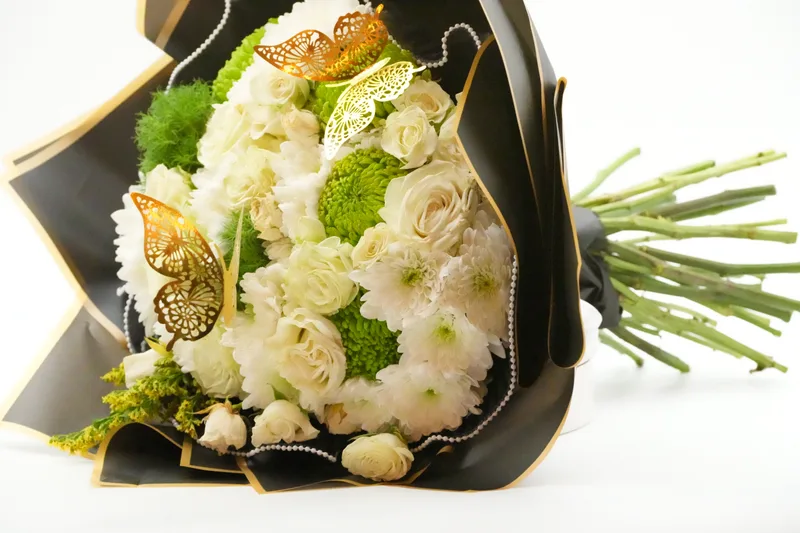
Name your fixed point
Tell us the one thing that cannot move – the colour, the flower, the form – and it goes on the order in your words.
Ask before you order
You can ask what we have in the bucket this week without placing anything at all.
Send flowers today
Call 631-612-6156 with the town, the date and what the flowers are for, or order red roses by phone.
Colour is not automatic
If the shade carries the message rather than the flower, say so out loud – the standard does not assume it.
The rule that catches almost everyone: variety outranks colour
Most buyers read the substitution sentence on a florist’s site as a hedge – a line that quietly means anything at all might turn up. It is close to the opposite. The substitution standard the trade works to is a written rulebook with a ranked order of priorities and an explicit list of swaps that may never be made under any circumstances. Once you know the ranking, you can predict what will land on the doorstep with far more confidence than the photograph on its own gives you.
Start with the clause that catches people out. Verbatim from the published standard:
In arrangements of all one type of flower such as all roses, the variety (e.g., red roses) is of first importance, preceding color in this instance only.
Read it twice. In an arrangement of a single flower type, the flower is the first promise and the colour is the second. Order two dozen yellow roses and the florist filling the order protects the roses. If the yellow is thin in the cooler that morning, roses in another shade satisfy the standard perfectly. Yellow blooms that are not roses do not. The hierarchy runs variety first, colour second – and the phrase “in this instance only” is doing real work, because outside single-variety arrangements the order flips back and the colour scheme is the thing that gets held while the stem list moves.
Sit with the consequence, because it quietly contradicts most of what is written about flower colour elsewhere. All the yellow-for-friendship, white-for-sympathy, pink-for-affection advice you will read is, in a single-variety arrangement, the first thing the rulebook is entitled to trade away. It is contractually overridable by default. If the yellow is the message and the roses are merely the vehicle, that has to be said at the point of ordering, because the standard assumes the reverse. Which colours can honestly be produced at all in a given week is a different question again, and it is answered on which flower colours are real and which are dyed; the variety hierarchy bites hardest on roses, simply because all-rose arrangements are the most common single-variety order there is.
Line for line, round for round
The second rule is the one that explains why a substituted arrangement still reads as the picture from across the room. Again, verbatim:
Line flowers shall be substituted for lines and round flowers for round and there shall be no substitution in the type of arrangement.
Stems that draw the outline
A designer does not look at a bouquet as a list of flowers. They look at jobs. Some stems carry their blooms up a tall spike – gladiolus, snapdragon, delphinium, the taller lilies among them – and their job is to set the height and cut the silhouette. Under the rule, a stem doing that job can only be replaced by another stem that does the same job.
Stems that fill the body
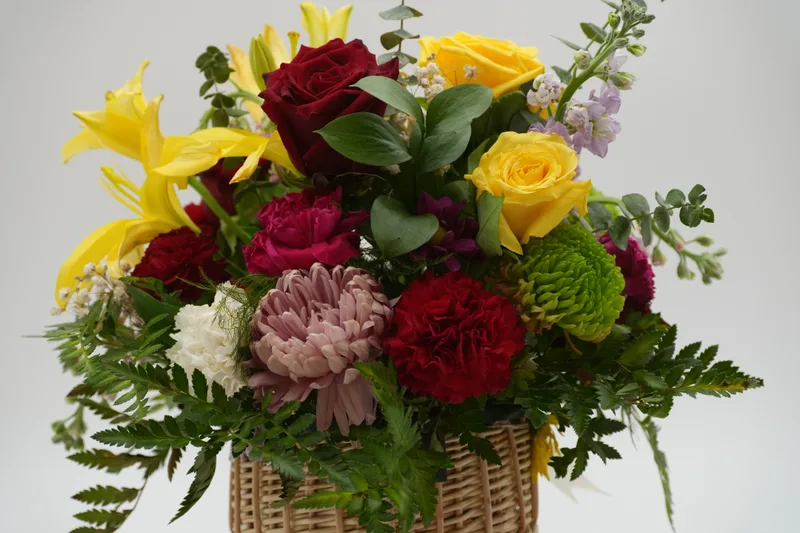
Others carry one dominant head – roses, carnations, gerbera – and their job is to hold the visual weight in the middle of the design. Round replaces round. This is why the shape survives a substitution intact: the silhouette is protected before the inventory list is, which is the exact inverse of how a buyer reading a product photograph assumes it works.
The form itself does not move
The final clause of that sentence is the strongest protection on the whole page and the least quoted: there shall be no substitution in the type of arrangement. A vase arrangement does not become a hand-tied bouquet. A basket does not become a box. Whatever else is negotiable inside it, the form you chose is fixed before anything else is even considered.
The container substitutes upward, never downward
Containers are the most common substitution of all, because a shop can run out of one vase far faster than it runs out of a flower. The standard is explicit about the direction that swap is allowed to travel:
If the container shown online is not available, a similar container of equal or greater value will be used.
Two things follow. The container is not protected the way the flowers are – it can genuinely change. But it can only change in one direction. There is no reading of that rule under which a cheaper vessel arrives. If the ceramic cube in the photograph is gone, what turns up is its equal or better, and the value floor you paid for moves up rather than down.
Putting your own hierarchy on the order
Everything above is the default, and a default is only a default. It can be turned over, but only by an instruction that comes with the order before we start on it. We make every order ourselves, so the person holding the shears knows exactly what you wrote and nothing you merely assumed. A preference kept in your head is not a preference. It is a hope.
So write your own ranking onto the order in one sentence, the way round you actually mean it. If the shade carries the message and the flower is only the vehicle, say that the yellow outranks the roses for this order and the standard’s hierarchy is to be read upside down. If the stem is the entire point, say roses or nothing and let the shade fall where the cooler allows. If a colour has to stay out of the box for a reason the designer cannot possibly guess – a wedding palette, a team’s rival colours, a shade the recipient has hated since childhood – name the colour rather than the reason.
That sentence does a second job most buyers miss. Fixing one thing frees everything else, and it shows the designer where they still have room to work, which is where the good decisions get made. If what you are fixing is the effect rather than any particular stem, designer’s choice is the honest form of that instruction and usually the better-looking one. Whether a named request can be filled at all on a given day is a separate question with no rulebook behind it – what came off the truck, when the wholesale market was last open, what month it is – and that belongs to the custom flowers hub.
What you can find in the box and still have got what you paid for
Read the rules from the doorstep rather than from the order form and they turn into a short set of legitimate surprises. The first is colour. Two dozen roses in a shade nobody chose, in an arrangement that was all roses from the start, is a correctly filled order – the flower was the first promise and the shade came second. Turn that around for mixed work bought for its palette: there the scheme is what survives, and the stem list underneath it is what moved.
The second is the cast rather than the shape. Tall spiked stems may have been answered by other tall spiked stems, standing to the same height and cutting the same outline against the wall behind them. Round heads may have been answered by other round heads of similar visual weight, sitting in the same position in the body of the design. From the far side of a room it is the arrangement in the photograph. Up close it is a different set of flowers doing identical jobs, which is the rule working rather than the rule being bent.
The third is the vessel. The ceramic on the table may not be the ceramic in the picture, because containers run out faster than flowers do, and the only swap permitted is sideways or upward in value. So the surprise available here is a better vase than the one you paid for, and nothing in the other direction.
Six doors the standard bolts shut
The rules so far govern what may move. The short closing list governs what may not, and it holds whatever the pressure on the cooler that morning. It is worth reading slowly, because this is the point where the subject stops being taste and becomes category error – every line names a swap that would answer your order with a different kind of object altogether rather than a different flower. Two of the six are funeral forms, which is why this list does more for a sympathy order than any assurance printed on a product page; the sympathy and funeral guidance sets out which form belongs where, before you get as far as choosing the flowers that go in it.
| You ordered | This cannot be sent in its place | Why that door is bolted |
|---|---|---|
| A standing spray for a service | A container arrangement, carried in as the closest thing on the shelf | A spray is built to stand and to be read from the back of a chapel. A piece in a container sits on a surface and disappears behind the first row of chairs, so the swap changes what the room sees rather than only what is in it. It is also the substitution a shop under pressure is most tempted to reach for, which is why it heads the list. |
| A wreath | A basket dressed to fill the same space | The circle is the message. A wreath is recognised as a wreath from a distance, where a basket reads as a gift – so answering one with the other misses the form entirely, however good the flowers in it are. |
| A plant in flower | A leafy green pot in its place | Foliage may not stand in for bloom. However handsome the substitute is, an order placed for something in flower is not filled by something that is not, and no amount of size or condition closes that gap. |
| A corsage | Loose stems wrapped and handed over instead | A corsage is a wearable object – pinned to a lapel or worn at the wrist, and expected to hold up for the length of an event. Cut flowers in a wrap cannot do that job, so the one is not a version of the other at any value. |
| Cut flowers | A potted plant, on the reasoning that it lasts longer | Lasting longer was not what was bought. A plant is a thing to keep and water; flowers are a thing to be handed. The rule holds even when the pot is the more expensive item on the bench. |
| A fresh arrangement | Silk, dried, or any other permanent work | This is the line that closes the list and the one most worth carrying to the doorstep: whatever else moved between the photograph and the door, what came through it is alive, and it is the category of thing you actually bought. |
Roses at the door tonight
Call 8 hours ahead. Made in our shop and ready with 8 hours’ notice.