

The daisy you are buying is almost certainly a gerbera — and it wants two inches of water, not a full vase
Gerbera, shasta or pom daisies: they do not last alike. Gerberas want a shallow vase and two inches of water. Daisy care, simply.
Which daisy you are getting
Gerbera, shasta or daisy pom — ask and we will name the type on the order, because the three do not last alike.
Ask for a low vase
Gerberas go into a shallow, narrow-necked vase here. A tall one filled to the brim is what bends the neck.
If the last bunch failed
A two-day collapse is nearly always water depth rather than a bad batch, and we would rather explain that than sell you a replacement.
No perfume to plan around
Daisies carry no fragrance, so a scent-sensitive recipient is one fewer thing to work out before you order.
Ask for daisies and what lands on the counter is, in almost every case, a gerbera: the big flat face in coral, hot pink or cream that everybody recognises and almost nobody calls by its actual name. That matters for one reason. A gerbera is the only stem we keep that has to stand in shallow water — two inches or so, poured out and replaced daily, not topped up. Its stem is hollow. Sink it in a deep vase and it rots from the inside while the head is still perfect, and then the head snaps at the neck. That is the whole story behind the complaint we hear more than any other about this flower: they died in two days.
Two inches, changed daily, and never topped up
The gerbera stem is hollow and faintly furred, and both features work against it in a vase. The furred surface holds bacteria, the hollow interior draws water up a long submerged length that was never meant to be submerged, and the tissue softens somewhere just below the flower. The head does not wilt in the ordinary way — it stays bright and simply tips over, hinged at a soft point in the neck. Once that hinge forms, nothing brings it back.
So: shallow water, and clean. Recut the stems, strip anything that would sit below the waterline, and give them two or three inches in a vase narrow enough at the neck to take some of the weight of the head. Then pour the water away and refill it each day rather than adding to what is already there — topping up leaves the bacteria in place, which is the point of changing it. A gerbera in a scrupulously clean, shallow vase is not a difficult flower. A gerbera stood deep in three-day-old water is a two-day flower.
It is worth saying plainly that this is the reverse of the instruction on our sunflower page, where a heavy head on a thick woody stem wants depth and plenty of it. Two flowers, same vase on the same windowsill, opposite requirements. If you have been given one rule for cut flowers and applied it to everything, gerberas are where it fails. The full routine — recutting, water temperature, what shortens a vase life and what does not — sits in our guide to keeping daisies alive.
Three flowers arrive under one name
Ask ten people to picture a daisy and you get one image. Ask a florist and you get three, and they behave differently enough in a vase that it is worth knowing which one is in the box.
Gerbera
The saturated coral, orange, hot pink and cream faces, and the default when someone orders daisies without specifying. The most photogenic of the three and the most demanding: hollow stems, a heavy head relative to what holds it up, and the shallow-water rule above. Shortest-lived of the daisy types even when handled well, which is why some florists run a thin support wire up the stem before it goes in a vase.
Shasta and marguerite
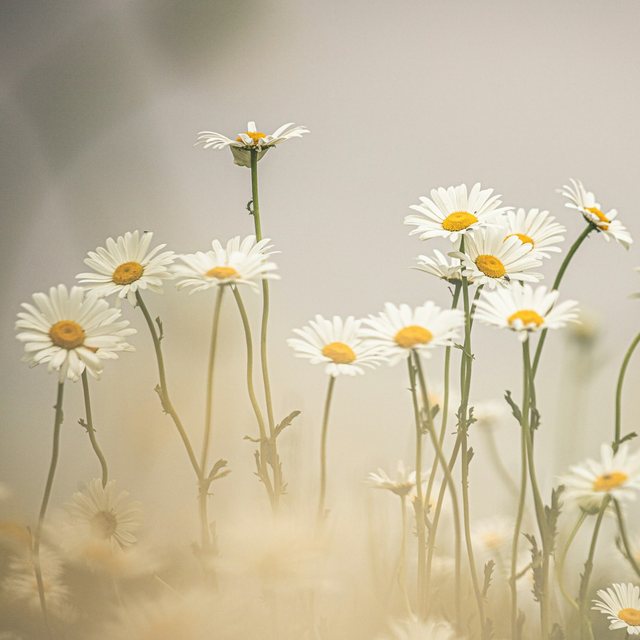
The white petals and yellow eye everyone actually pictures. Cottage-garden rather than florist-shop, informal by nature, and the type most likely to read as a handful of flowers picked for someone rather than an arrangement ordered for them. Ordinary vase depth suits them.
Daisy poms
Chrysanthemum-family sprays carrying several small daisy heads per stem, and also happy in a normally filled vase. The workhorse: longest-lasting of the three by a clear margin, which is why a daisy arrangement can still look alive at the end of a long hospital stay when a rose arrangement sent the same day has gone over. If a bunch has to survive weeks rather than an evening, poms are the reason to ask for daisies at all.
The second question people bring to this flower is what it is taken to mean, which has its own history and its own contradictions — that one is taken up further down this page.
The cooler has no daisy season. The yard has a short one.
There is no month in which we would tell you daisies are off. FloraLife describes both gerbera and spray chrysanthemum as generally available year round, so neither the gerbera nor the daisy pom has a real seasonal gap in a Long Island florist’s cooler — February and July are the same proposition. What is seasonal is the daisy in the ground, and that one runs roughly June through August or September.
The garden one is the Shasta daisy. NC State Extension puts it at white rays around a yellow centre, two to three inches across, on plants two to four feet tall, flowering June to August and hardy in USDA zones 5a through 9b. It is not a wild species that somebody brought indoors: it is a hybrid of Leucanthemum lacustre, L. maximum and L. vulgare, raised near Mt. Shasta in California by Luther Burbank in the 1890s.
That hardiness range means Shasta daisies overwinter across the whole Island. On the 2023 USDA Plant Hardiness Zone Map, Long Island falls in zones 7a and 7b: Riverhead (11901) and Southampton (11968) come out 7a, an average annual extreme minimum of 0 to 5°F, while Hempstead (11550) and Amityville (11701) are 7b at 5 to 10°F. Every one of those sits inside the Shasta’s 5 to 9 range, so the plant overwinters across the whole Island.
What we will not give you is a bloom week. NC State’s June-to-August range is for the species, and the Perennial Plant Association’s late June through September is for the cultivar ‘Becky’; neither is a Long Island observation, and we have not found one that is. A Nassau or Suffolk bloom date offered as measured fact is being borrowed from somewhere else.
The white daisies along Long Island roadsides and field edges are a different plant again: oxeye daisy, Leucanthemum vulgare, introduced to the United States in the 1800s and listed by USDA PLANTS as introduced across the lower 48. It blooms May to August, one to three inch flowers on one to three foot stems, and NC State Extension describes it outside its native range as an invasive weed that tends to displace native species. Good to look at from a car in June. Not a stem anyone puts on an order form.
And the daisy-shaped flower in an October yard is not the June one carrying on. Garden mums do not flower until autumn, so the outdoor Long Island chrysanthemum season and the outdoor Shasta season do not overlap: two different plants, two different halves of the year, one flower shape between them. Which is which, and which one arrives when you order, is the whole subject of our page on daisy varieties.
Suffolk grows an enormous amount of green, and almost none of it is cut daisies
Suffolk County ranked first in New York State and twelfth in the United States for the market value of nursery, greenhouse, floriculture and sod sales in the 2022 Census of Agriculture — $239,845,000 across 578 farms and 33,821 acres. Nassau, in the same category, reported 29 farms on 665 acres and ranked 41st in the state. It is tempting to turn a number like that into a local-flowers story, and we cannot. Suffolk’s top crops by acreage in 2022 were vegetables at 4,809 acres, grapes at 4,683 and nursery stock at 3,959, with sod alongside them: the floriculture ranking is driven by nursery stock and sod rather than field-cut flowers, and the census does not support a claim that Long Island is a major cut-daisy growing region.
Odourless is a property, not a permission
Daisies are effectively scentless, and that is genuinely useful. Fragrance rules in a sickroom are rarely about taste: nausea during chemotherapy is triggered by smell more reliably than by anything visual, migraine and neurology patients can be floored by a perfume a healthy visitor barely registers, and in a shared room the person in the next bed has nowhere to go. Plenty of wards are scent-free for the staff working twelve-hour shifts in them, not only for the patient. Where that applies, most of a standard bouquet is disqualified — oriental lilies, freesia, stock, hyacinth, scented garden roses — and daisies are among the stems that stay in. What little you can smell from a bunch of them is green and vegetal, cut stem and foliage, closer to mown grass than to perfume.
Two things undo it. The first is filler: unscented daisies wrapped in eucalyptus, stock or scented greenery smell as strongly as whatever they replaced, so say “fragrance-free, including the greens” when you order. The second is assuming no scent means no obstacle. A fragrance restriction is one rule; a blanket ban on fresh flowers is a different rule, and daisies do not get around the second. Stony Brook University Hospital’s published visitor guidance names intensive care, oncology and transplant units, the burn unit, behavioural health, pre-operative, recovery and the emergency department among areas where fresh flowers and plant-based items are not permitted, and it excludes potted plants entirely on CDC grounds — so a potted marguerite is refused at a door a vase of cut daisies walks through. Policies differ sharply between hospitals a few miles apart, which is why the door rules live in our get-well and new-baby guidance and, per site, in the Long Island hospital delivery rules rather than on this page.
Unscented is not the same as pollen-free
Daisies belong to the Asteraceae, the composite family, which also contains chrysanthemums, sunflowers and ragweed. That relationship makes some people nervous, and it deserves an honest answer rather than a marketing one. Composite flowers of this kind are insect-pollinated: their pollen is heavy and sticky, it is built to travel on a bee rather than on air currents, and it does not behave like the wind-borne ragweed pollen that fills late-summer allergy forecasts.
Two caveats we would rather state than hide. Some people who react strongly to the chrysanthemum family develop skin irritation from handling the stems, which matters more for whoever arranges them than for the person receiving them. And a mature gerbera will drop a small amount of dark pollen from its centre onto a bedside table. If the recipient has a known ragweed or chrysanthemum sensitivity, tell us on the order and we will build the arrangement from something outside the family.
Informality is the message, not a compromise
There is a second reason daisies suit a recovery, and it has nothing to do with chemistry. A tall formal arrangement arriving at a bedside carries a tone. It can read as gravity — as though someone has decided this is serious. Daisies read as get well soon rather than we are worried about you, and for a knee replacement, a new baby, a colleague on the mend or a Tuesday with no occasion attached, that register is the entire point.
The same quality makes them wrong elsewhere. Daisies are a poor fit for a formal funeral tribute, a milestone anniversary or anything where the sender needs to look serious about the occasion. If that is what you are sending, start from the other stems we keep instead of forcing this one into a role it does not play.
Which daisy meanings have a paper trail
The name is the oldest thing about this flower and the one meaning nobody has to argue for. “Daisy” comes from the Old English dægeseage, day’s eye, because the flower head of Bellis perennis closes at night and opens again in the morning; Chaucer called it the eye of the day. That is not a sentiment somebody assigned to the flower afterwards. It is a description of what the flower does, and it is the reason the word exists.
For assigned meanings, the usable primary source is Kate Greenaway’s Language of Flowers of 1884 — a floriography text in its own right, not a modern repetition of one. It carries five daisy entries: Daisy, innocence; Garden daisy, I share your sentiments; Michaelmas daisy, farewell; Party-coloured daisy, beauty; Wild daisy, I will think of it. Its reverse index, running from sentiment back to flower, lists innocence as daisy.
Almost everything else you will read about what daisies mean is not in there. Loyal love, true love, new beginnings, cheerfulness, keeping a secret — none of those appear in Greenaway, and we could not trace them to a primary source of any kind. The story that the daisy was sacred to the Norse goddess Freya and therefore stands for childbirth and motherhood is repeated all over the internet, and we found no primary or scholarly source behind it. The line that the daisy is the fifth-anniversary flower is repeated just as widely and traces to no authority we could reach. We would rather name those as untraceable than pass them on: if the meaning is the reason you are sending the flower, it is worth knowing which meanings have a document behind them.
One Greenaway entry sounds badly wrong for a get-well bunch — Michaelmas daisy, farewell — and it does not apply. The Michaelmas daisy is an aster, not a daisy at all. The most funereal-sounding daisy meaning in the primary source belongs to a plant that is neither a gerbera, a Shasta nor a daisy pom.
The birth-flower convention produces a genuine oddity here. The Old Farmer’s Almanac lists the daisy as April’s primary birth flower, with sweet pea as the secondary, and gives its meanings as innocence, purity and gratitude. The same list gives November to the chrysanthemum, for friendship, loyalty and honesty. Because the florist’s daisy pom is a chrysanthemum, one physical stem is April’s flower or November’s flower depending on which name the sender uses. The convention splits on nomenclature rather than botany, which is worth knowing before you buy by birth month for one of the occasions where that is how people choose.
The shared identity carries something heavier with it as well. The Oxford Dictionary of Phrase and Fable describes the chrysanthemum as a favourite funeral flower in some parts of Europe and associated with All Souls’ Day, and notes that in Japan it is the crest of the imperial family. Wikipedia’s account records white chrysanthemums standing for adversity, lamentation and grief in China, Japan and Korea; chrysanthemums traditionally brought to deceased loved ones at the cemetery in Italy around 2 November; and chrysanthemums placed on graves in Poland for All Saints’ and All Souls’ Days. The much-repeated rule that chrysanthemums must never be given as a gift in a specific list of European countries is a different matter: that list carries a citation-needed tag where it is published. The funeral association is documented. The blanket prohibition is not.
None of that makes a bunch of daisy poms the wrong flower for a living room in Massapequa. It does mean the name on the card can be doing more work than the flower is, and we would sooner you knew it before ordering than after. For a formal tribute the answer sits elsewhere in any case — our sympathy and funeral guidance starts from stems chosen for the occasion rather than around it.
Roses at the door tonight
Call 8 hours ahead. Made in our shop and ready with 8 hours’ notice.
Common questions
Why did my last gerberas collapse at the neck in two days?
Almost always the water line. A hollow stem standing in six inches of water softens below the surface long before the flower looks tired, and the head folds over at that soft point while the petals are still bright. Two or three inches of clean water, emptied and replaced daily rather than topped up, is the fix, and it costs nothing to try on the next bunch.
How long will daisies last in the vase?
It depends which of the three you have. Gerberas are the short ones and reward shallow, frequently changed water. Shasta and marguerite types sit in the middle. Daisy poms run considerably longer, and are the reason we reach for them when an arrangement needs to survive a stay rather than an evening.
Do daisies really have no smell?
Nothing you would call a perfume. Standing close to a large bunch you may notice a faint green, sappy note from the stems and foliage, which is the smell of cut grass rather than a floral fragrance. In a scent-restricted room that distinction is the one that matters.
Are daisies safe to send during chemotherapy?
The scent trigger that makes flowers difficult during treatment is not an issue with daisies. Whether fresh flowers are allowed near a particular patient is a clinical decision, though, and several oncology and transplant units on Long Island prohibit them regardless of type — the per-hospital position is in our hospital delivery guidance. If the answer is no, send to the home so the flowers are waiting after discharge.
Can I send a potted daisy plant instead?
To a home, gladly — a potted marguerite outlives any cut arrangement and asks less of whoever is looking after it. To a hospital, usually not: potted plants are the first thing excluded when a hospital writes a policy, and Stony Brook University Hospital excludes them by name on CDC grounds. Cut stems get through doors that pots do not.
Are daisies ever right for sympathy?
Not for the formal tribute at a service, where the informality works against you. They are genuinely good three or four weeks later, when the formal flowers have gone and the house is quiet — a cheerful, unfussy bunch at that point says something a large white arrangement cannot.