

Your hydrangeas collapsed. Put the whole head under water for an hour.
A hydrangea with a hanging head is thirsty, not ruined: the fix is a sink and an hour. Why hydrangea colour changes, and how to revive one.
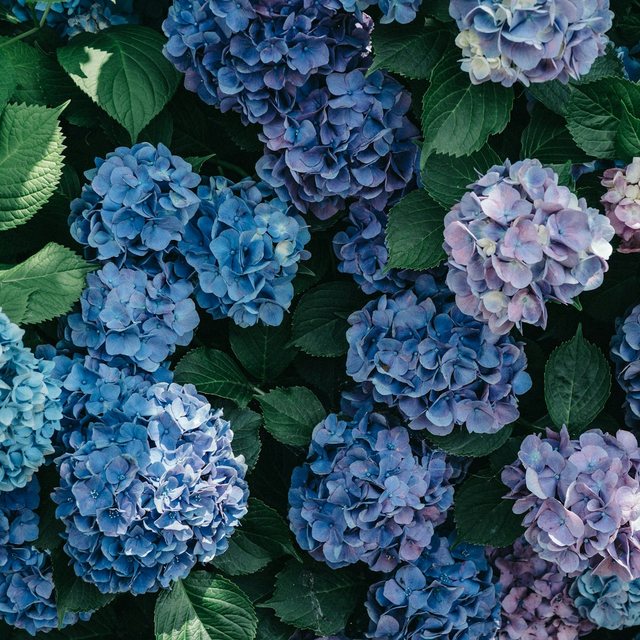
Drooping is not damage
A hydrangea that arrives with its head hanging is thirsty, not ruined. The fix is a sink and an hour.
Same-day on Long Island
Tell us the town and the hour it needs to land, and we will tell you what is possible today.
Say which blue you mean
Blue, mauve and pink are the same flower grown in different ground. Describe it and we will say what is coming in.
Heads by the box
Long tables and arbours want loose heads rather than vases, which we quote through weddings and events.
Start at the sink, not the vase
Nearly every cut flower drinks through one place: the cut end of the stem. Hydrangeas drink through their petals as well – the papery sepals that make up that huge head absorb water directly. That is the whole story of the flower. It is why they wilt faster and more dramatically than anything else on the bench, because a head that broad loses moisture across its entire surface, and it is why the rescue works.
Fill a sink or a deep basin with cool water. Turn the stem upside down and hold the entire head under, weighted with a plate if it floats. Leave it an hour. Lift it out, shake it, recut the stem at a sharp angle, and stand it in deep water. A head that was flat on the table at breakfast is usually standing up again by lunch.
Do not do this with anything else in the vase. Rose petals bruise and spot after a soak, lily pollen runs, and most soft petals simply rot. Full submersion is a hydrangea trick and almost nothing else survives it, which is worth knowing before you decide a wilted head is a wasted one.
The colour is decided by the ground, not the label
Blue and pink hydrangeas are frequently the same plant. Bloom colour shifts with soil pH: acidic ground frees up aluminium the roots can take in and the heads come out blue, while alkaline ground locks that aluminium away and the same shrub flowers pink. Gardeners move the colour deliberately over a couple of seasons by amending the soil, and a hedge that sat squarely between the two throws mauve and dusty purple. White varieties ignore all of it and stay white.
For anyone ordering, that means colour is a question about which field the stems were cut from, not about a dye vat. It also means a precise shade is worth describing rather than naming – “the greenish blue” and “the hot pink” land better with a florist than “blue”. Which hydrangeas can be moved that way, and which cannot, is the section directly below.
Which hydrangeas answer to the soil, and which ignore it
The pH story above holds for one group. Bigleaf hydrangea – Hydrangea macrophylla, sold as mophead, lacecap or French – is the one whose bloom colour responds to the ground it grew in. Oakleaf and PeeGee or panicle hydrangeas flower white or cream, and their colour cannot be changed that way at all. Smooth hydrangea, H. arborescens, is also unmoved by soil pH; its range runs cream and tan through green, pink and white, and the pink in it comes from bred cultivars – ‘Bella Anna’, the Invincibelle group – rather than from the field. So “blue” is a question about which species is in the bucket before it is a question about acidity.
Oakleaf and panicle do change colour, just on a clock rather than a soil test. Oakleaf opens creamy white, fades to pink, and goes tan in the fall. Panicle opens creamy white and shifts to pink and then brown as autumn approaches. That drift is age-driven, not soil-driven, which is why a September panicle head and a July one are not the same flower to look at – the season guide follows that calendar.
The numbers behind blue and pink
For bigleaf, the control is aluminium availability rather than pH acting on the bloom directly: aluminium is mobile only in acid soil. NC State Extension in Wayne County sets the bands at pH 5.0 to 5.5 for blue, 6.0 and above for pink, and 5.5 to 6.0 for the purples and the shades in between. University of Georgia CAES describes what is in the flower itself – blue blooms contain aluminium, pink ones do not, and intermediate colours contain small amounts, the colour being a pigment-and-aluminium complex rather than a dye drawn up out of the ground. Cornell Cooperative Extension of Suffolk County describes Long Island landscape soils as tending to be acid, and as tending not to be high in carbonates: the aluminium end of that scale, arrived at without anyone engineering it.
Moving the colour takes a season, and it drifts back
UGA gives the timing: broadcast lime may take a year to show a noticeable change in bloom colour, and the soil drifts back toward its original pH over time. It is a garden project measured in seasons, not a lever anyone pulls for a delivery on Thursday.
Tinted heads are not damaged heads
Cut hydrangea is traded in both natural and tinted colours, and FloraLife’s troubleshooting guidance is that naturally coloured and airbrushed stems perform the same in the vase – the paint does not shorten vase life. Wholesale grading is by head width rather than by colour: a standard bloom measures 4 to 6 inches across, a mini 3.5 to 5.5 inches, with a jumbo grade above them, on stems averaging 12 to 16 inches. So a colour no soil produces is reachable by spray, and it costs nothing in vase days – the rest of that picture is on the care guide. A whole palette built to a room rather than to a field is a custom order.
What we cannot tell you is what a colour costs. The trade line that blue heads carry a premium over white is one we have not been able to trace to a published price, so we quote on what the week actually holds rather than by shade.
Why the East End is thick with them
Drive any lane in the Hamptons or out along the North Fork in summer and the hedges are mopheads, mostly blue, because sandy coastal soil out there runs acidic. That association is strong enough that hydrangeas read as East End summer even in an arrangement sent to an apartment in Nassau. It is also why they turn up in so much local wedding work, and why we keep notes on the local growing window in a separate season guide.
One head does the work of a dozen stems
A single mophead is the width of a spread hand. Three of them fill a vase that would otherwise swallow twenty roses, which is why hydrangeas anchor so many of our larger arrangements and why they are the cheapest honest way to make a table look full. The trade-off is weight. Wet heads are heavy, so they want a low wide vessel with a stable base rather than a tall narrow vase, and they will empty that vessel fast – check the water daily, not every third day.
Let the water run out and keep them
This is the one time to ignore the advice above. If you want to dry hydrangeas, stop topping up the vase and let the water disappear slowly while the heads are still standing. They stiffen into paper and hold their shape for months, fading to soft green, parchment or burgundy depending on how far into the season they were cut. Late-summer heads that already feel papery on the plant dry far better than the plump early ones. Nothing else we sell repays neglect quite like this.
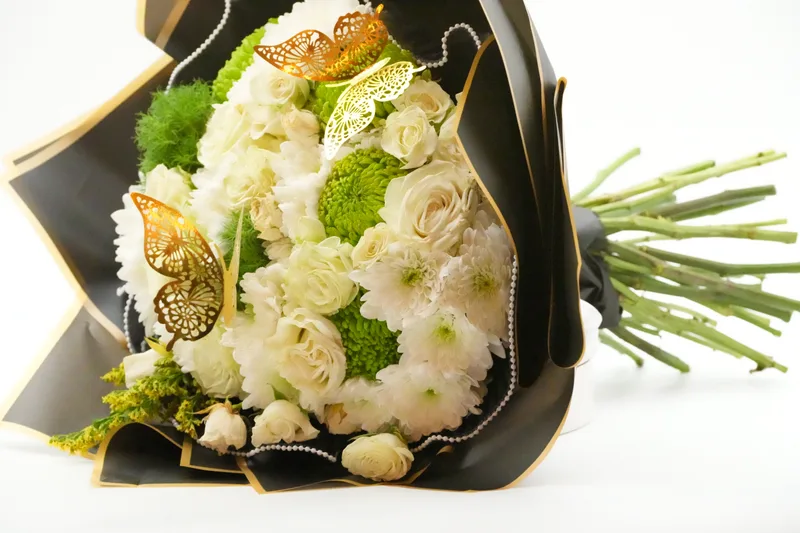
Roses at the door tonight
Call 8 hours ahead. Made in our shop and ready with 8 hours’ notice.
Common questions
My hydrangea went flat overnight. Is it finished?
Almost certainly not. Submerge the whole head in cool water for about an hour, recut the stem, and put it back in deep water. If the head is still limp after two soaks, or the stem end has gone brown and soft, then it is done – but a first collapse is normal hydrangea behaviour, not a fault.
Why did the blue ones arrive looking purple?
Soil pH is a spectrum, not a switch. Ground that sits between acidic and alkaline produces mauve and violet heads rather than a clean blue, and blooms drift further toward green or rose as they age on the plant. If an exact shade matters for a room or a colour scheme, say so when you order and we will tell you what is actually available rather than guessing.
Can I mix hydrangeas with other flowers?
Yes, with one caution: they are thirsty and will drain a shared vase faster than their neighbours can tolerate. Keep the water deep and top it up daily. Also remember that the submersion rescue is for hydrangeas alone, so lift the hydrangea out of a mixed arrangement to revive it rather than dunking the whole thing.
Are hydrangeas safe around pets?
The leaves and buds are listed as toxic to cats, dogs and horses if eaten, so the risk is chewing rather than proximity. In a household with a grazer, put the vase somewhere high or choose something else. If you are sending to a home with a cat, lilies are the far more serious problem – that is covered on the lily page.
Are they only available in summer?
The local East End window runs midsummer into early autumn, and that is when the heads are largest and cheapest. Cut hydrangeas are traded well beyond it, so they can usually be sourced out of season at a different price and in a narrower range of colours. Tell us the date and we will tell you what is coming in that week; there is a fuller season guide beneath this page.
Can I order loose heads for my own arranging?
That is the usual request for an event, and it is a different order from a finished vase – quantities are counted in heads, and they need conditioning in water the moment they arrive. Start with weddings and events and tell us the venue and the date. Care advice specific to hydrangeas gets its own guide beneath this page as well.