

Get well and new baby flowers: the hospital decides what actually reaches the patient
Get well and new baby flowers delivered on Long Island. We check each hospital's flower rules first, because the ward decides what is allowed.
Tell us the unit
The ward matters more than the room number, because the ward is what decides whether flowers are permitted at all.
We read the policy
Every hospital in our directory has been checked against its own published visitor guidance, not against a directory listing.
A home address works
When a ward will not take flowers, the family’s house is usually the better address anyway.
We will tell you no
Where a hospital refuses florist deliveries, we say so before you order rather than after.
Any florist can load an arrangement into a van and drive it to a hospital on Long Island. Whether it gets past the lobby is a completely separate question, and the building answers it, not the florist. Two of the hospitals here refuse outside florist deliveries in writing. One takes them straight up to the patient unit. One accepts them but will not carry them a single floor higher than the lobby. Most publish nothing at all.
That is why this page is mostly about rules rather than bouquets. Choosing the flowers is the easy part of sending a get-well or new-baby gift on Long Island. Getting them into the room is the part that goes wrong, and it usually goes wrong for reasons the sender had no way of knowing.
Ask which unit they are on before you choose anything
Hospitals do not apply one flower rule to the whole building. They apply it ward by ward, and the pattern repeats across the island: intensive care, oncology, transplant and burn units commonly bar flowers outright, on infection-control grounds. A patient who could have received a bouquet on a general medical floor on Monday may be somewhere on Wednesday where nothing living is allowed through the door.
So the useful question to the family is not “what room is she in” but “what unit is she on”. Room numbers change when patients are moved, and a delivery addressed to a room the patient has left goes back to the van. The unit name is the thing that governs the rule and the thing that survives a transfer. Give it to us in the order notes and we will work to it.
Two hospitals here name florists in their own rules
Stony Brook University Hospital and Stony Brook Southampton Hospital both publish that they do not accept deliveries for patients, and both list local florists explicitly, alongside food-delivery apps and parcel carriers. This is not a quiet preference buried in a policy document. It is on the visitor guidance, in plain language, and it means a florist promising you delivery to Stony Brook University Hospital is promising something the hospital has already said it will refuse.
What still works at both is a visitor carrying flowers in by hand, outside the restricted units. And at Stony Brook University Hospital there is a gift shop in the main lobby that sells flowers and can move them internally. Neither of those is a sale for us, and we would rather say so than take an order that ends with an arrangement sitting in a van in a car park.
Same health system, opposite answers
The instinct to reason from one hospital to its sibling is the single most expensive mistake in this category, and Stony Brook Medicine disproves it four times over. Stony Brook University Hospital permits Mylar balloons in most areas, up to five, and no latex. Stony Brook Southampton permits no balloons whatsoever, Mylar included, and bans potted plants, scented candles and incense with them. Stony Brook Children’s Hospital goes further again: live flowers and plants are not permitted in patient rooms at all, which makes it stricter about flowers than the adult hospital on the same health system’s letterhead. Stony Brook Eastern Long Island Hospital, meanwhile, publishes no delivery refusal at all.
Four hospitals, one brand, four materially different answers. If a page tells you what “Stony Brook” allows without naming which Stony Brook, it is guessing. Our hospital-by-hospital directory keeps them separate for exactly this reason.
Arriving is not the same as reaching the patient
NYU Langone Hospital-Long Island in Mineola accepts gift deliveries by messenger or vendor, but the courier cannot take them to the room. The patient’s support person has to collect the delivery from the lobby. Read that as a sender and the consequence is obvious: if nobody is visiting that afternoon, the flowers arrive and then go nowhere. This is a genuinely accepted delivery that still fails as a gift.
The fix is unglamorous. Decide who is collecting before you order, tell them roughly when to expect it, and put their name on the order rather than only the patient’s. Compare that with Cohen Children’s Medical Center in New Hyde Park, which publishes the cleanest yes in the whole set: flowers and gifts from outside vendors can be ordered by phone and delivered the same day directly to the patient unit. Same island, two accepting hospitals, and the practical difference between them decides whether you need a person standing in a lobby.
Silence from a hospital is not permission
Most Long Island hospitals publish nothing about outside deliveries either way. Their visitor pages cover parking, visiting hours and the gift shop, and stop there. That absence is worth stating plainly, because it means nobody can honestly promise you delivery to those hospitals, ourselves included. Anybody who does is inferring a yes from silence.
What we do instead is tell you the policy is unpublished, point you at the number to call, and get the order right once you know. Five minutes on the phone to the nurses’ station settles it, and the answer you get is worth more than any florist’s assurance, because the ward staff know what is happening on that floor today.
New baby is a different problem from get well
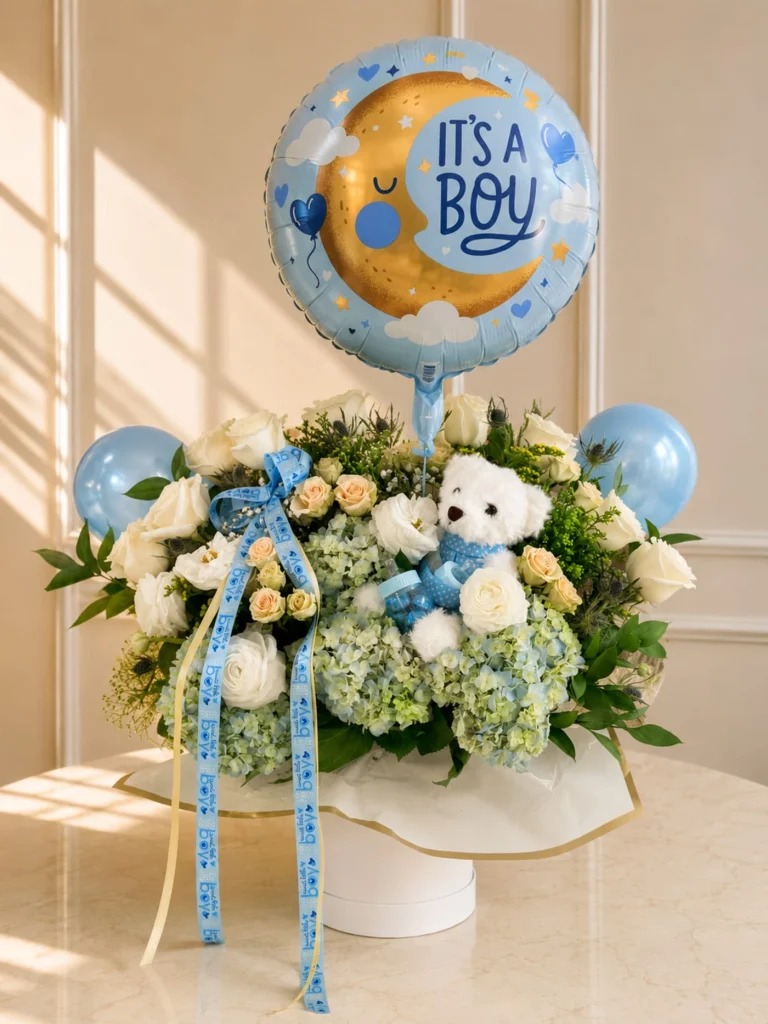
Maternity is usually among the more permissive parts of a hospital, but new-baby deliveries fail in their own particular ways. The first is timing: a maternity stay is short, and a bouquet ordered for tomorrow afternoon can easily arrive after mother and baby have been discharged. If the birth was straightforward, the home address is very often the right one from the start.
The second is the neonatal intensive care unit, which is a different world from the postnatal floor a corridor away. Flowers do not go into a NICU. And at Stony Brook Children’s Hospital the ban runs wider still, covering live flowers and plants in patient rooms generally, with Mylar balloons the thing that is allowed. If you are sending to a child rather than an adult, check that specific hospital before you assume flowers are even on the table.
What gets turned away at the door
Latex balloons
Barred almost everywhere, for two separate reasons. Latex allergy is serious in a clinical setting, and in paediatric units a burst balloon is a choking hazard. Cohen Children’s states both reasons in its own guidance. Mylar is the standard substitute, but the limits vary from a single balloon at one hospital to five at another, and Stony Brook Southampton bans Mylar too. An “it’s a girl” latex bunch is the classic new-baby gift that never makes it upstairs.
Potted plants and orchids
This is the rule that surprises people most, because it inverts the usual logic. Several hospitals permit cut flowers while barring potted plants, citing infection-control guidance about soil. A plant lasts longer than a bouquet, so it feels like the thoughtful choice, and it is the one most likely to be refused. That makes an orchid, which is nearly always sold as a living plant in its pot, the wrong gift for a hospital room and a good gift for the house afterwards. Our orchid guide covers the difference.
Anything strongly scented
Nausea is a constant after surgery and during chemotherapy, and a small warm room concentrates fragrance in a way a living room never does. Some wards are fragrance-restricted outright, and one Long Island hospital bans scented candles and incense by name. Unscented, low-allergen stems are the safer build; daisies are cheerful, informal and carry almost no scent, which is why they end up in so many hospital arrangements.

Roses at the door tonight
Call 8 hours ahead. Made in our shop and ready with 8 hours’ notice.
Common questions
The hospital refuses florist deliveries. Is there any way to get flowers to the patient?
Three, usually. A visitor can carry an arrangement in by hand if the unit permits flowers, an on-site gift shop can often move them internally when an outside courier cannot, and you can send to the family home instead. Ask us for the home-address option and we will treat it as the primary plan rather than the consolation prize.
Are flowers allowed on a maternity ward?
Often yes, and maternity is generally less restricted than surgical or oncology floors. The two things to confirm are whether the hospital accepts an outside delivery at all, and whether mother and baby are still there. Neonatal intensive care is a separate case, and flowers are not permitted there.
What happens if they are discharged before the delivery arrives?
Tell us as soon as you know and we will redirect to the home address where the schedule allows it. Give us a mobile number for a relative on the original order, not the patient’s own, because that is the number that actually gets answered when a driver is standing at a nurses’ station with nowhere to leave an arrangement.
Can I send balloons instead of flowers?
Sometimes it is the only thing that gets through, particularly at children’s hospitals where live flowers are barred from patient rooms but Mylar balloons are permitted. Latex is out almost everywhere. Check the number allowed as well as the material, since one hospital caps it at a single balloon and another refuses balloons of any kind.
Do you deliver to hospitals that publish no policy?
We will take the order, but we will not pretend the outcome is settled. Where a hospital has published nothing, we say so, tell you which number to call, and suggest arranging for someone to be there. That is a less confident answer than you will read elsewhere, and it is the accurate one.
How current is any of this?
Visitor policies move, sometimes quickly, and every hospital entry in our Long Island hospital directory carries the date it was last read against the hospital’s own guidance. Treat anything undated on any website as a starting point for a phone call rather than a fact.