

At a Jewish funeral or a shiva, flowers are not the gesture — check the chapel before you order
Sympathy and funeral flowers on Long Island. White roses for the family or the funeral home, hand-wrapped in our Port Jefferson shop and delivered today.
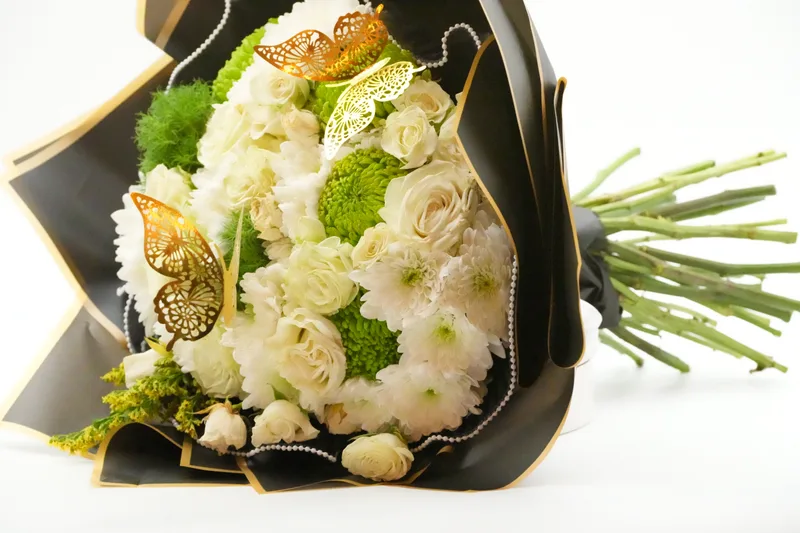

Sometimes we say don’t send
If flowers are the wrong gesture for that family, we tell you so instead of taking the order.
Kosher food for a shiva
Where flowers are not customary, food that reheats or serves cold is what fits.
Give us the chapel name
The funeral home, not the family’s house, is where almost all of these belong.
One piece, every name
Office and family collections go out as a single arrangement with everyone listed on the card.
Before anything else, settle the question most florists would rather you never asked: does this family receive flowers at all? At a Jewish funeral, and during the shiva that follows it, flowers are not customary. The tradition runs toward simplicity and equality — a plain casket, an unadorned room — and a standing spray on an easel works against that. What is welcome instead is kosher food sent to the shiva house, a condolence card, or tzedakah, a donation made in the deceased’s memory. The phrase to hold on to is not customary, never forbidden. Practice differs household to household, and some Reform families accept flowers without a moment’s awkwardness. If you are close enough to the family to ask, ask them. If you are not, the funeral director will settle it in about ten seconds and will think nothing of the question.
If the answer is yes, the next thing to get right is the building. Sympathy flowers go to the funeral home holding the wake, not to the family’s house, because for those few days the family is barely at home — they are at the chapel from mid-afternoon until nine at night, and an arrangement left on the step is one more thing waiting for them at the end of it. Give us the chapel name and its town, and nearly every other decision on this page follows from those two words.
Which chapel, and what kind of chapel
The obituary is the order form. It names the funeral home and the town it stands in, which is what actually identifies the chapel — the same family name is over the door in three or four towns out here, and picking the wrong one means the flowers stand in an empty room twenty miles away. It gives the viewing hours, usually in two blocks, something like 2–4 and 7–9. It gives the correct spelling of the deceased’s name for the card. And it often tells you, in the name of the chapel itself, which tradition you are dealing with.
Several Long Island funeral homes are Jewish chapels. Our directory of Long Island funeral homes flags the ones we have confirmed from the firm’s own description of itself, never from a family name or a town’s demographics, because guessing at that is worse than saying nothing. For the same reason, you will not find us publishing confident etiquette for Muslim, Hindu or Buddhist services: practice varies by community, we have not confirmed it chapel by chapel, and a florist inventing custom is exactly the kind of help nobody needs that week. One phone call to the funeral home answers it properly.
What to send to a shiva house instead
- Kosher food. Mourners are not expected to cook or shop for themselves during shiva, and feeding the constant stream of visitors falls to whoever is nearest. Food that reheats or serves cold is the practical answer, and it must be kosher if the household keeps kosher — a non-kosher platter cannot be used and someone has to deal with it.
- A condolence card. Appropriate in any tradition, and often kept.
- Tzedakah — a donation in the deceased’s memory. To the charity the family names, or to one connected with how they died. The organisation will notify the family of the gift without stating the amount.
“In lieu of flowers” is the other stop sign
When a family writes “in lieu of flowers, donations to” a named charity, that is a request, not a courtesy formula, and it overrides everything else on this page. Honour it for the service.
Nothing stops you sending a small arrangement to the house a fortnight later, once the donations have been made and the week is over. That gesture is usually better received than a spray would have been, and it is not the thing the family asked you not to do.
The piece that gets carried up the aisle
Once the chapel is settled, the only remaining variable is the clock, and it has one genuinely bad outcome. An arrangement that arrives while people are seated in the chapel has to be walked up the aisle past all of them, mid-service, by someone holding it at chest height. One that arrives the next morning is late, but nobody watches it happen. Late and quiet is the lesser mistake by a distance, so if it comes down to a choice, choose the next morning.
Work backwards from the first viewing block rather than from the funeral. Tell us when the viewing starts and we will build the window around that hour, and tell you plainly if it cannot be done. Some homes also ask that deliveries stop an hour before a service begins, so the director can set the room without a van at the side door.
The casket spray is not yours to order
Sympathy pieces divide by who sends them, and it is worth knowing which side of the line you are on. Standing sprays on easels, basket arrangements and cross or wreath forms are what friends, neighbours, colleagues and clubs send; they line the walls of the chapel and are placed by the director. The casket spray — the piece that lies on the casket itself — is traditionally chosen and paid for by the immediate family, and it has usually been ordered within hours of the death, before most people have even heard the news.
Order one as an outsider and you put the funeral director in the position of explaining why there are two sprays and one casket. If you are the spouse, a child or a parent, say so when you order and the conversation changes completely, including the size and how it is finished at the corners. If you are anyone else, a standing spray reads exactly right.
Lilies, cats, and what happens after the service
White lilies are the conventional sympathy stem for good reasons: they are large enough to read from across a room, they open over several days, and the scent carries. But sympathy arrangements do not stay at the chapel. When the service ends, the director sends them home with the family, and by Sunday night the piece you sent may be standing on a kitchen counter in a house with a cat in it.
Lilies are toxic to cats — every part of the plant, including the pollen that drops on the counter — and a grieving household is not one you want to hand a veterinary emergency. If you know there are cats, say so on the order. Carnations carry the same formality and last notably longer in a warm chapel, and chrysanthemums, stock and roses all read as sympathy without the risk. For a memorial held somewhere that has nowhere to put a spray, an orchid in a pot goes home with someone and keeps going.
Sign the card with how you knew them
Use your full name and one line of connection. A family reading forty cards in a side room cannot always place a first name, and “Jim” is not enough when the deceased knew four. Worked with him, taught with her, lived next door for eleven years — that is what makes the card mean something months later, when the family finally sits down and reads them properly.
Short is fine. Two sentences is fine. What does not work is the sentence beginning “at least” — at least she did not suffer, at least he had a long life — because every one of them argues with the grief instead of acknowledging it. If you have more to say than an enclosure card holds, say it in a letter posted a week later. That letter will be read when the flowers are gone.
The delivery almost nobody sends
Everything arrives at once. Cards, casseroles, callers, and every arrangement in the chapel — all inside about six days. Then it stops, abruptly, and that is when the house gets quiet. An arrangement sent to the family home two or three weeks after the funeral, when the chapel flowers have died and the visitors have gone back to work, lands harder than anything sent during the week itself. Keep it low, in a container they do not have to find a vase for, and put your name on it. The first anniversary works the same way, and almost no one remembers it.
Roses at the door tonight
Call 8 hours ahead. Made in our shop and ready with 8 hours’ notice.
Common questions
It is a Jewish chapel, but the family is not observant. Can I send flowers?
Possibly, and this is why the wording is “not customary” rather than “not allowed.” Some Reform households accept flowers without any awkwardness at all. The chapel itself may still prefer an unadorned room, though, so the call to the funeral director settles both halves of the question at once. If you would rather not put anyone on the spot, food to the shiva house is never the wrong move.
The obituary says “in lieu of flowers.” Can I send any at all?
Not to the service. Treat it as a stated wish and make the donation instead. A modest arrangement to the family home a couple of weeks afterwards is a different gesture and is not covered by that line, but the chapel is not the place for it.
How late can I order and still make the viewing?
It depends on the chapel and the day, and we would rather quote you a real window than a slogan. Give us the funeral home and the time the viewing starts and we will tell you whether it can be done, or whether the next morning is the better call.
There is no wake — direct cremation, memorial later. Where do flowers go?
To the family home, in that case, because there is no chapel to receive them. If a memorial service is announced for a later date, ask whether the venue accepts arrangements; a restaurant or a club often does not have anywhere to put them, and a plant or a donation suits that format better.
Six of us at work want to send one arrangement together. How does that work?
One order, one arrangement, all six names on the enclosure card, or a department name if that is simpler to read. It is a better use of the same money than six small pieces competing for wall space, and it saves the family six separate thank-you notes at the worst possible time.
Should anything be sent to the family’s house during the week of the funeral?
Food, more usefully than flowers — and this holds in any tradition, not only at a shiva. The house fills with relatives and nobody is cooking. If you want flowers there as well, keep them small and self-contained; a tall arrangement needing a vase and a table is one more thing for someone to solve on the worst week of their life.