

The three calls behind a company bereavement send: the address, the signature and the hour — and why the budget is not one of them
Employee bereavement flowers: where to send them, whose name signs the card and when they should arrive. Hand-wrapped and delivered from Port Jefferson.
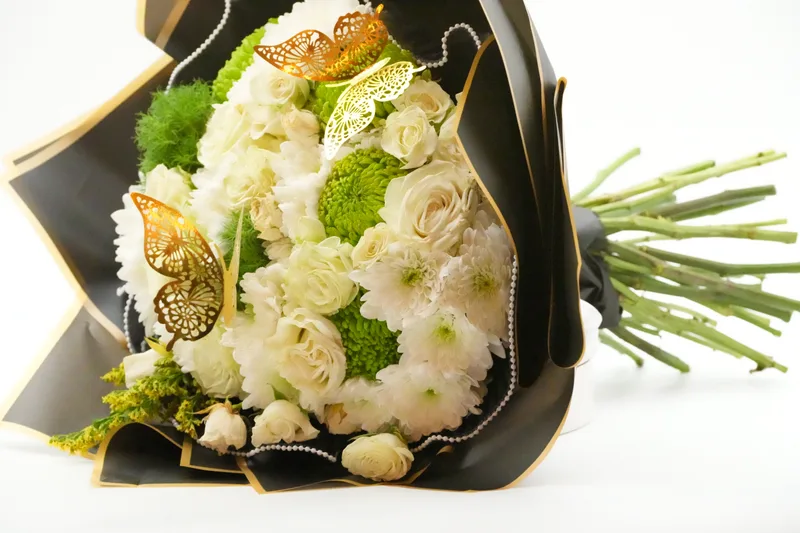
Three calls, not four
Where it goes, whose name signs it and when it lands are the decisions here; the price is not one of them.
Some families take no flowers
Name the chapel when you brief us and if flowers are not customary there you will hear it before anything is ordered.
Timed backwards from the doors
Give us the hour the viewing opens and the delivery is planned back from that, not forward from when you asked.
Three places, three pieces
A chapel, a family kitchen and an empty desk each want a different arrangement, and none of them wants the piece built for the other two.
In most companies a figure is quietly making this decision. A per-head ceiling in the expense policy, a category limit someone set years ago, whatever the last person in the chair signed off — that figure gets consulted first, and once it is settled the rest of the order tends to write itself. For a bereavement send the figure does not apply. That sounds like relief and is not, because what the ceiling had been doing was deciding on your behalf, and with it gone three questions are left standing that no purchase order has ever handled well. Where the flowers go. Whose name signs the card. What hour they arrive.
The exemption behind that is quickly stated and then done with. The securities industry’s per-person annual gift limit — $100, untouched since 1992 — rose to $300 on 30 March 2026, and the same notice codified that customary and reasonable bereavement gifts are not considered to be in relation to the recipient’s employer’s business, which puts them outside the cap and outside the recordkeeping that travels with it. What that gift log wants on a receipt, and why a company invoice reads the way it does, is the subject of how a company order gets billed; on this page it is one line and no more — this send does not go in the register, though a firm’s own policy can be stricter than the rule, which is a question for a compliance officer rather than a florist.
Everywhere else on the corporate flower calendar the send is essentially a line item: priced, approved, forgotten. This one is a message from an organisation to a person having the worst month of their life, and it is remembered in detail for years, in whichever direction it goes. So the three calls below are the whole of the job.
Call one: the address, which is really a choice between three different products
There are three plausible destinations and they are not three versions of one order. Each is built for a different room, and the piece designed for one of them looks wrong in the other two. Settle the destination first; the arrangement follows from it, never the other way round.
The chapel holding the wake
This is the formal send, the one carrying the company name, and it is built for a room full of people who are standing up: tall enough to be seen over shoulders, on an easel or in a substantial vase, in the restrained palette a chapel expects. It goes to the funeral home holding the wake. The death notice gives you the firm, the town and the viewing hours, and the town matters as much as the name — out here the same family name is over the door in several places, which is most of the reason our Long Island funeral home directory exists. If nobody in the office has the details, the employee’s closest colleague usually does, and asking them is a smaller intrusion than guessing.
The family’s house, once the week is over
A domestic send is smaller, lower and self-contained — nothing that needs a vase found for it or a table cleared to hold it. Its real advantage is timing rather than form: it can arrive when nothing else is arriving. The week of a funeral a house takes delivery of everything at once and then goes silent, so a company piece landing two or three weeks later, after the chapel flowers are gone, reads as remembering rather than reacting.
The desk, on the first morning back
This one gets less thought than it deserves, because a desk is public. Flowers waiting on it when the employee walks in are either a kindness or a spotlight, and which one depends entirely on the person. Someone who wants an ordinary Monday and no conversation about it does not want an arrangement announcing the loss to the whole floor. If you cannot tell, send to the house and leave the desk clear — or hold the desk piece until the second or third day, once the returning has stopped being the event.
Call two: whose name signs it, and the note no company can send
Three signatures are available and they do different work, which is why the answer is rarely just “the company”. The company signs the chapel piece, and that card carries the organisation’s name plainly — no slogan, no tagline, nothing lifted from the email footer, because a marketing line on a sympathy card is the fastest way to make a generous send feel automated. The team or the department signs the piece going to the family home, and there the names themselves are the point: the people who sat near them, listed out, mean more to a family than a division title nobody in that house has heard of.
The third signature is a manager writing personally, and it substitutes for neither of the others. A handwritten note from the person the employee actually reports to, sent separately, saying something specific about the parent or the spouse who died, does work no institutional gesture can do. It costs nothing and it is the part people quote back to you a decade later. Where a company piece and a personal note both go out, resist merging them onto one card; let the organisation be an organisation and the person be a person.
Call three: the hour, where the only safe direction is early
Anything going to a funeral home has to be there before the doors open. Directors place arrangements in the room ahead of the first visitors, and a delivery arriving mid-service is the outcome to design against: someone has to leave the family, take receipt at a side door, and find a place for a piece in a room that has already been set. Between those two points there is nothing worth aiming at. An arrangement turning up the following morning is simply late. One turning up at half past seven during viewing hours is an interruption, and that is worse than late. If the window has gone, redirect it to the house rather than pushing it at the chapel — after the service the flowers there are moved to the cemetery or given away, so a late chapel delivery has almost nowhere to be. The wider timing rules are set out on our sympathy and funeral flowers page, and they apply to a company order exactly as they apply to a family one.
The case where the answer is not a flower order at all
Sympathy flowers are not customary at a Jewish funeral or at a shiva. What fits instead is food sent to the shiva house, a condolence card, or a donation made in the deceased’s memory. Several Long Island funeral homes are Jewish chapels, which makes this a live question on this island rather than an abstract one — and it is the mistake that costs a company most, because a large arrangement with the firm’s name on it, standing in a room where flowers were never expected, is seen by everybody who came. Hold the distinction as not customary rather than forbidden: practice varies household to household, and the funeral director will settle it in a sentence if asked. Name the chapel when you brief us and we will raise it before anything is ordered.
Specifying the piece once the three calls are made
With the destination settled, the brief for each is short. For the chapel, formality is the whole of it: white and green, generous scale, nothing seasonal and nothing novelty. Lilies are the traditional choice and read correctly in that room, though the variety matters more than most senders realise — some carry a heavy scent and some almost none, which is worth knowing before the same flower is routed to a small kitchen or to a desk in an open-plan office. A house or desk send is better served by something low, mixed and undemanding. And for the employee who will still be at work long after the arrangements have finished, a plant rather than cut stems: an orchid is the usual desk answer, because it survives a weekend nobody waters it.

Roses at the door tonight
Call 8 hours ahead. Made in our shop and ready with 8 hours’ notice.
Common questions
There is no ceiling, so what should we actually spend?
Apply the test the wording itself uses: customary and reasonable. In practice that means a piece sitting comfortably among the family’s own flowers rather than dominating the room. A send that visibly outscales everything the relatives arranged stops looking like sympathy and starts looking like a company making an impression, which is the opposite of the intended effect.
Nobody here knew the person who died. Do we still send?
Yes, and it is worth being clear about why. The gesture is directed at the employee, not at the deceased. You are not claiming a relationship with someone you never met; you are telling a colleague that the organisation noticed. The card should read that way too — addressed to them and their family, not composed as a tribute to a stranger.
The notice asks for donations in lieu of flowers.
Make the donation and skip the chapel piece entirely. That line is a stated wish, and overriding it with a large corporate arrangement is conspicuous in the worst way. Tell the employee in a card that the donation was made and in whose name. If you still want something to arrive for them personally, a small send to the house a fortnight later sits outside what that line was asking about.
Three teams all want to send. Do we co-ordinate?
Co-ordinate the chapel and leave the rest alone. Several company arrangements competing for wall space in one viewing room reads as an org chart on display, so consolidate those into a single piece with the firm’s name on it. Individual teams and individual people are then free to send to the house or to write separately, and that layering is what keeps the whole thing feeling human instead of processed.
The employee has asked us not to make a fuss.
Take that literally at the desk and loosely everywhere else. No arrangement waiting on the first morning back and nothing announced to the floor — but a send to the house and a short note from their manager are not a fuss, and neither obliges them to react in front of anybody. Not making a fuss usually means not making it public; it rarely means wanting nothing at all.
We only heard after the funeral. Is it too late?
No. Late is a problem for a chapel delivery and for almost nothing else. Flowers arriving at the house a few weeks after everyone else has moved on are frequently the ones people remember most, precisely because the attention has stopped by then. Say plainly in the card that you have only just heard; that reads far better than pretending the timing was deliberate.