

Designer’s choice: why not picking the flowers usually gets you better ones
Designer's choice flowers: give us the occasion, recipient, colours and size, and the designer picks the strongest stems in the shop that day.
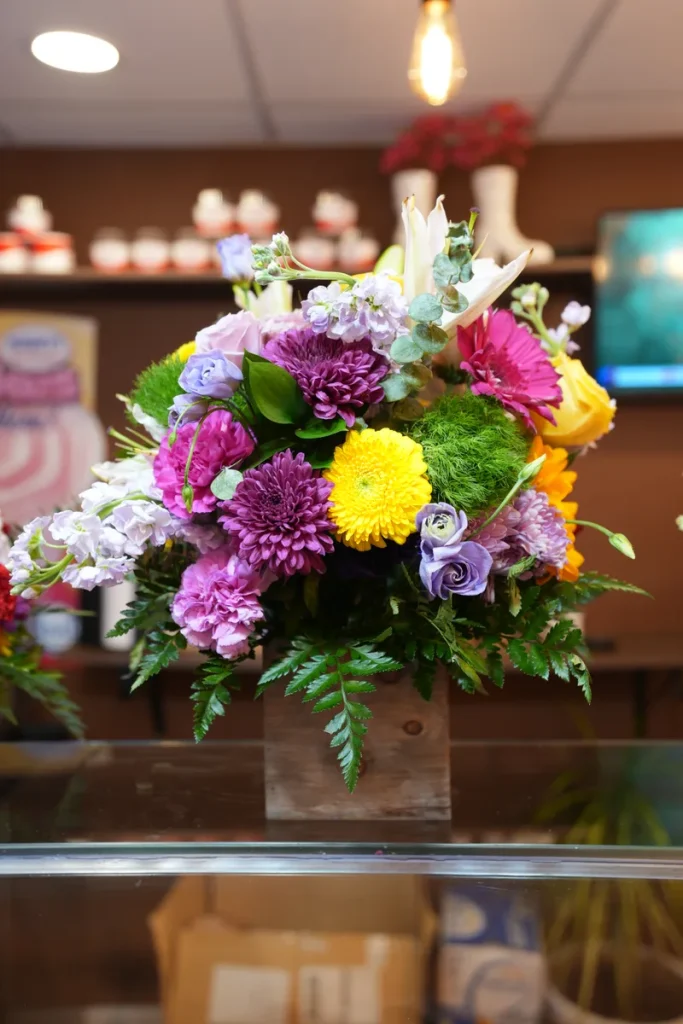
Tell us the occasion
Occasion, recipient, a colour direction, a size and anything to avoid is a complete brief, and none of it is a photograph.
Today’s flowers, today
A designer’s-choice order is built in our shop from what is best in the cooler that day.
Ask what came in
You can ask what a shop actually has this week before you commit to anything, and no order is attached to the answer.
Bring the photo anyway
A picture is a useful description of taste, and we would rather tell you which parts of it this month can carry than pretend all of it can.
The same money buys two different bouquets
Here is the part that sounds wrong until you follow the money. A same-day order is filled from standing inventory – the stems a shop already holds in its cooler, not stems ordered in for you. A designer’s-choice brief therefore spends your entire budget on flowers that came off the truck that morning and are in season right now. A photo-matched request in the wrong month does the opposite: it forces out-of-season imports, which cost multiples more per stem and arrive further from harvest. Same money, fewer flowers, and every one of them older when it reaches the door.
None of that is a florist being awkward. It is arithmetic. Your budget is a fixed number, and whatever share of it goes to scarcity and freight is a share that does not turn into stems. Ask for a look rather than a list and every dollar lands on the bench as flowers. The separate question of why today’s order can only touch what has already been bought – the wholesale hours behind that – belongs to what can and cannot be custom-made today rather than here.
What the designer knows at nine in the morning
The person building your arrangement opened the boxes today. They know which hydrangea heads came in tight and which came in blown, which roses are cracking open too fast to send out, which bucket is simply the best thing in the shop this week. You know none of that, and there is no mechanism by which you could: the photograph you are matching was shot in another month, in another shop, by someone whose delivery that morning has nothing to do with yours.
That asymmetry is the whole argument. The buyer picks from memory, the designer picks from the cooler. Told the occasion and the colour direction and then left alone, a designer lets the budget follow the quality – the stems that arrived strong get used generously, the ones that arrived tired stay in the bucket. Handed a photo as a specification, the same designer has to buy the stem in the picture whether or not it is the best thing on the bench that day. That is how a mass of fresh carnations, crowded the way they want to be crowded, ends up outperforming three imported stems bought on the same receipt.
The brief a florist can actually use
Designer’s choice does not mean saying nothing. It means saying the useful things instead of the visual ones. What a florist needs is not a picture, and a picture is a poor brief precisely because it answers a question nobody asked while leaving all five of these blank.
The occasion
Not the category, the actual event. “Her seventieth”, “he got the promotion” and “no reason, we just miss her” produce three different arrangements from identical budgets, because formality and shape change with each. Birthday and just-because sending are the two occasions where designer’s choice is most obviously the right default, for the simple reason that nobody at the other end is holding the result up against a photograph.
The recipient
Age, taste and the room it will stand in. Someone who gardens reads a loose, seasonal arrangement as generous; someone who does not may read the same arrangement as unfinished and want structure. A kitchen island takes height, a hospital tray does not. This is the line buyers skip most often and the one designers would keep if they could only have one.
A colour direction, not a colour match
“Warm – peach, cream, a bit of rust” is a direction. “This exact coral” is a match, and a match is the instruction most likely to be quietly overwritten, because the substitution standard the trade works to allows colour to give way under defined conditions. Those rules are worth reading before you specify anything tightly: what actually arrives when you order the photo sets them out mechanically. A direction survives contact with the cooler. A match usually does not.
A size
Say what you want spent and where the arrangement is going to sit. Those are the same fact approached from two directions, and both of them are yours to set – the one part of the design a designer will never overrule.
Anything to avoid
Allergies, a stem someone privately dislikes, lilies in a house with a cat, the flower that stood at a funeral last year. One clear “no” is worth more to a designer than a paragraph of yes, because it removes a whole aisle of the cooler without narrowing the rest. If you are unsure what a stem is or how it behaves once it is cut, the stem-by-stem guides are quicker than trying to describe it.
The part of this that costs you something
Worth being straight about the trade. The result cannot be pictured before it exists. You do not name the stems. You lose the small pleasure of recognising your own taste in a product photo. Weighed against flowers that were in a box this morning rather than on a plane last week, most senders find that cheap.
One situation makes it expensive: the recipient has already seen the picture. A screenshot forwarded to a group chat, a photograph of last year’s arrangement, a bouquet somebody is deliberately re-creating – the expectation has been fixed outside your control, and a designer’s choice has no way to meet it. Nothing has failed there. The approach has simply been pointed at a job it was never built to do.
When picking really is the right call
Some arrangements have to be specific. An anniversary piece repeating a wedding bouquet, a reception-desk arrangement in a company’s own two colours, a stem that carries family meaning and cannot be swapped for its nearest relative. Sharpening the same-day brief will not rescue any of those. Time will: ordered far enough ahead, the stems can be bought for you rather than found for you, at their proper price and at their proper age. That is what the custom side of the service is for, and the difference between the two routes is worth understanding before you choose one.
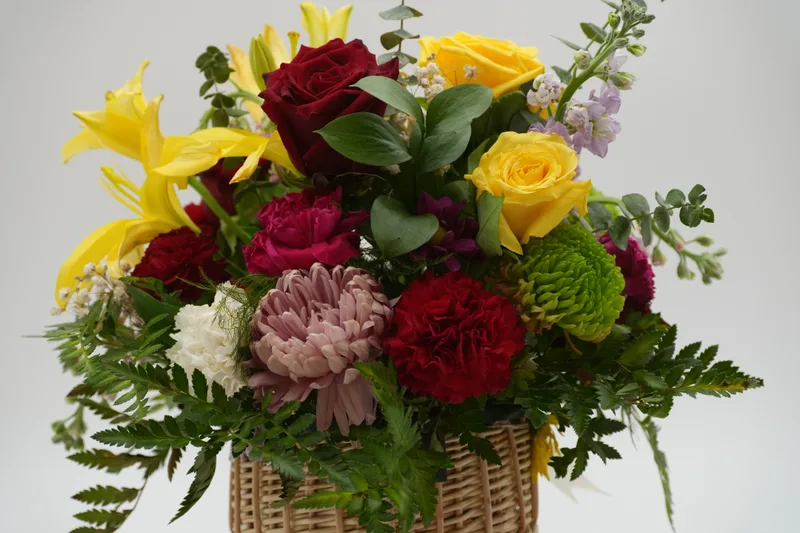
One message, repaired three times
Below is a single enquiry of a shape florists receive every day, rewritten in place until a shop can act on it. Read down. The version at the bottom is the one to copy.
As it arrived
“Hi – I’d like the one in the photo, the blue and white one with the peonies and the ranunculus. Same as the picture, please. Delivery today.”
Three sourcing problems are packed into that one sentence. Both named stems can be between crops in any given month – peonies notoriously so – and the blue in one of them does not exist without dye. Whatever part of the picture can be bought today gets bought at import prices, and the remainder is substituted under the substitution standard the trade works to. The money leaves and the picture still does not arrive. There is also nobody in the message: no occasion, no recipient, no size, nothing to avoid.
Repair one: put the person back in
“It’s for my mother’s seventieth, to her house in [town], Saturday. Blue and white like the photo – peonies and ranunculus.”
The occasion is now doing real work: a seventieth carries a formality and a scale, and a house is a different room from a lobby. Everything about the sourcing, though, is exactly where it was, because the stems are still named and the palette is still copied off a stranger’s photograph.
Repair two: find out whose blue it is
Before rewriting a colour, it is worth asking where that colour came from. Here it came from the picture – nobody had checked the woman it was for. She gardens, and what she likes is what her own borders do in late summer. So the photograph gets demoted from specification to evidence of taste, and the taste turns out to point somewhere else entirely.
“It’s for my mother’s seventieth, to her house in [town], Saturday. She gardens, so loose and seasonal rather than tight and round. Warm colours – peach, cream, soft orange – nothing hot pink.”
That is a direction rather than a match, and a direction survives contact with the cooler. Not one stem is named, so no part of it can be knocked out by a crop that came in short.
Repair three: hand over the last two decisions
Two things are still missing, and both belong to you rather than to the shop: how big, and what must not appear. Add them and there is nothing left to guess at – five constraints, not a single stem named, read once and built out of the strongest thing that came in that morning. Change the details in brackets and send it as it stands.
“It’s for my mother’s seventieth, to her house in [town], Saturday. She gardens, so loose and seasonal rather than tight and round. Warm colours – peach, cream, soft orange – nothing hot pink. Big enough for a dining table but low enough to talk over. No lilies, she has a cat. Spend [your budget]. Designer’s choice within that is fine, use whatever is best today.”
Roses at the door tonight
Call 8 hours ahead. Made in our shop and ready with 8 hours’ notice.