

Before you send lilies, find out whether there is a cat in the house
Lilies are toxic to cats, pollen and all. What to know before you send lilies, and what to send instead to a home with a cat.
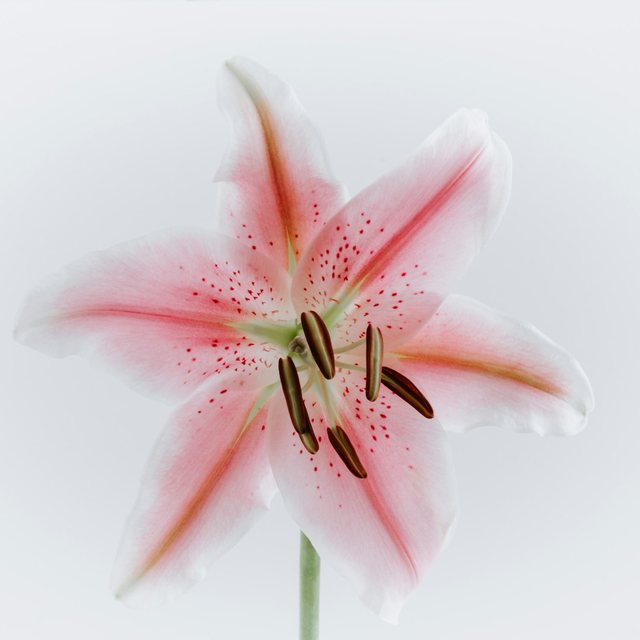
We Ask About Cats
Every lily order gets the same question from us, because the answer changes what we build.
Anthers Removed Before Delivery
The pollen sacs come out at the bench, so nothing arrives loaded and ready to stain a sleeve.
Timed To The Service
For a wake or funeral we work backwards from when the room opens, not from when the order came in.
Swap It, No Argument
Say the word and we rebuild the same arrangement around a different stem, and note the change so nobody thinks the order went wrong.
Lilies are what people reach for when someone has died, and they are also the stem most likely to create a second problem in the house that receives them. Both of those things are true at once, and almost nobody sending flowers is told the second one.
Why we ask about cats before we build a lily arrangement
True lilies — the Lilium genus, which covers Stargazers, Casa Blancas, tiger lilies and the Asiatic hybrids — and daylilies (Hemerocallis) cause acute kidney injury in cats. This is not the mild stomach upset that gets listed next to a dozen other houseplants. It is kidney failure, it can follow a very small exposure, and cats do not need to eat a flower to get it.
The whole plant is involved: petals, leaves, stem, pollen, and the water sitting in the vase. A cat that walks past an arrangement, picks up pollen on its coat and grooms it off has been exposed. A cat that drinks from the vase has been exposed. A cat that chews one leaf has been exposed. That is why a shelf out of reach is not a plan — cats reach shelves, and the pollen travels on its own.
There is no home remedy for this. If a cat has been anywhere near lilies, call a veterinarian right away and use the word lily, because treatment started early works far better than treatment started once the animal looks unwell. Waiting for symptoms is what turns these cases fatal.
Not everything called a lily is one
This is where the advice people repeat to each other falls apart. Someone will say their vet was relaxed about the lily on their windowsill, and they are usually right — because the thing on the windowsill is not a lily.
True lilies and daylilies
The kidney risk above. These are the ones in sympathy arrangements, and the ones to keep out of a cat household entirely.
Peace lilies and calla lilies
Neither is a Lilium. They contain calcium oxalate crystals, which cause a burning mouth, drooling and pawing at the face if chewed. Genuinely unpleasant, rarely dangerous, and a completely different problem from kidney failure. Do not let one reassure you about the other.
Lily of the valley
Also not a lily, and the one to take most seriously after true lilies. It contains compounds that act on heart rhythm, and it is a serious ingestion for dogs as well as cats. Dogs, incidentally, are far less vulnerable to true lilies than cats are — they tend to get stomach upset rather than kidney damage — which is exactly why the household question is about cats specifically.
Sending lilies to a home with a cat
Ask, rather than assume
One text message to whoever is closest to the family settles it. If you cannot ask without giving away a surprise, tell us and we will build the arrangement lily-free by default. Nobody has ever remarked on an arrangement for not containing lilies. The other conversation is far worse to have.
The funeral home is not the final destination
This is the case that catches thoughtful people out. Flowers sent to a chapel are frequently loaded into a car afterward and taken back to somebody’s house, which means an arrangement you sent to a building can end up on a kitchen table two days later. If you are ordering for a service, our funeral home delivery pages cover where each home wants flowers left, and the wider sympathy and funeral flowers guide covers what is customary to send at all — which for some families is not flowers.
What we build instead
A white and green sympathy arrangement does not need a lily to read as one. Roses, stock, snapdragons, chrysanthemums and carnations carry the same weight, and carnations in particular hold up for two weeks or more, which matters when flowers sit in a chapel for two days before anyone takes them home. Say the arrangement is going to a cat household and that is what arrives.
If the lilies are already there
Move them behind a closed door rather than up high, tip the vase water down the sink instead of leaving it standing, pick up any fallen pollen with a damp paper towel and throw it away, and wash your hands before you touch the cat. If there is any chance of contact at all, call the vet rather than watching and waiting.
The pollen stains, and water makes it permanent
Every open lily carries six anthers loaded with rust-colored pollen. On a tablecloth, a mourner’s jacket or a funeral home carpet it sets quickly, and the instinctive response — dabbing at it with a wet cloth — is the single worst thing you can do, because water drives the pigment into the fibers.
Take the anthers out as buds open
We pinch them out with a tissue before an arrangement leaves us, but lilies open in sequence over the following week, so each new flower brings a fresh set. Pull them with a folded tissue, never bare fingers.
On fabric, lift rather than rub
Keep it dry. Shake the loose grains off, then lift what remains with the sticky side of a piece of tape or a soft dry brush. Whatever survives that usually fades if the garment is left in direct sunlight for a few hours.
On skin, it is only cosmetic
Soap takes the color off hands easily enough. The scent is more stubborn than the stain.
Which lily we use, and why it matters in a small room
Lilies vary more than most stems, and the difference people actually notice is scent.
Oriental
Stargazer, Casa Blanca and their relatives: enormous blooms and a perfume that fills whatever room it is in. Right for a chapel with height and air. Overwhelming in a small apartment, and often the wrong call for a hospital room where fragrance is restricted.
Asiatic
Upward-facing, brighter, and with little to no scent. The one to ask for when the recipient is sensitive to fragrance or the room is small.
Longiflorum
The long white trumpet sold around Easter, and the traditional sympathy lily in most of the arrangements we send to services.
All of them ship mostly in bud, deliberately. The buds open in turn, so an arrangement keeps producing new flowers for a week or more, and someone expecting every bloom open on the doorstep occasionally thinks the delivery was short when it was doing exactly what it should. The lily care guide covers what a stem does once it is in the vase and the lily season page covers when each group is cut; the varieties themselves are below.
How the lily trade sorts them, past Oriental and Asiatic
Lilium is a big genus before anybody hybridises anything. Plants of the World Online records 119 accepted species, with a native range spanning the temperate Northern Hemisphere down to the northern Philippines. What reaches a florist bench is a much narrower set of bred groups.
LA and OT hybrids carry the Dutch volume
AIPH FloraCulture International puts LA hybrids at an estimated 60 per cent of Dutch cut lily volume and OT hybrids at about 30 per cent, with Orientals, Asiatics and longiflorums sharing what is left. That is the Dutch figure rather than a count of what lands on Long Island, but it is the crop those groups are being grown for. Named cultivars a buyer can actually run into include the pollen-free Liber Orientals — ‘Snow’, ‘Joy’, ‘Sky Master’ and ‘Edge’ — the OT hybrids ‘Table Dance’, ‘Conca d’Or’ and ‘Touchstone’, and the double Roselilies ‘Nadia’, ‘Dalinda’ and ‘Joella’.
Pollen-free is a bred trait rather than something done to a stem after cutting: a genetic model for the pollenless trait in Asiatic hybrid lily was published in Scientia Horticulturae, working from an F1 pollenless plant obtained by crossing the Asiatic cultivars ‘Montreux’ and ‘Geneva’. If the reason you are asking is stains, the anther side of it sits on the lily care page. If the reason is a cat, a pollen-free cultivar is still a lily.
Which way the flower faces is registered information
The Royal Horticultural Society is the International Cultivar Registration Authority for lilies and publishes the International Lily Register. A registered cultivar carries a division number and then a dual subdivision code: the first letter for flower habit — (a) up-facing, (b) out-facing, (c) down-facing — and the second for flower form — (a) trumpet, (b) bowl, (c) flat, (d) recurved. The RHS’s own worked example is 1(b/c) ‘Aloft’, an Asiatic with out-facing, flat-faced flowers. So when we say a lily will look at the room rather than at the ceiling or the carpet, that is a recorded property of the cultivar, not a judgement made at the bench.
Stargazer was bred to look up
The lily breeder Leslie Woodriff created ‘Stargazer’ in the 1970s, commonly dated 1974. The point of it was the direction of the bloom. Oriental lilies before it, the rubrums among them, faced downward, and consumers read that as wilted; Woodriff named the result for blooms facing the sky rather than the ground. Ohio State Extension credits Orientals as a group with huge blooms and intense colour, and describes the fragrance as one “some may find nauseating and cloying” — which is the honest version of why we ask about the room before we put one in an arrangement.
The other thing said about that name in florist copy — that a Stargazer stands for ambition, or prosperity, or aspiration — we could not trace to any source. The only sourced statement about the name is Woodriff’s reference to the sky. Take it as a flower that was bred to face you, and leave the rest of it alone.
The bud count was settled at the bulb
Cut lily stems run roughly 80 cm to 140 cm depending on cultivar. A 140 cm stem and an 80 cm stem are not the same purchase, and cultivar is what decides which one arrives. The number of flowers on that stem is settled earlier still. University of Maryland Extension grades lily bulbs by circumference in centimetres, measured horizontally at the middle height of the bulb, and smaller bulbs give weaker stems and fewer flowers — so bulb grade, not stem length alone, is what predicts how many buds you are getting.
Two faults are documented at the growing end. Oriental lilies are prone to a physiological disorder called upper leaf necrosis, which Maryland links to calcium deficiency and which distorts and kills the upper leaves; and lilies abort flower buds under stress from excessive heat or inconsistent watering. When a group is short we say so and offer the swap rather than quietly downgrading the stem — the same rule as the rest of our substitutions policy. What is running at any given point in the year is on the lily season page.
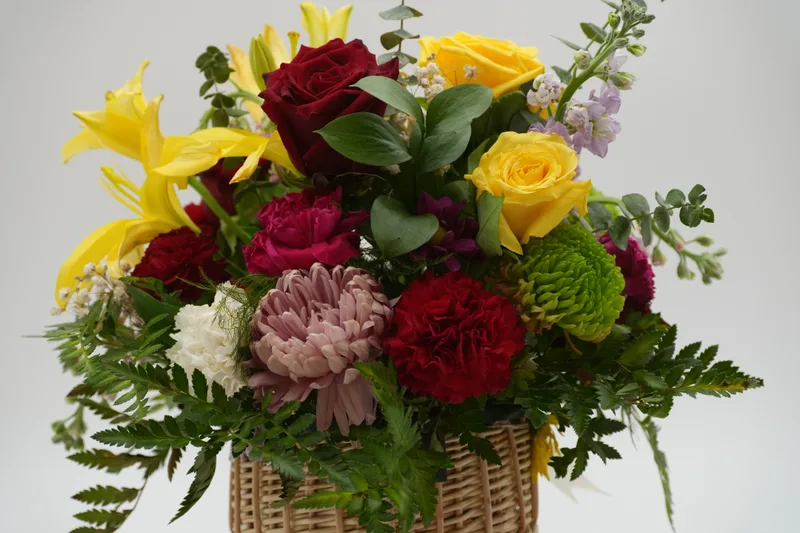
Roses at the door tonight
Call 8 hours ahead. Made in our shop and ready with 8 hours’ notice.
Common questions
Are lilies dangerous to dogs too?
Much less so. True lilies and daylilies generally cause vomiting or diarrhea in dogs rather than the kidney failure seen in cats. Lily of the valley is the exception and is a serious ingestion for a dog. If a dog has eaten any quantity of a flowering plant, it is still worth a call to the vet.
My cat brushed past the vase but seems fine. Do I wait and see?
No. A cat exposed to lilies looks normal at first, and the window where treatment works best is the window where the animal still looks well. Call a veterinarian and say the flowers were lilies.
Is a peace lily safe for cats, then?
Safer, not safe. A chewed peace lily causes mouth and throat irritation, drooling and distress, but it does not carry the kidney risk of a true lily. It is a vet visit, not an emergency of the same order.
Why did my lilies arrive closed?
Because that is how they last. Lilies cut in bud open over several days in the vase, which stretches the display rather than shortening it. Open blooms on delivery day means fewer days of flowers afterwards.
Can I still send lilies to a funeral if the family has a cat at home?
You can, and plenty of people do, but tell the funeral director the arrangement should stay at the chapel rather than travel home. If nobody is going to be there to say that, send something else. A lily-free sympathy arrangement looks no less appropriate.
How do I get lily pollen out of a shirt?
Dry first, always. Shake it off, lift the rest with sticky tape, then leave the fabric in sunlight. Reach for water or a stain pen at the start and you will fix the color in place instead of removing it.