

Late-summer sunflowers are days out of a Long Island field, not a week off a plane
Sunflowers on Long Island: when the local crop peaks and how cut sunflowers behave. Order a sunflower bouquet by phone on 631-612-6156.
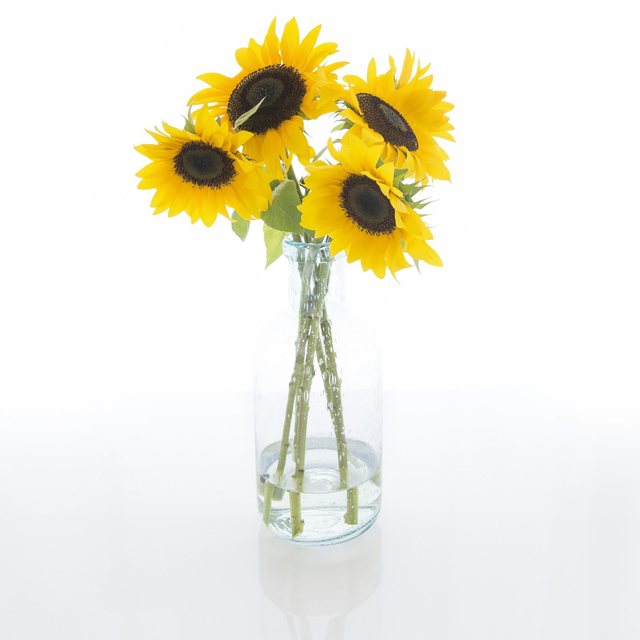
Ask what is local
In season we can tell you what was cut in a field out east this week and what has come in from a long way off.
Tell us which side
A cut sunflower faces one way and stays that way, so tell us where the bunch will be looked at from and we will aim it.
No vase? Say so
We can send them in a container with enough weight in the base to hold the heads up.
We will say no
If it is the wrong month for sunflowers, or the wrong room, we will tell you that before you order rather than after.
Every rose on this site arrived by air. Cut on a farm in South America, graded, boxed, flown north and trucked out to a florist — a week between the field and the vase is ordinary, and the whole trade is built to make that week invisible. A sunflower in late summer is a different object. It is cut standing in a field on Long Island and it is in a kitchen here days later, not a week later. This is the one stem we sell where “locally grown” describes the supply chain rather than the mood of the photograph, and the only one whose freshness argument is a question about the calendar rather than a question about us.
Two things follow from that, and neither applies to anything else on the site: when to send them is a real question with a real answer, and when they get there the bunch has to be pointed in a direction. In that order.
The local window is a supply fact, not a slogan
Fields out east crop heavily from late summer into early autumn, and inside that window the sunflowers coming through our shop were growing a short drive away rather than crossing the country in a box. Heads are larger, stems are firmer, and they cost less than the same flower does in February, when it has been shipped in from a long way off and the heads tend to be smaller and tighter. If someone asks us when to send sunflowers, the honest answer is now-ish rather than any other month.
Outside the window they are still available and still perfectly good. They are simply an imported flower like everything else on the shelf, and the local half of the story stops being true. That matters if the point of the gift is partly that it came from here — a September sunflower carries that and a February one does not. Why the local window falls where it does is a longer story, and it has its own page: sunflower season.
A cut sunflower head does not turn round
The sun-following belongs to the young plant. A sunflower tracks the sun while it is still in bud, and the tracking stops as the flower matures: the head sets facing the direction it finished in, which in a field is generally east, and there it stays. Cutting it changes nothing about that. It will not swivel toward your brightest window overnight. It points where it pointed when it was growing.
So a bunch of sunflowers has a front and a back, which is not true of a dozen roses. Roses go into a vase any way round and read the same from every angle. Sunflowers have to be aimed — you turn each stem in the water until the face is looking where you want it, and a stem that thick holds the rotation once it is set. The back of a head is a green rosette of bracts. It is not ugly, but it is not the thing anyone bought.
Against a wall, aim the whole bunch into the room. On a table people sit around, either accept that somebody is looking at the backs or stagger the stems so the heads face out at different angles and different heights instead of forming one flat wall of faces. And if the flowers are going to a desk, say so on the order and we will aim them at the chair before they leave.
Thick stems drink hard, and the vase has to allow for it
Almost all of a sunflower’s mass sits at the very top of a thick, rigid stem that will not drape or spread the way a rose or a tulip does. Put a dozen of those heads into a tall glass cylinder with a narrow base and the flowers decide where the arrangement ends up, usually on the counter in a puddle. Deep water solves both halves of that problem at once. Sunflowers drink hard — a thick stem moves a lot of water, and a vase that was full on Monday morning can be low by Monday night. Filled two-thirds of the way up, it keeps the stems supplied and puts real weight low down in the arrangement. A splash of water in the base of a tall vase does neither. Tell us what they are going into at the other end and we will cut the stems to suit it.
Containers that hold them
- Heavy stoneware, a ceramic crock, or a solid pitcher — anything you could not knock over with the back of your hand.
- A wide base rather than a wide mouth. The footprint is what matters, not the opening.
- A shorter vessel with the stems cut down to match, so the heads sit just above the rim instead of swaying a foot above it.
Containers that go over
- Tall narrow glass cylinders, which are the default vase in most homes and the worst possible choice for this stem.
- Anything on a pedestal or a footed stem.
- Decorative tins, plastic liners and lightweight enamel — they weigh nothing, so the flowers win.
The robust look is misleading
A sunflower reads as indestructible: a woody stem, a face the size of a spread hand, coarse leaves. It is not indestructible. It is also not short-lived, which is the part people get wrong in the other direction: AHDB’s National Cut Flower Centre testing put five field-grown cultivars at an average of 11 days of acceptable vase display, and that was measured after a five-day simulation of the grower, transport, depot and retail stages, before the vase test began. The reason to handle a sunflower carefully is not that it dies young.
Two things shorten them further. The leaves are large and soft, and any left below the waterline rot quickly and turn the water cloudy, which then blocks the stem. And the stems drain the vase faster than most people expect, so a dry vase for half a day shows up as a head bent sharply at the neck — the weight that makes them tip is also what makes water stress visible almost immediately. Strip the lower leaves, top up daily, and recut the stem ends every few days.
A day stored dry and the leaves do not come back
Postharvest guidance from UMass Amherst is unusually flat about this one: sunflowers have to be stored wet, and after as little as 24 hours held dry the leaves may wilt irreversibly — putting the stem back into water does not bring them back. The head can still be perfect while the foliage is finished. UMass puts that wet storage at 36 to 41 degrees Fahrenheit, and a sunflower can be held cold for roughly a week before it is marketed; the figures quoted for the stem run from 1 to 2 degrees C for up to seven days through to 2 to 5 degrees C for seven to ten.
The cutting stage is the other thing decided long before anyone sees the bunch. Growers are told to harvest when the ray florets are between half and fully expanded, and the working marker is petals standing perpendicular to the head. Cut tighter than that and then cold-stored, a sunflower may never open properly.
Two pieces of standard advice the sources disagree about
Sunflower handling is not a settled subject, and the arguments are between institutions rather than between an institution and somebody’s blog. The AHDB grower sheet advises against two treatments that get recommended for this flower constantly: recutting and plunging the stems into warm water, and standing them in water with a wetter, or surfactant, added. UMass takes the opposite position on the second. It reports that pretreating with a Triton surfactant significantly improves sunflower vase life, with around 30 per cent greater post-storage hydration, and that the gain is largest for flowers cold-stored three days or more, with Tween 20 doing the same job. UMass also warns that too much Triton — higher concentration, or longer treatment time — damages sunflower leaves. Both of those are grower-scale treatments rather than anything to be doing at a kitchen sink.
Ethylene is the second split. A peer-reviewed screening of ornamental Asteraceae exposed flowers to 1 to 3 microlitres per litre of ethylene for 20 hours and classified sunflower as ethylene-sensitive, recording petal abscission and reduced petal drawing resistance. The AHDB grower sheet reports the reverse, that Helianthus annuus is not sensitive to ethylene. We are not going to pretend that is resolved. Where two sources of that standard disagree, the honest answer is that they disagree.
The pollen is a documented allergen
Sunflowers carry little or no scent, which is why they get suggested for workplaces and for rooms where perfume is unwelcome. Scentless is not the same as inert. In a 2015 study of 354 pollen-allergic patients aged 16 to 50, 21 per cent had a positive skin prick test to sunflower pollen extract, and seven IgE-reactive proteins were identified in the pollen, three of them classed as major allergens. That is a result about people who already react to pollen, not a claim about everybody. But where the room matters — a bedside on a get-well order, a shared office — a pollen-less variety is a real thing to ask for rather than a fussy preference, and there is a named one in the next section.
Which sunflower: the names Cornell puts in front of New York growers
Cornell’s high tunnel guidance for New York cut-flower growers names three sunflowers in particular, and they are three different products rather than three shades of one. ‘Sunrich Orange’ it flags as daylength-sensitive. ‘Arbel’ is a pollen-less hybrid — the one to name if pollen is the problem, whether that problem is a tablecloth or the skin-prick figures above. ‘Moulin Rouge’ is a tall, late, branching type. Cornell also separates how long they hold by colour: orange types show longer longevity, while dark-coloured varieties may shed their petals inside seven days. If a dark sunflower is what you want, that is the trade being made.
“Compact” is a relative word here
The species can reach 5.0 m, which is why a cultivar of 1.0 to 1.5 m gets sold as compact. In AHDB trials, stem lengths ran from 45 cm for ‘Premium Lemon’ to 190 cm for ‘Vincent’s Choice’ under tunnel, with ‘Vincent’s Fresh’ at 160 cm, ‘Galilee Orange’ around 158 to 160 cm, ‘Tanya’ and ‘Tavor Lemon’ near 100 cm, and ‘Happy Face’ the shortest at about 90 cm. A single stem in the 2011 field trial weighed between 209 and 728 grams, with head diameters of 14 to 19 cm. So “a bunch of sunflowers” spans a four-fold range in stem length and better than a three-fold range in weight before anybody cuts one down to fit a vase. Those grams are the number behind the heavy-based vase advice further up this page, and the reason it is worth telling us what they are going into at the other end.
Single-stem or branching
Cut sunflowers divide into two commercial families. Single-stem types, sold as grandiflora, give one flower per plant and a concentrated, uniform harvest. Branching types, multiflora, give many smaller flowers over several weeks. That choice is made when the seed goes into the ground, and it sets whether a field yields one short run of matched heads or a longer trickle of smaller ones — which is why what is actually in the coolers this week is a better question to ask us than what a photograph shows.
Head size is set in the field, not chosen at the counter
Cultivar is not the only thing deciding how big a head arrives. Spacing does a great deal of it: Johnny’s grower library puts 6 by 6 inch spacing at smaller, bouquet-sized blooms and 12 inch spacing at dinner-plate flowers, while AHDB gives a wider commercial range of 15 to 60 cm between plants. Sowing method shows up in the finished stem as well — direct-drilling in the field is reported to give thicker stems and larger heads than transplanting at the same spacing. Two growers can put in the same cultivar and send out visibly different flowers, which is worth knowing before you decide a substitution was a downgrade.
Even the seed is not uniform. Germination across AHDB’s 2011 trial stocks ran from 38 to 100 per cent and averaged 74, enough of a weak point that the report called for breeders to improve sunflower seed quality. For a flower that looks this standardised, remarkably little about it is.
Loud, scentless and impossible to hide
Sunflowers are loud, informal and cheerful, and they carry little or no scent, which quietly makes them one of the easier stems to send into a workplace or a fragrance-sensitive room. They also set the scale of any arrangement they appear in — you cannot add one to a delicate mixed bunch and expect it to sit politely in the background.
Where they land well
Birthdays, new homes, thank-yous and the sort of pick-me-up that does not want to be subtle. They are one of the stems we suggest most often on our birthday flowers page, particularly for someone who would find a dozen red roses embarrassing. If you want them mixed with other stems rather than massed on their own, our arrangements show how they work as the anchor flower with lighter material around them.
Where to think twice
Formal sympathy work, where the tone is usually restrained — though for a celebration of life, or for someone who grew them, they can be exactly right. Ask us and we will talk it through. Bedsides are the other awkward one: the lack of scent is in their favour, but a full-head bunch needs more surface and more vase than a hospital table usually offers, so ask for a short-cut version in a weighted container and check the ward’s own rules first. Also worth checking: some varieties shed pollen that marks tablecloths and shirt cuffs, and pollenless varieties exist if that matters where the flowers are going. What sunflowers have come to stand for is a bigger subject than this page, and a separate guide to their meaning is planned.
Roses at the door tonight
Call 8 hours ahead. Made in our shop and ready with 8 hours’ notice.
Common questions
Do sunflowers keep following the sun once they are cut?
No. The tracking is something the plant does while the flower is still in bud. By the time the head is open it has settled facing the way it grew, and cutting fixes it there. Aim the stems yourself when you put them in the vase, because they will not correct themselves afterwards.
When are Long Island sunflowers actually in season?
Late summer into early autumn is the local window, and it is when they are at their best and their cheapest. Outside it they are shipped in, which usually means smaller, tighter heads for more money.
What vase should I use for sunflowers?
A heavy one with a wide base — stoneware, a ceramic crock or a solid pitcher. Fill it about two-thirds full, which both feeds a thirsty stem and weights the base. The tall narrow glass cylinder most households own is the one container to avoid.
How long do sunflowers last once cut?
Longer than the reputation suggests. AHDB’s testing averaged 11 days of acceptable vase display across five field-grown cultivars, after a five-day simulation of the supply chain. How much you get depends almost entirely on water: deep water, stripped lower leaves, daily topping up and a fresh cut on the stem ends every few days will get you the top of their range rather than the bottom.
Why has the head bent over at the neck?
The stem has stopped moving enough water, usually because the vase ran low or the cut end has sealed or clogged. Recut an inch off the stem and put it straight into deep fresh water. Because the head is heavy, this failure shows up on sunflowers hours before you would notice it on a lighter flower.
Can I send sunflowers to an office or a desk?
Yes, and they suit it, but tell us that is where they are going. We will cut them short, weight the container and turn the faces toward where the person sits. A wrapped bunch handed over at a reception desk with no vase behind it ends up propped in whatever is available, which is how they end up on the floor.