

Caring for cut lilies: the buds open in sequence, and the fridge is the wrong idea
Cut lilies arrive closed and open bud by bud. Vase life numbers, why cold storage backfires, what anthers do, and what to check at the door.
Call 631-612-6156 with the town, the date and what the flowers are for, or order red roses by phone. On the phone, anything specific about the lilies — anthers out, buds tight, a different stem entirely — gets said out loud rather than typed into a box.
Two questions come up more than any others once lilies are in the house: why did they arrive shut, and why are the leaves going yellow while the flowers still look fine. Both have answers.
A lily is cut closed on purpose
Lilies are cut when the first, lower-most bud shows full colour but has not yet opened. The remaining buds on the stem open in sequence afterwards, which is why lilies are deliberately sold closed rather than open.
A lily stem typically carries three to five, or six to eight buds, depending on bulb size and variety, so a single stem delivers a succession of flowers rather than one bloom. Freshly harvested cut lilies have a vase life of 9 to 14 days, depending on cultivar and environment.
The one piece of standard advice that runs the other way
UMass Extension recommends that cut lilies not be cold stored: cold storage of four or more days induces rapid development of postharvest leaf yellowing. That is the opposite of the standard advice for most cut flowers.
Cold at one stage is not cold at another. Growers are told to place cut stems in water in a cooler at 35 to 41 degrees F within an hour of harvesting, to avoid shocking the flowers. One instruction covers the hour after cutting. The other covers days of storage, and it says no.
The line repeated across the internet — that lilies last up to 14 days refrigerated, so refrigerate them overnight — is a claim we could not trace to a source, and it runs against what UMass states. Cut lily stems should be transported in water rather than dry-packed, to prolong vase life.
Three further things are worth naming for what they are not. We found no lily-specific guidance from a credible source on vase water depth, temperature or pH; the research vase solutions cite 3% sucrose plus 200 ppm 8-HQC, which is a laboratory formulation rather than a kitchen recipe. The warning that lily sap harms other flowers sharing a vase could not be traced to any lily source, and appears to be carried across from daffodils. Nor could the idea that lily stems keep elongating after cutting.
Watch the leaves, not the petals
Leaf yellowing — not petal wilt — is a defining postharvest fault of cut lilies, and Cornell’s Flower Bulb Research Program lists it alongside bud necrosis as one of the major postharvest problems of the crop.
The ethylene question is genuinely unsettled
Whether cut lilies as a class are ethylene-sensitive is contested. A study of the Asiatic cultivars ‘Elite’ and ‘Prato’ found very low ethylene production with no climacteric peak after detachment, and concluded that although lilies are considered ethylene-insensitive, ethylene “may not play a primary role” in their senescence. In that work, flower longevity fell by only one to two days after detachment and cold storage respectively. Other extension guidance treats hybrid lilies as sensitive. Both positions are in print.
Questions that come up once the lilies are in the house
Why are the upper buds still shut after several days?
Because that is the design. Lilies are cut when the lower-most bud shows full colour but has not yet opened, and the remaining buds on the stem open in sequence afterwards. A stem carrying three to five, or six to eight buds is working through them.
The leaves are yellowing but the flowers still look good. What happened?
Leaf yellowing rather than petal wilt is a defining postharvest fault of cut lilies, and Cornell lists it alongside bud necrosis among the crop’s major postharvest problems. Cold storage of four or more days induces rapid development of it, which is one reason UMass advises against cold storing lilies at all.
Should the vase go in the fridge overnight?
Not on the strength of anything we could verify. UMass Extension’s recommendation is that cut lilies not be cold stored, because four or more days of cold induces rapid leaf yellowing. The overnight-refrigeration tip for lilies is widely repeated and we could not trace a source behind it.
The florist pulled the orange parts out before delivery. Was that necessary?
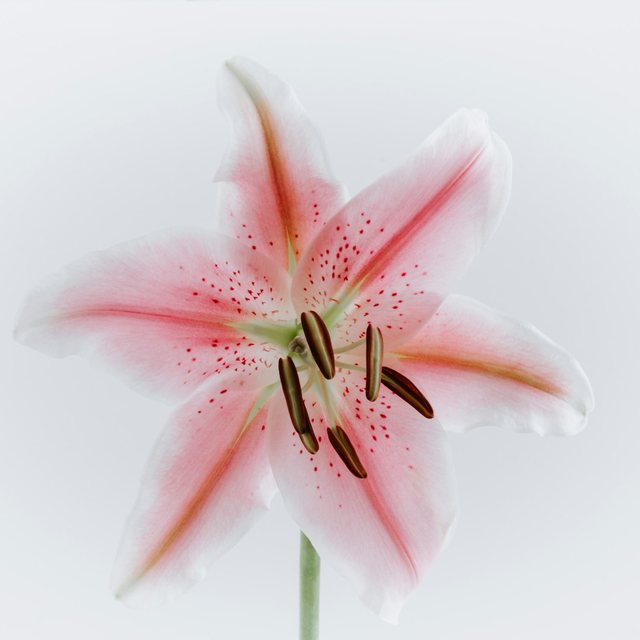
Those are the anthers, and growers are advised to remove them on open blooms to prevent pollen from soiling the flower or any surface it falls on. It is a staining measure. The frequently quoted figure that emasculated lilies live about 10% longer could not be traced to a paper we were able to read.
How many days should a lily stem give?
Nine to fourteen days from fresh harvest, depending on cultivar and environment. The extension-stated step for the final customer is re-cutting the stems and placing them in a solution containing a floral preservative.
The anthers, and the water they fall into
Growers are advised to remove the anthers on open lily blooms to prevent pollen from soiling the flower or any surface it falls on. That is the verified reason, and it is the whole of it. Pollen-free and double-flowered lily cultivars solve the same staining problem at the breeding end instead of at the bench.
What none of that does is make the flower safe in a house with a cat. The ASPCA listing covers Lilium as a genus and all parts of the plant, so a pollen-free cultivar is still a lily.
All parts of a Lilium lily are toxic to cats: any amount of leaf, stem, flower, pollen, rhizome, or vase water. There are documented cases where exposure to pollen alone has caused acute kidney injury in cats, and if treatment is started more than 18 hours post-exposure, the renal damage may be irreversible. That is what makes topping up or tipping out the water a care instruction rather than a chore. There is more on that decision on the lilies overview, and the mechanics of swapping a stem out of an arrangement are set out on the substitutions page.

Signs to look for when the lilies are handed over
Five checks, in the order they are easiest to make at the door.
1. The lowest bud. It should be showing full colour and not yet open, or only just opening. That is the stage lilies are cut at.
2. The bud count. Count what is on the stem, not what is open: three to five, or six to eight, depending on bulb size and variety. A single stem delivers a succession of flowers rather than one bloom.
3. The foliage colour. Look down the stem before you look at the flowers. Leaf yellowing, rather than petal wilt, is a defining postharvest fault of cut lilies.
4. Wet or dry arrival. Cut lily stems should be transported in water rather than dry-packed, to prolong vase life.
5. The anthers. On any bloom that has opened, check whether the anthers are still there. Removing them is what keeps pollen off the flower and off whatever it would otherwise fall on.
If any of the five are off, say so on the phone the day the flowers arrive rather than at the end of the week. The rest of the stem guides are set out across the flower guides.
Roses at the door tonight
Call 8 hours ahead. Made in our shop and ready with 8 hours’ notice.