

Lilies and Season: A Year-Round Cut Stem and a June-July Wild Bloom in New York
Lilies are a year-round cut flower. Greenhouse crop cycles, Easter lily forcing dates and the June and July wild lily bloom recorded in New York.
Call 631-612-6156 with the town, the date and what the flowers are for, and we will make it in our Port Jefferson shop. Every order is confirmed by phone on 631-612-6156 before anything is cut.
Ask when lilies are in season and there are two separate answers. The cut stem is described in the floriculture trade press as a genuinely year-round crop rather than a seasonal one. The wild lily vouchered for Nassau and Suffolk blooms in June and July. This page keeps the two apart.
The greenhouse and field calendar behind the cut lily
Greenhouse crop cycles run 9 to 11 weeks for LA hybrids, 12 to 14 weeks for OT hybrids and 14 to 16 weeks for Orientals. Dutch LA growers achieve up to four crop cycles a year, and the trade press gives that as what makes lilies a genuinely year-round cut flower rather than a seasonal one. Counter-seasonal bulb production in Chile and New Zealand supplies Dutch lily growers with fresh bulbs year-round.
Days to flower differ sharply by lily type and set the greenhouse calendar. University of Maryland Extension gives Asiatic 85 to 95 days at a 50 to 55 degree F night temperature; LA hybrids 70 to 100 days at 50 to 55 F; Oriental hybrids 100 to 125 days at 58 to 62 F; OT hybrids 90 to 105 days at 58 to 62 F.
Field production has its own window. In Mid-Atlantic field production, precooled LA hybrid bulbs can be planted from March through June; high tunnels let growers start about six weeks earlier, in mid-February; and LA hybrids can be planted up until early August to obtain a fall harvest.
The scale behind that supply is Dutch. The Netherlands grows cut lilies on about 190 hectares, producing approximately 350 million stems a year. Dutch lily bulb farming involves roughly 80 to 100 farmers producing about 1.5 billion bulbs across 4,500 to 5,000 hectares, worth around 225 million euros at farm gate, with yields of 500,000 to 600,000 bulbs per hectare. The lily is described in floriculture trade press as the world’s fourth most-traded cut flower.
The Easter lily runs on a dated schedule
Easter lily bulbs take two to three years to develop before greenhouse shipment. Forcing then begins twenty-three weeks prior to Easter and includes about six weeks of cooling at 40 to 45 degrees F, supplying roughly 1,000 vernalization hours.
US Easter lily bulb growers have contracted from approximately 1,200 at the height of production to about ten producers today, working roughly 600 acres in the Smith River Valley of northwestern California and southwestern Oregon.
Questions we get about lily timing
When is the wild lily season recorded for Nassau and Suffolk?
June and July. Lilium canadense, the Canada lily, is vouchered in both Nassau and Suffolk counties and blooms in June and July, reaching 3 to 8 feet tall. That is the true wild lily season in the New York region, months narrower than the year-round cut flower supply.
Why does a florist say lilies are available all year?
Because the cut stems come off greenhouse crop cycles of 9 to 11 weeks for LA hybrids, 12 to 14 weeks for OT hybrids and 14 to 16 weeks for Orientals, with Dutch LA growers achieving up to four crop cycles a year, and because counter-seasonal bulb production in Chile and New Zealand supplies Dutch growers with fresh bulbs year-round.
How far ahead does an Easter lily crop start?
Forcing begins twenty-three weeks prior to Easter, and that is only the greenhouse stage. The bulb itself takes two to three years to develop before greenhouse shipment, and about six weeks of the forcing schedule is cooling at 40 to 45 degrees F to supply roughly 1,000 vernalization hours.
Are cut lilies grown commercially on Long Island?
We could not trace any evidence of commercial cut-lily field production on Nassau or Suffolk farms, so we will not claim it. The Long Island lily connections we could verify are Cornell’s Long Island Horticultural Research and Extension Center as a beetle biocontrol release site, and native Lilium records vouchered in both counties.
Where has the lily leaf beetle been recorded in New York?
A 2015 survey documented the lily leaf beetle in 30 New York counties, with 73 percent of those counties reporting high damage, and 58 percent of those surveyed saying lily sales were down and consumers had stopped growing lilies in their areas.
The wild lily season recorded for New York
Six Lilium taxa are recorded in New York State: Lilium canadense (native, S5), the hybrid L. canadense x L. michiganense (native, SNA), L. lancifolium (not native, SNA), L. michiganense (native, S1), L. philadelphicum (native, S4) and L. superbum (native, S4).
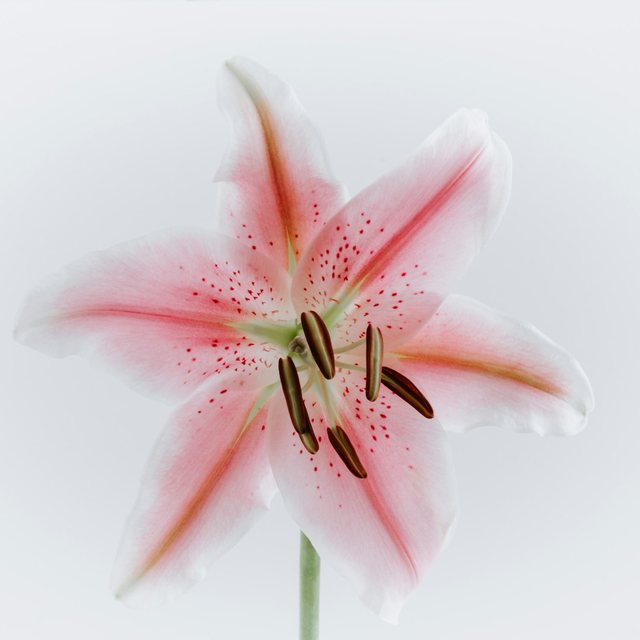
Lilium canadense is vouchered in both Nassau and Suffolk counties, is ranked S5 (demonstrably secure) in New York, and grows in alluvial thickets, floodplain forests and wet thickets. Its flowers are yellow on the outside and reddish orange with dark spots inside.
Wood lily, Lilium philadelphicum, is vouchered in Suffolk County among others, is ranked S4 in New York with a Coefficient of Conservatism of 8, and grows in forests, woodland edges and utility rights-of-way in dry thin or sandy soils.
The lily leaf beetle in New York
The lily leaf beetle, Lilioceris lilii, reached North America near Montreal in 1942, was first sighted in the Boston area in 1992, and was first found in New York State in late May 2001 at Mooers and Plattsburgh. Some sources give 2004 as the first New York confirmation; the 2001 Cornell report is the primary account and is the date used here.
A 2015 survey documented the beetle in 30 New York counties, with 73 percent of those counties reporting high damage, and 58 percent of those surveyed saying lily sales were down and consumers had stopped growing lilies in their areas. Without intervention the beetle’s larvae can defoliate an entire lily plant.
Three parasitoid wasp species – Tetrastichus setifer, Lemophagus errabundus and Diaparsis jucunda – were released against it in Maine, New Hampshire, Vermont, Massachusetts, Rhode Island, Connecticut and New York, and are now established and dispersing through New England and New York. Release sites included Cornell’s Long Island Horticultural Research and Extension Center, alongside Cooperative Extension sites in Putnam and Albany counties, under a three-year $60,000 grant awarded in 2016.
What a local supply chain is stated to buy you
University of Maryland Extension names one commercial advantage for a local lily supply chain: local growers can harvest stems with one flower open and hold them in water, delivering a fresher product than boxed out-of-state stems.
We make every bouquet in our Port Jefferson shop, so the stems are whatever came in strongest to us that week. If a particular lily type is not in that florist’s cooler on your date, we will say so on the confirmation call – see how substitutions are handled. For what is moving through local coolers now, see what’s in season now, and for the rest of the lily material start at the lilies guide.
Verification
Facts on this page were checked on 2026-08-19 against University of Maryland Extension, the Cornell Chronicle, the New York Flora Atlas, University of Illinois Extension, the Lady Bird Johnson Wildflower Center, the University of Rhode Island Biocontrol Lab and AIPH FloraCulture International.
| Fact as stated on this page | Source | Date checked |
|---|---|---|
| Crop cycles 9-11 weeks LA, 12-14 OT, 14-16 Oriental; up to four Dutch LA cycles a year | AIPH FloraCulture International, “Lush lilies in the limelight” | 2026-08-19 |
| Counter-seasonal bulb production in Chile and New Zealand supplies Dutch growers year-round | AIPH FloraCulture International | 2026-08-19 |
| 190 hectares of Dutch cut lilies, about 350 million stems a year; fourth most-traded cut flower | AIPH FloraCulture International | 2026-08-19 |
| 80-100 Dutch bulb farmers, about 1.5 billion bulbs, 4,500-5,000 hectares, about 225 million euros, 500,000-600,000 bulbs per hectare | AIPH FloraCulture International | 2026-08-19 |
| Days to flower: Asiatic 85-95, LA 70-100, Oriental 100-125, OT 90-105, with night temperatures | University of Maryland Extension, Production of Hybrid Lilies for Cut Flowers | 2026-08-19 |
| Field planting March-June, mid-February under high tunnels, early August for fall harvest | University of Maryland Extension | 2026-08-19 |
| Easter lily bulbs take two to three years; forcing begins 23 weeks before Easter, about six weeks cooling at 40-45 F, roughly 1,000 vernalization hours | University of Illinois Extension, “Easter lilies: war, global production, and the Midwest landscape” | 2026-08-19 |
| About 1,200 US Easter lily bulb growers down to about ten, roughly 600 acres, Smith River Valley | University of Illinois Extension | 2026-08-19 |
| Six Lilium taxa in New York; L. canadense vouchered in Nassau and Suffolk, ranked S5 | New York Flora Atlas, Lilium genus and Lilium canadense pages | 2026-08-19 |
| L. canadense blooms June-July, 3-8 feet tall, yellow outside, reddish orange with dark spots inside | Lady Bird Johnson Wildflower Center Native Plant Database | 2026-08-19 |
| Wood lily vouchered in Suffolk County, ranked S4, Coefficient of Conservatism 8 | New York Flora Atlas, Lilium philadelphicum | 2026-08-19 |
| Lily leaf beetle: Montreal 1942, Boston 1992, New York late May 2001 at Mooers and Plattsburgh | Cornell Chronicle, 2001 | 2026-08-19 |
| 2015 survey: 30 New York counties, 73 percent high damage, 58 percent reporting lily sales down | Cornell Chronicle, 2017 | 2026-08-19 |
| Wasp releases at Cornell’s Long Island Horticultural Research and Extension Center under a three-year $60,000 grant awarded 2016 | Cornell Chronicle, 2017 | 2026-08-19 |
| Three parasitoid wasp species established across seven northeastern states; larvae can defoliate a whole plant | University of Rhode Island Biocontrol Lab | 2026-08-19 |
| Local harvest with one flower open, held in water, as the stated advantage over boxed out-of-state stems | University of Maryland Extension | 2026-08-19 |
| Commercial cut-lily field production on Long Island – no evidence found; not claimed | No traceable source found | 2026-08-19 |
Roses at the door tonight
Call 8 hours ahead. Made in our shop and ready with 8 hours’ notice.