

Alstroemeria vase life: 12 to 13 days measured, not the two-to-three-times-a-rose the copy claims
Alstroemeria vase life is 12 to 13 days in a measured trial, not two to three times a rose. The numbers, the varieties and the colour range.
Call 631-612-6156 with the town, the date and what the flowers are for, or order red roses by phone. Orders route to an independent florist on Long Island and are confirmed with you by phone before anyone starts building.
The number the whole commercial argument rests on
A 2025 controlled trial published in Heliyon held untreated alstroemeria of the cultivar ‘Amatista’ in plain distilled water at 22 ± 1 °C and 70% relative humidity, and recorded a vase life of 12 to 13 days. One cultivar, one trial, no preservative in the water and no help from a cool room. That makes it a floor figure rather than a showcase, which is exactly why it is the number worth quoting.
Set it against the same kind of source for the stem it gets compared to. UC Davis’s postharvest fact sheet states that properly handled commercial roses will easily last ten days in the vase. So the advantage over roses is real, and it is measured in days — two or three of them, on those two figures. The line that alstroemeria lasts two to three times longer than a rose does not survive contact with either number, and it could not be traced to anyone who measured anything.
Two higher figures circulate, and both come from the people selling the plant. US Plant Patent 11,688, for the cut-flower variety ‘Stalsimo’, claims a cut-flower vase life of about 16 to 18 days — the patent’s own claim for its own variety. The 21 days quoted for the Charmelia type is the breeder’s marketing claim, with no independent trial found behind it. Neither is dishonest; neither is a measurement anyone else repeated.
That trial stopped the clock on the leaves, not the flowers
How the 12-to-13-day figure was earned matters as much as the figure. The trial defined the end of vase life as the point where either 50% of the leaves had turned yellow or 50% of the florets had dropped. Leaf failure was scored on equal footing with flower failure, which is an unusual grading rule. The published number is therefore the day the stem stops looking good, foliage included — not the day the last flower dies.
The trade treats the foliage as the problem too. Ball’s grower cultural notes describe placing alstroemeria into a gibberellin solution immediately after harvest and grading, specifically to stop the leaves yellowing, and describe it as routine practice — so a stem arriving at a florist may already have been hormone-treated at the farm. UC Davis records the same effect from a pulse treatment with a preservative containing growth regulators, gibberellins or cytokinins.
One type distinction follows straight from this. Butterfly-type alstroemeria show markedly fewer leaf-yellowing problems than other types. Given how the count is scored, that is the one type distinction with a direct consequence for how long the stems look worth keeping.
One stem is several flowers, and that is where the price argument lives
An alstroemeria head is a terminal umbel of one to three whorls, each whorl carrying two to eight flowers, and the whorls open in succession — the next whorl opens only after the previous one has withered. Individual flowers stay open 8 to 10 days. The stem is a sequence, not a bloom.
How many flowers that adds up to depends on who you ask. UC Davis puts the minimum acceptable number of florets per stem at 7 to 10. Ball’s grower notes say a stem produces 3 to 7 flowers, and that first-quality grade means four or more. Those two figures do not reconcile, and the pack behind this page does not carry anything that settles them. What they agree on is that one alstroemeria stem is several blooms.
That is what makes the wholesale comparison awkward for roses. On the USDA Boston terminal ornamentals report of 18 February 2025, alstroemeria was quoted at 8.50 per bunch of ten — about 85 cents a stem — while hybrid tea roses from the Netherlands ran 1.75 to 1.85 a stem for assorted colours and 2.00 to 2.35 for red. A red rose stem cost roughly 2.4 times an alstroemeria stem, and the alstroemeria stem carries several flowers. That is Northeast wholesale market data rather than a retail price, and it is not ours: our own prices are on each product page.
The bunch of ten is not a rounding either. Alstroemeria is traded bunched in tens, sleeved, and packed in horizontal boxes, and USDA quotes it bunched 10s accordingly. A bunch of alstroemeria is a defined trade unit of ten stems.
What takes those days back off
Alstroemeria is ethylene sensitive, and the damage shows as petal drop rather than wilting — flowers on the table while the stem still looks sound. Drop is delayed by pretreatment with 1-MCP or STS applied at the grower or the importer. UC Davis records that the treatment exists and works; nothing here verifies whether any particular supply chain into the New York metro area uses it.
Storage is the other limit, and it is short. UC Davis puts alstroemeria at 0–1 °C and states it can readily be held only up to one week at 1 °C. On the same series of fact sheets, carnations hold 2 to 4 weeks open and 4 to 5 weeks bud-cut. Alstroemeria is a fresh-turnover flower, not a stockpiling flower, which makes it a stem worth ordering close to the date you want it rather than far ahead of one.
There is also a visible effect particular to this stem. Alstroemeria flower pedicels are affected by gravity and will bend upwards if temperature control during storage or transport is poor. The stem visibly reshapes itself after cutting.
UC Davis’s buying rule is short enough to repeat. At least one flower per stem should already be open at the time of purchase, and stems should be bought by cultivar name; for local markets, harvest is delayed until the first three flowers have opened. Buying by name is exactly the instruction that matters when a named variety cannot be got, and what happens in that case is worth reading before you specify one.
Varieties: about 78 species, three trade types, a handful of names that behave differently
The genus contains about 78 species. Chromosomes have been counted for 29 of them, 2n = 16 being the recurring count, and the genus splits into an early-branching Chilean group and a derived Brazilian group. Missouri Botanical Garden’s older figure of about 50 species is superseded.
The commercial trade divides alstroemeria into three type-groups — orchid types, butterfly types and aurantiaca types — while noting that most varieties sold today are complex hybrids across those groups. Only one of the three carries a recorded consequence for the vase, and it is the butterfly types with their reduced leaf yellowing.
Below the type level, named production varieties differ in ways growers act on. ‘Modena’, ‘Glacier’, ‘Stratus’ and ‘Hot Pepper’ flower in autumn without soil cooling. ‘Fuji’, ‘Isola’ and ‘Tampa’ suffer poor flower induction after a hot summer soil. ‘Tampa’ and ‘California’ hold quality for five to six years of cropping. Those are production traits, not promises about the stem in your hand.
One name carries a handling exception worth knowing. Alstroemeria stems are normally pulled out of the ground rather than cut; UC Davis names young plants of the cultivar ‘Regina’ as the case where pulling would damage the underground parts, so the stem is cut and the remainder removed later.
Colours: a real range, and it stops short of blue
The wild species carry the colour range on their own, before any breeding: yellow in A. aurea, pink in A. pelegrina, orange in A. ligtu ssp. ligtu, white in A. pulchra, violet in A. violacea. No species in the reviewed botanical and pigment literature is blue.
The pigment work says where the range ends. Cyanidin 3-rutinoside occurs in every coloured alstroemeria flower, while delphinidin 3-rutinoside — the bluer pigment — is restricted to the pink and purple cultivars and to A. violacea. Lavender and purple are reachable; blue is not. Some of the colour also comes from 6-hydroxyanthocyanidins, pigments described as found rarely in nature, and the orange-red alstroemeria cultivars were the first plants in which 6-hydroxypelargonidin glycosides were ever reported.
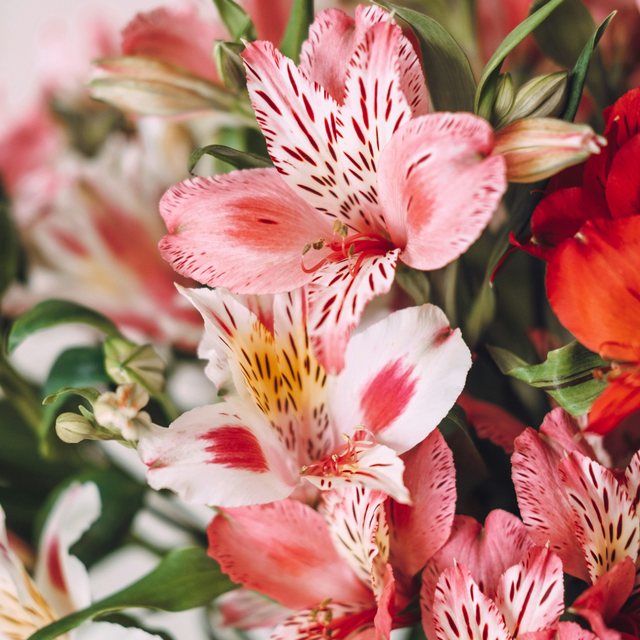
The dark streaks are not decoration. An alstroemeria flower has six free petaloid tepals in two whorls, the inner ones shorter, patterned, and narrowed at the base into a nectar-bearing channel; the streaks on the two upper inner tepals mark the nectar ducts, so the pattern and the nectary are the same structure. In a field experiment on A. aurea at Valle del Challhuaco in Nahuel Huapi National Park, Argentina, masking the guides significantly reduced pollinator visit frequency, pollen grains deposited on stigmas and nectar removal — and about 90% of all floral visits at that site were made by two bumblebee species. The streaks are signage.
One consequence lands at the ordering end. Across four USDA Boston terminal ornamentals reports, alstroemeria is quoted only as ASSORTED COLORS, never by individual colour, while roses, carnations, hydrangea and calla on the same reports are quoted red, pink, white and blue separately. At Northeast wholesale it moves as a mixed bunch. If a colour matters to you, say the colour when we call rather than assuming the bunch arrived sorted.
Questions worth settling before you order
How long does alstroemeria actually last in a vase?
Twelve to thirteen days is the measured figure for untreated ‘Amatista’ in plain distilled water at 22 °C in a 2025 controlled trial. A US plant patent claims about 16 to 18 days for its own variety, ‘Stalsimo’. Both are single-variety numbers, so twelve to thirteen days is the honest expectation to work from.
Does it really last two to three times longer than a rose?
No. UC Davis puts properly handled commercial roses at easily ten days in the vase, and the measured alstroemeria control was twelve to thirteen. The advantage is genuine and it is a few days, not a multiple. Nothing traceable supports the larger version of the claim.
Why do the leaves yellow before the flowers are finished?
The 2025 trial scored 50% leaf yellowing as the end of vase life, on equal footing with 50% floret drop, so it is a recognised failure mode for this flower rather than a sign something went wrong in your vase. Growers pulse stems in gibberellin after harvest to delay it, and butterfly-type varieties show markedly fewer leaf-yellowing problems.
Is alstroemeria safe around cats and dogs?
The ASPCA lists Peruvian lily as non-toxic to dogs, cats and horses, with no clinical signs listed. Pet Poison Helpline differs, listing irritant glycoside phytochemicals causing mild gastrointestinal distress such as vomiting and drooling, while stating explicitly that these plants do not cause kidney damage in cats — the injury true lilies cause. Both bodies agree it is not a kidney threat.
Can handling alstroemeria cause a skin reaction?
UC Davis’s fact sheet notes plainly that some humans get allergic dermatitis from this species. The allergen is tulipalin A, stored in the plant as tuliposide A, the same compound behind tulip fingers in bulb workers, and it is released primarily from wounded areas — the cut stems rather than the intact flowers. DermNet’s management advice for the allergy is to wear nitrile gloves.
Not a lily, and the reference works do not agree on what it is
Alstroemeria is not a lily, and the standard references disagree about the family. Missouri Botanical Garden’s Plant Finder gives the currently accepted family, Alstroemeriaceae. UC Davis’s fact sheet places it in Amaryllidaceae. The ASPCA’s plant list gives Liliaceae. Alstroemeriaceae is the answer; the popular record has not finished catching up.
The genus was named by Linnaeus for his student and friend, the Swedish botanist Klas von Alstroemer, 1736–1794, who had seed of the plant sent to Europe from Spain in 1754. That is the documented origin of the name. The other name it travels under, lily of the Incas, has no source here connecting the plant to Inca culture at all.
The leaves are resupinate. The blade twists 180° at the petiole during growth, so the surface that is botanically the underside is the one facing the light. In A. psittacina the twist runs in the same direction regardless of the plant’s phyllotaxy, which makes it a genetically fixed handedness rather than a response to where the light is.
The meaning attached to alstroemeria in florist copy — friendship, devotion, loyalty — is untraceable, and saying so is more useful than repeating it. Kate Greenaway’s Language of Flowers (1884), the most-cited Victorian floriography dictionary, has no entry for Alstroemeria, Peruvian lily or lily of the Incas; its lily entries are Day, Imperial, White, Yellow and Lily of the Valley. Henrietta Dumont’s The Language of Flowers: The Floral Offering has no entry either. What both do carry is Peruvian Heliotrope, for devotion and devoted attachment. Peruvian heliotrope is Heliotropium, an unrelated plant. Two dictionaries, the same absence, the same near-miss.
Where it comes from, and why none of it comes from here
USDA’s Boston terminal reports show a clean seam in origin. On 26 December 2023 and 18 February 2025 the alstroemeria on that market came from Colombia and Ecuador. On 18 August 2026 it came from Chile and California. Winter alstroemeria in the Northeast is equatorial; summer alstroemeria is Southern Hemisphere or domestic. What barely moved across that span is the price: mostly 8.50 a bunch of ten on the first date, 8.50 on the second, mostly 8.50 on the third, with the market reported steady on every one of them. Nearly three years, the same figure. The wider version of that seam across stems sits on what is in season now.
The reason the equator can hold the winter is structural. Alstroemeria’s flowering is governed by soil temperature rather than air temperature, because the shoots form on an underground rhizome; high summer soil temperatures produce blind shoots that never flower, so growers run soil-cooling pipes to hold the root zone near 14 °C from roughly June to October. In Colombia, where the crop is grown at around 2,000 m, that cooling is unnecessary — the altitude does the job the Dutch achieve with chilled pipes.
It is not a Long Island garden plant either. Missouri Botanical Garden rates hybrid alstroemeria hardy to USDA Zones 8–10, some sources 7–10, surviving winter lows of 15 to 20 °F. USDA’s current hardiness data puts Nassau County at Zone 7b, lows of 5 to 10 °F, and eastern Suffolk around Riverhead at Zone 7a, 0 to 5 °F — colder than the plant’s stated floor. Ball’s notes add that it will not flower in winter once temperatures fall below about 8 °C with high humidity, which rules out unheated winter production in this climate. In the ground it is a summer flower, blooming June to July, with longer-season selections such as ‘Glory of the Andes’ running June to September.
No New York or Long Island origin appears for alstroemeria in any of the Boston terminal reports examined; the quoted origins are Colombia, Ecuador, Chile and California. Suffolk County’s nursery, greenhouse, floriculture and sod sales came to $239,845,000 in the 2022 Census of Agriculture, first in New York State and twelfth in the United States — but that Census does not break out cut flowers, and nothing in the USDA price data shows alstroemeria being grown here.
Alstroemeria by type and named variety, as recorded
Every row below is a trade type-group or a named variety that one of these sources measured or judged by name. Cells reading “not recorded here” are blanks in what this page can trace, not zeroes.
| Type or variety | Group | Recorded specification | Where the figure comes from |
|---|---|---|---|
| Butterfly types | Trade type-group | Markedly fewer leaf-yellowing problems than other types | Ball grower cultural notes |
| Orchid types | Trade type-group | Not recorded here | Named as one of three trade groups, Ball |
| Aurantiaca types | Trade type-group | Not recorded here | Named as one of three trade groups, Ball |
| ‘Amatista’ | Cut cultivar | Vase life 12 to 13 days untreated, in plain distilled water at 22 ± 1 °C and 70% relative humidity | 2025 controlled trial, Heliyon |
| ‘Stalsimo’ | Patented cut-flower variety | Main stem about 170 cm; about 3 to 6 blooms per umbel; 7 cm flower; vase life given as about 16 to 18 days | US Plant Patent 11,688 — the patent’s own claim |
| ‘Akemi’ | Alstroemeria hybrida | 0.001 g/L chlorine in the vase solution extended postharvest longevity by 4 days over the control | 2024 ISHS trial, Acta Horticulturae |
| ‘Casablanca’ | Garden and cut-flower hybrid | White petals splashed yellow and pale pink and streaked dark red; sturdy clumps, flowering stalks up to 4 ft; hardy USDA Zones 8–10 | Missouri Botanical Garden Plant Finder |
| ‘Glory of the Andes’ | Variegated sport of ‘Sweet Laura’ | Golden yellow flowers edged dark red; blooms June to September; about 2.75 to 3 ft; credibly claimed hardy to Zone 6 with a protected site and heavy winter mulch | Missouri Botanical Garden Plant Finder |
| ‘Modena’, ‘Glacier’, ‘Stratus’, ‘Hot Pepper’ | Production varieties | Flower in autumn without soil cooling | Ball grower cultural notes |
| ‘Fuji’, ‘Isola’, ‘Tampa’ | Production varieties | Poor flower induction after hot summer soil | Ball grower cultural notes |
| ‘Tampa’, ‘California’ | Production varieties | Hold quality for 5 to 6 years of cropping | Ball grower cultural notes |
| ‘Regina’ | Production variety | Young plants must have the stem cut rather than pulled, with the remainder removed later | UC Davis Postharvest fact sheet |
Roses at the door tonight
Call 8 hours ahead. Made in our shop and ready with 8 hours’ notice.