

Delphinium’s blue is bred, not dyed — and the gene it lacks is why red delphinium barely exists
Delphinium blue is a bred pigment, not a dye - and a missing gene is why red delphinium barely exists. Colours, season and buying on Long Island.
Call 631-612-6156 with the town, the date and what the flowers are for, or order red roses by phone. We build the order in our Port Jefferson shop once we have gone through it with you by phone.
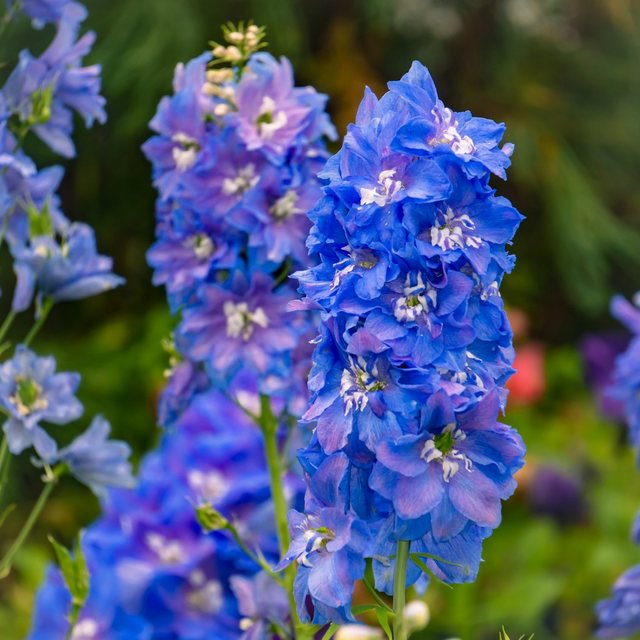
Any blue flower invites the same suspicion: was the colour put there afterwards? For delphinium that question has an unusually precise answer, because the blue has been taken apart in a laboratory and the pieces have names.
The blue is a pigment, and it has a name
Delphinium blue is produced by two 7-polyacylated anthocyanins — violdelphin and cyanodelphin — both built on a delphinidin chromophore. That structure was described in The Plant Cell in 2013. It is a real pigment with a documented architecture, not a surface treatment.
The same paper explains where the colour comes from: intramolecular copigmentation, in which aromatic acyl groups stack against the anthocyanidin core and shift the colour. For the p-hydroxybenzoyl-conjugated anthocyanins the researchers measured a 10-nanometre bathochromic shift in the absorption maximum. That is the whole trick — the blue is a stacking effect inside a molecule the plant assembles itself.
One correction is worth making before anyone repeats a florist slogan. Delphinium is not the only flower that does this. The same class of 7-polyacylated anthocyanins, violdelphin and cyanodelphin included, also turns up in the purple-blue flowers of Campanula medium and cineraria. Delphinium is not a chemical one-off and should not be sold as one.
What is true is that blue is genuinely scarce across flowering plants. In the TRY plant trait database, 772 of 10,437 species — about 7 percent — are classed as blue-flowered, and blue occurs in only 372 of 14,038 angiosperm genera and 53 of 406 plant families. Whether delphinium is ever sold tinted is not something we can source in either direction; the bred blue is the half of that question that is documented, and it is documented down to the molecule.
The colours delphinium comes in, and the one it does not
NC State Extension’s cultivar list for Delphinium elatum runs to more than 50 named varieties. The colours on it are blue, indigo, violet, mauve, pale blue, white, cream, green-tinged white, rose and pink. There is no red entry and no orange one. The closest thing on the list is ‘King Arthur’, which NC State records as red-purple.
The gene the genus is missing
Standard delphinium cultivars are blue because they accumulate delphinidin-based anthocyanins and the genus lacks flavonoid 3′-hydroxylase, the gene needed to make cyanidin — the pigment behind red. Pink cultivars get their colour from pelargonidin instead. True red was absent from the genus for that genetic reason, not because nobody wanted it.
Getting it in has been slow work. Red-purple delphinium was achieved by crossing the wild yellow species Delphinium zalil into D. cardinale to bring the flavonoid 3′-hydroxylase gene along with it, which let the plants accumulate cyanidin-based anthocyanin. An ISHS report on red-flowering Delphinium ‘University Hybrids’ covers eleven generations of breeding, across which flower diameter rose from 4.5 to 5.7 cm and semi-doubleness reached close to 100 percent — and 80 to 90 percent of each progeny still had to be discarded.
That is the practical meaning of bred rather than dyed. If a particular colour is the whole point of the order, say so on the phone — our note on substitutions covers how we handle a colour that cannot be had on the day.
Every stem carries two colours at once
Delphinium cultivars are sold by the outer colour and by the colour of the central cluster, which the trade calls the bee. Utah State Extension’s trial series were named exactly that way: ‘Dark Blue with Dark Bee’, ‘Mid Blue with White Bee’, ‘White with White Bee’. That is two colour decisions in one stem, so naming both is more precise than asking for blue.
Three different plants are sold under one name
The florist trade sells three plants as delphinium: tall Delphinium elatum hybrids, the shorter and looser Delphinium x belladonna, and annual larkspur, which is a different genus entirely — Consolida ajacis. Cornell notes that the Belladonna types trade stem length for staying power, with shorter stems but longer plant life than the elatum hybrids, and names Bellamosum, Cliveden Beauty and Oriental Blue among them.
The split shows up in wholesale price. On the USDA’s Boston terminal market ornamentals report of 18 August 2026, delphinium was quoted in bunches of ten: Ecuador Belladonna long at $20.00 to $25.00 a bunch, and greenhouse hydroponic hybrid long at $30.00 to $35.00 — roughly $2.00 to $2.50 a stem for the Belladonna against $3.00 to $3.50 for the tall hybrid. That is one day’s wholesale quote on a market in another state, offered as context for why the tall spikes cost more, not as our pricing.
At the farm gate the stem is cheap. California’s 13 reporting growers sold 6,751,000 delphinium stems at an average wholesale price of $0.53 per stem in 2021, for $3.49 million, and 4,661,000 stems at $0.47 for $2.19 million in 2022, according to the California Department of Food and Agriculture. Utah State records elatum types leaving the farm in 5-stem bunches at $2.40 to $3.20 and Belladonna types in 10-stem bunches at $1.20 to $1.60.
Roses at the door tonight
Call 8 hours ahead. Made in our shop and ready with 8 hours’ notice.
Common questions
Is blue delphinium dyed?
No — the blue is a pigment the plant makes. Two 7-polyacylated anthocyanins, violdelphin and cyanodelphin, both built on a delphinidin chromophore, were described in The Plant Cell in 2013. The colour comes from acyl groups stacking against the pigment core inside the molecule, a shift the authors measured at 10 nanometres.
Why is there no red delphinium?
The genus lacks flavonoid 3′-hydroxylase, the gene needed to make cyanidin, which is the pigment behind red. Pink cultivars use pelargonidin instead. Red-purple has been bred by crossing the wild yellow Delphinium zalil into D. cardinale to import that gene, and one published programme ran eleven generations while still discarding 80 to 90 percent of each one.
How long does cut delphinium hold in a vase?
Nebraska Extension puts it at about 6 to 8 days. FloraLife’s technical troubleshooting sheet gives an average range of 4 to 12 days, and caps dry-pack storage at 5 to 7 days and wet-pack storage at 3 days or less before the stem reaches a customer at all.
Is delphinium safe around pets?
No. The ASPCA lists Larkspur, Delphinium species, family Ranunculaceae, as toxic to dogs, toxic to cats and toxic to horses, with diterpene alkaloids as the toxic principle. If the recipient has an animal that chews flowers, tell us and we will build the order from something else.
Why does the spike arrive with so little open?
A delphinium spike opens from the bottom upward, and FloraLife’s sheet describes a stem sold with only a couple of florets open at the base. The rest of the spike is bought unopened and opens in the vase, so a delivery that looks tight on day one is behaving as the stem is sold.
Season: a cool-season crop in a place that is not cool
Cornell lists delphinium as a perennial hardy in Zones 3 to 7 that will flower in its first season from seed. Long Island sits at the warm edge of that range or just outside it. The 2023 USDA plant hardiness map puts Riverhead and Southampton at 7a, and Garden City and Centereach at 7b.
The temperature window is narrow. Utah State Extension gives delphinium an optimum of 65 to 75 degrees F by day and 58 to 61 degrees F at night, with annual larkspur cooler still at 60 to 70 degrees F. NC State adds that high humidity is detrimental to the plant, that the ideal location has cool, moist summers, and that some protection from afternoon sun is required in the southernmost zones. A Long Island July supplies none of that.
On the USDA’s Boston terminal market report of 18 August 2026 — the height of the northeastern field season — the delphinium quoted came from Ecuador or from greenhouse hydroponic production, not from local field stock. If the calendar matters more than the flower, our note on what is in season now is the better starting point.
Where it is grown for cutting, the season is stretched under cover
In Cornell’s Ithaca trials — Zone 6a, 144 freeze-free days — high tunnel delphinium gave 1.7 to 4.6 stems per plant against 0.9 to 2.8 in the open field, and the tunnel advanced harvest by 11 to 14 days. Utah State’s staggered plantings of first- and second-year plants held a continuous cutting window of 22 weeks, from early May to mid-October; tunnels advanced the early season by 2 to 5 weeks and lifted yield from 8.8 stems per square metre in the field to 25.1 under cover.
Age matters as much as shelter. Cornell’s New York high tunnel work found delphinium transplanted in mid-May harvested from early July but producing only 2 to 3 usable stems in its first year, and both earlier and more productive in its second. In Utah State’s trial, second-year plants yielded up to 70 stems per square metre and flowered 2 to 3 weeks earlier than first-year plants, and late-March tunnel transplants produced 37 stems per square metre by mid-June. Cornell’s Ithaca larkspur trial pulled the same lever from the other end: seed sown directly in the tunnel on 24 October flowered on 6 June, against 17 to 22 June for the same varieties transplanted on 8 April, and the autumn-sown plants carried stems 13 percent longer.
If you are planting rather than buying
Delphinium is short-lived even where it is happy, and the sources disagree about how short. NC State gives 3 to 5 years, Nebraska Extension says most last only 2 or 3 years in the garden, and Utah State’s trial treats them as 1 to 3 year perennials. Cutting a spent plant down to its basal leaves after flowering may bring a second bloom in late summer into autumn; Nebraska records the same rebloom for late summer or early fall.
What the spike does once it is in the room
Nebraska Extension states that delphinium flower spikes are hollow and brittle, which is why wind and rain on a flower-laden spike will bend or snap it. FloraLife carries the handling warning into the shop: the blooms, stems and foliage bruise and break easily, and the stems tangle in the bucket, so pulling one out too hard damages the flower. Utah State’s trial stripped the leaves off marketable stems before holding them at 2 degrees C in preservative — the defoliation happens before storage, not at the kitchen sink.
Ethylene is the other thing this stem cannot tolerate. Cornell calls delphinium very sensitive to it and instructs that it be stored away from ethylene-producing produce. The American Floral Endowment lists delphinium among the common ethylene-sensitive flowers alongside alstroemeria, carnation, freesia, lily, lisianthus, snapdragon, statice and stock, and notes that flowers can respond at concentrations as low as 100 parts per billion. A vase next to a fruit bowl is working against the flower.
On the safety question, the ASPCA lists Larkspur — Delphinium species, family Ranunculaceae — as toxic to dogs, toxic to cats and toxic to horses, with diterpene alkaloids as the toxic principle. The USDA Agricultural Research Service’s Poisonous Plant Research Laboratory adds that in larkspur the new growth and the seeds carry the highest concentrations of toxic substances, that toxicity is highest during early growth and declines through the season, and that toxin levels may rise again in flowers and pods late in the season.
If the plan is to dry the spikes rather than keep them fresh, Nebraska says to harvest when about four-fifths of the florets on the spike are open — a considerably later cut than the one-third to one-half used for fresh stems.
The name, and the meanings that will not check out
The genus name comes from the Greek delphis, dolphin, and refers to the shape of the flower bud; the species epithet elatum is Latin for tall. That etymology is sourced to NC State Extension. The companion story — that larkspur is named for the resemblance of the flower’s spur to the hind claw of a lark — is repeated everywhere and could not be traced to any botanical or lexicographic primary source in this research pass. The dolphin is documented; the lark is not.
The symbolism is worse. Kate Greenaway’s Language of Flowers (1884) assigns Larkspur the meanings ‘Lightness. Levity.’, Pink Larkspur ‘Fickleness’ and Purple Larkspur ‘Haughtiness’ — and the same volume then contradicts itself, because its illustrated alphabet plate gives Purple Larkspur as ‘Naughtiness’. The 1884 volume that nearly every modern delphinium meaning is traced back to does not agree with itself.
The warm modern readings — an open heart, ardent attachment, big-heartedness — come from florist marketing copy, and the oldest source that can actually be fetched contradicts them outright. The claim that larkspur is the birth flower of July sits in the same category: repeated on effectively every florist and greeting-card site, traceable to no primary or institutional source at all. Treat it as a trade custom of unknown origin rather than as history, and if the flower is going to carry a message, put the message in the card.
Which delphinium, if any
You want blue, and you want it to be real blue
This is the stem. The pigment is named and the structure is published. Ask by bee colour as well as by the outer one, since cultivars are sold on both.
You want red, in a tall spike
Not this stem. NC State’s list of more than 50 elatum cultivars carries no red and no orange, and the closest entry, ‘King Arthur’, is recorded as red-purple. Tell us on the phone that red is the requirement and we will start from a different flower entirely rather than send a purple one and hope.
You want height above all
Ask for elatum hybrids, and ask by grade. Delphinium is graded on a four-step commercial scale — Cull under 16 inches, Basic 16 to 24, Standard 24 to 36, Premium over 36 — while larkspur runs on a shorter one, Cull under 12 inches, Standard 12 to 24, Premium over 24. In the ground, NC State sorts elatum varieties into short at 3 to 5 feet, medium at 4 to 5.5 feet and tall at over 6 feet, with ‘Summer Blues’ reaching 7 feet.
You want the arrangement to still be there in two weeks
Pick something else, or ask for delphinium as the tall element in a mixed vase rather than the whole gift. Nebraska puts cut delphinium at about 6 to 8 days, and FloraLife’s range tops out at 12. If the vase has to hold longer than that, start from another of the stems we carry.
There is a dog, a cat or a horse at the address
The ASPCA lists Larkspur as toxic to all three. That is the one occasion rule for this flower we can stand behind, and it settles the question on its own. Say so when we call and the order gets built without it.
You want it in a Long Island garden, not a vase
Go in with the numbers in front of you. Nassau and Suffolk sit at Zone 7a to 7b against a Zone 3 to 7 crop, NC State calls high humidity detrimental, and the plant is short-lived even where the summers suit it — 3 to 5 years by NC State, 2 to 3 by Nebraska, 1 to 3 in Utah State’s trial. Plant it knowing it is a few good summers rather than a permanent thing, cut it back to the basal leaves after it flowers, and you may get a second bloom out of it in early autumn.