

Gladiolus: how tall the spike stands, and how far up it opens
A gladiolus spike runs two to five feet and opens from the bottom up. How far up it opens, how the colour code works, and how to buy the height.
Call 631-612-6156 with the town, the date and what the flowers are for. We build it in our Port Jefferson shop and deliver it, and we confirm the price with you before anything is charged.
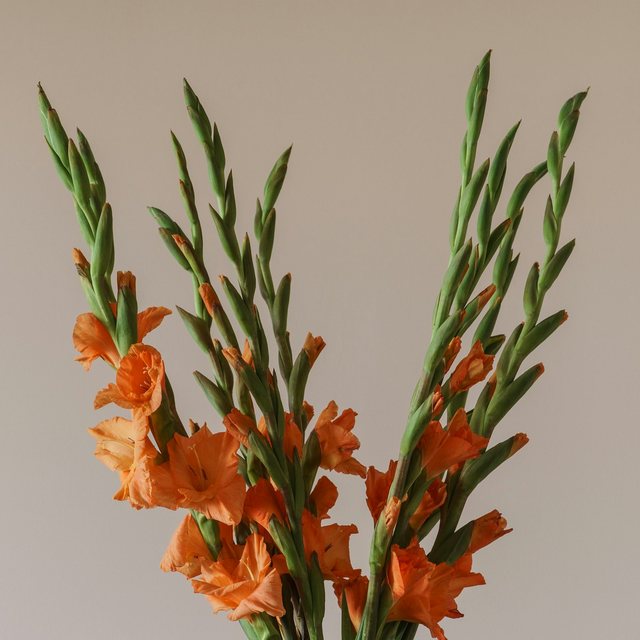
Gladiolus is bought by the length of stem and by how much of that stem has yet to open, so the two decisions that matter are vertical ones. Get those right and the spike works. Get them wrong and you have paid for a tall green wand with six flowers at the bottom of it.
Two to five feet of stem, and that is the whole argument for it
Penn State Extension gives the plant a range of two to five feet, with individual florets running from miniature, under three inches, to giant, over five inches across. The University of Arkansas Extension describes it more bluntly as a “spiky four foot tall inflorescence.” That vertical scale, rather than any assigned symbolism, is why the flower ends up in standing work.
For a buyer there are effectively two products. Missouri Extension describes the large-flowered glads as the type much used by florists as cut flowers and well suited to exhibition, with petals frilled, ruffled, semiruffled or plain. The miniatures are a separate purchase: Missouri describes them as miniature replicas of the ruffled large-flowered types on short spikes, better suited to small arrangements, and warns against confusing them with species varieties such as Primulinus. If you want height, ask for it by name, because a miniature is not a small version of the same order.
Garden height is also not vase height. Commercial gladiolus is trimmed to fixed lengths under trade classification standards — Costa and Finger standardised their research stems to 60 cm to meet the Brazilian classification criteria they were working under — so the four-foot figure describes what grew in a field, not what comes out of a box.
The spike opens from the bottom, and part of it may never open
NC State Extension puts the basic behaviour plainly: the florets of a gladiolus spray do not open simultaneously, and they keep opening after the stem is cut. That is the flower’s best trick and its biggest risk, because how far up the spike that process runs is not fixed.
Costa and Finger measured it across ten cultivars standing in plain distilled water with no flower food. The proportion of florets that opened ran from 57.02% to 67.16% — roughly a third to two-fifths of the buds on a spike stayed shut and green for the whole of the flower’s life. In the same trial, vase life ran from 4.0 days to 6.5 days, scored at the point where at least half the open florets had wilted. Those are the numbers we can cite, and the conditions they were measured under are part of the number: distilled water, no preservative.
Cut early, deliberately
A gladiolus arrives with much of itself still shut because that is how it is harvested. UMass Extension gives the commercial harvest stage as the moment one to five flowers on the spike are showing colour, with the stems going straight into a solution of a bactericide, citric acid and four to six percent sugar. Mississippi State Extension splits the stage by destination: for local sale, cut when the lower two to three florets are showing colour or the lowest floret is open; for stems that will be stored first, cut earlier, when the lowest buds are only starting to show colour.
There is even a published picture of the ideal. Missouri Extension’s exhibition criteria call for the bottom third of the florets in full bloom, the middle third showing colour and the upper third still in bud, with the florets evenly spaced and all facing the same way. That is a show-bench standard, not a delivery standard, but it is a useful thing to hold in your head when the box is opened.
Sugar is what pushes the rest of the spike open
Gladiolus is one of the two textbook cases for sugar pulsing. UC Davis names it alongside tuberose and reports that sugar-pulsed gladiolus “open further up the spike, are bigger, and have a longer vase life.” UMass puts a recipe on it: stems held overnight, about twenty hours, in a 20% sugar solution and then moved into sugar-free water produced greater numbers of opened flowers and extended vase life.
Costa and Finger found the same thing sitting inside the plant. Peak total soluble sugar content was highest in ‘Verônica’ at 23.5 mg per gram of fresh weight, then ‘Red Beauty’ at 22.6 and ‘Amsterdam’ at 21.4 — the same rank order as those cultivars’ vase lives, which ran 6.5, 5.6 and 4.0 days respectively. Their conclusion was that the maintenance of flower opening is attributed to total soluble sugar content, and that this in turn is a major determinant of vase life. Named cultivars differ by more than 50% on that measure, which is why “how long do glads last” has no single answer.
The trade chemistry points the same direction. UMass reports silver thiosulphate at 1 mM for two hours, or a five-hour 1-MCP treatment, used on gladiolus specifically to improve the opening of the small buds further up the spike. On other flowers those treatments are used to stop wilting; here the target is the unopened top of the stem.
Questions worth settling before you order
How far up the spike will the florets actually open?
In the one peer-reviewed measurement we can cite, ten cultivars standing in plain distilled water opened between 57.02% and 67.16% of their florets. A third to two-fifths of the buds stayed shut. Sugar is what moves that figure: UC Davis reports sugar-pulsed spikes open further up the stem, and UMass records more open flowers after an overnight 20% sugar treatment.
Why has the tip of my gladiolus curled upward?
Because it spent time lying flat. Gladiolus is strongly geotropic, and Missouri Extension’s instruction is to store spikes vertically until they are used. UC Davis notes the response is greatly reduced at low temperature, which is why glads can travel flat in a cold box but bend in a warm one. The curve is permanent once it has formed.
How long does a gladiolus spike hold in the vase?
Costa and Finger measured 4.0 to 6.5 days across ten cultivars, scoring the end point as the moment at least half the open florets had wilted — in distilled water, with no flower food at all. Trade sources quote longer, but that is the figure with a method attached to it, and the conditions belong with the number.
Are gladiolus a problem around a cat, a dog or a horse?
The ASPCA lists Gladiolus species as toxic to dogs, cats and horses, with the toxic principles listed as unknown. The clinical signs given are salivation, drooling, vomiting, lethargy and diarrhea, and the ASPCA notes the highest concentration of toxin is in the corms rather than in the flower spike itself.
What makes the florets look streaked or speckled?
That is a pest signature rather than a variety trait. Missouri Extension describes gladiolus thrips working on the buds before they emerge from the sheaths and causing malformed and spotted flowers. NC State identifies the insect as Taeniothrips simplex, adults about a sixteenth of an inch long, and notes that flower buds may be injured badly enough that all of the blossoms are ruined.
What the water and the air do to a spike
Fluoride, which flower food does not fix
Gladiolus belongs to a short list of cut flowers with a specific fluoride problem. UC Davis: “Fluoride (F) is very toxic to gerbera, gladiolus, roses and freesia; fluoridated drinking water contains enough F (about 1 ppm) to damage these cut flowers.” Marousky and Woltz put numbers on the damage in 1971: every gladiolus cultivar they tested showed distinct petal-margin deterioration and necrosis at 1 ppm, and many cultivars showed petal-margin discolouration along with bract and leaf margin damage within four days at just 0.25 ppm.
The same pair tested whether a preservative could rescue the stems. A solution of 600 ppm 8-hydroxyquinoline citrate with 4% sucrose increased the number of open florets and sustained floret quality, but it “did not overcome the deleterious effects of fluoride in vase water,” and florets kept continuously in fluoride water also failed to open fully. One more detail from that work is worth carrying into a colour choice: coloured cultivars showed more fluoride injury than the white or yellow ones.
Ethylene, which leaves it largely alone
Where a fruit bowl ruins other flowers, gladiolus largely shrugs. Costa and Finger sealed ten cultivars in airtight chambers at ethylene concentrations of 0, 0.1, 1.0, 10, 100 and 1,000 microlitres per litre for 24 hours and found no effect on flower opening and no effect on vase life at any concentration. UMass calls gladiolus flowers insensitive to ethylene even at 1 ppm.
Two qualifications keep that honest. UMass adds that ethylene exposure can still shorten commercial life by aborting the unopened buds further up the spike, even where it does not shorten the life of florets already open — so the part of the flower ethylene reaches is exactly the part you are buying. And the literature is not unanimous: a 1988 report by Woltering and Van Doorn, cited inside the Costa and Finger paper, called gladiolus slightly sensitive at 3 microlitres per litre. Low sensitivity is the defensible claim; indifference is not.
Season: seventy days of corm before a single floret
Missouri Extension gives the time from planting a corm to bloom as 70 to 90 or more days, depending on weather and variety. Because that window is long and fixed, growers stagger it: glads may go in as early as a month before the average last frost date and then at two-week intervals for a succession of bloom, but the calendar has a hard back edge — the last planting should be no later than early July if the corms are to mature before frost. Mississippi State tightens the interval for people growing spikes to sell, at seven to fourteen days apart, three to five inches deep, four to six inches apart, rows twelve to thirty-six inches apart, and about an inch of water a week for good spike development.
Whether there is a spike at all is decided before planting. Missouri grades corms from Jumbo, two inches or more across, down through No. 1 at one and a half to two inches to No. 6 at three-eighths to a half inch, and states that Jumbo and sizes 1, 2 and 3 can be expected to flower, sometimes producing two or more spikes each, while sizes 4 and 5 flower only occasionally and under ideal conditions. “Corms are most productive during their first six years,” after which they decline in vigour, which is why growers keep raising replacement cormels alongside the crop.
On Long Island specifically
NC State gives the genus a bloom period of late summer into fall and hardiness in USDA zones 7a to 10b, with tender types lifted after the foliage dies, cleaned and stored dry in mesh bags with good air circulation at 35 to 41 degrees F. Missouri’s version of the same job: dig four to six weeks after the blooms finish or when the tops die off, cure for two to three weeks, then store over winter at 35 to 45 degrees F in a well-ventilated container. Cornell Cooperative Extension of Suffolk County lists gladiolus among the spring-planted bulbs for summer colour, hardy to zone 7, and reports that “many gladioli also survive winters in our gardens, thanks to global warming” — which puts local glads right at the edge of staying in the ground rather than being lifted every autumn.
All of that is a growing calendar, not a delivery calendar. We have no verified month-by-month figures for when cut gladiolus reaches this market or where it comes from, so this page will not print one. What is actually in the coolers on a given week is a question for the call, and the what’s in season now page is where that gets answered rather than guessed.
Meaning: sword leaves, August, and a funeral reputation nobody chose
The name is about the foliage, not the flower. The South African National Biodiversity Institute: “Gladiolus gets its name from the Latin word gladius, meaning ‘sword’, referring to its sword-shaped leaves.” The older English name follows the same logic — Missouri Extension opens its guide with the line that the gladiolus was once known as sword lily, and NC State’s plant toolbox still carries Sword Lily among the accepted common names. Penn State Extension’s Master Gardener programme gives gladiolus as the birth-month flower for August.
The sympathy association is documented, and its origin is commercial rather than symbolic. The University of Arkansas Extension records that “florists began using it as a cheap and readily available funeral flower,” and that the association then cost the flower its garden audience: the gladiolus craze “seems to have subsided by mid century,” blamed on both the bereavement link and the fact that gladiolus “is just not a tidy garden plant.” The same source puts the consequence bleakly: “only the most intrepid supporter will stay faithful to a flower associated with bereavement.” So the honest sentence for a sympathy or funeral arrangement is not that gladiolus symbolises remembrance. It is that gladiolus became the funeral flower because it was tall, plentiful and inexpensive, and the height is still the reason to choose it.
None of which means the flower was ever minor. The American Gladiolus Society was founded in 1910 to promote the growing of glads and to standardise their nomenclature — a national single-genus society, established before the funeral reputation set in. Missouri Extension notes that while glads are used to a limited extent for landscape effect, their chief value is for cut flowers, and that member societies of the North American Gladiolus Council still hold competitive shows through the summer, with gladiolus classes in the floriculture sections of county and state fairs.
Two stories travel with this flower that we will not print as fact. The first is the Roman one, that gladiators fought to the death of gladioli and that victors were showered in the flowers; it appears in the Penn State article without a citation and we could trace it to no primary Roman source. The second is the Victorian flower-dictionary reading — infatuation, love at first sight, you pierce my heart — which circulates in identical wording across the trade and which we could not trace to a primary source either. The same is true of the five-colour symbolism table, which is applied to roses and carnations in the same words and so says nothing about gladiolus in particular.
Colours: the three-digit code, and what it will not sell you
Gladiolus cultivars carry a three-digit number that encodes size, colour and markings in that order. The first digit is floret size: 500 Giant, over five and a half inches across; 400 Large, four and a half to five and a half; 300 Medium, three and a half to four and a half; 200 Small, two and a half to three and a half; 100 Miniature, under two and a half inches. The measurement is taken on the bottom florets of the spike, not flattened out.
The second digit is the colour class — 0 white, 1 yellow, 2 orange, 3 salmon, 4 pink, 5 red, 6 rose, 7 lavender, 8 violet, 9 smoky or tan — and the third is depth, from pale through light, medium, deep and very deep, with named specials including 58 black red, 68 black rose, 78 purple and 98 brown. The third digit does one more job: an odd number means the florets carry conspicuous or contrasting markings, an even number means none. Missouri Extension’s worked examples: “The number 454, for example, indicates a large-flowered medium-red glad without prominent markings, while 262 indicates a small-flowered glad with a light rose color.”
Two entries in that table are worth knowing before you ask for a colour. There is no blue class. The 80 to 86 series is printed as “Violet (Blue),” with blue as a parenthetical on violet, and 78 is purple — so anything sold to you as a blue glad sits somewhere inside the violet range. Green, by contrast, is entirely real: codes 02 and 04 cover light and medium green, and NC State lists green among the genus’s natural flower colours alongside white, cream and tan, yellow, orange, pink, purple and lavender, and red and burgundy. Smoky is a formal class too — 92, 94 and 96 for light, medium and deep smokies, with 90 tan and 98 brown.
Ask by colour class and you will get closer than a photograph would take you, but the code describes what was bred, not what was cut this week. Where a class is not in the cooler on the day, the call is where that gets resolved, and our note on how substitutions are handled explains what a florist swaps in and how you are told.
Signs to look for when the spike arrives
A gladiolus spike carries its handling history where you can read it. Six things are worth checking in the first minute, while there is still something to be done about them.
- The tip of the spike, for an upward hook. A curled tip means the flower spent time flat somewhere warm. Missouri Extension’s exhibition standard asks for a straight stem with the tip of the spike not bent, and the bend does not straighten out afterwards.
- How much of the spike is still in bud. The show-bench ideal is the bottom third in bloom, the middle third showing colour and the top third still closed. A spike delivered wide open at the top has little left to give.
- The buds above the open florets, for shrivelling or abortion. UMass records that ethylene exposure shortens gladiolus’s commercial life by aborting the unopened buds up the spike rather than by damaging the open ones. Those buds are the purchase.
- Petal margins, for browning or necrosis. Marousky and Woltz found petal-margin deterioration and necrosis in every cultivar tested at 1 ppm fluoride, and margin discolouration with bract and leaf damage within four days at 0.25 ppm. Coloured cultivars showed it worse than white or yellow ones.
- Florets, for streaking, speckling or malformation. Gladiolus thrips work on the buds before they emerge from the sheaths, so the damage is already present when the flower opens; NC State notes buds can be injured badly enough that all the blossoms are ruined.
- Whether the florets face the same direction and sit evenly spaced. That is part of the same published standard, and on a spike meant to stand at eye level it is the difference between a line and a muddle.
Then stand it up, in water, straight away — and if it is going to sit for a day before it is used, stand it up cool.
Roses at the door tonight
Call 8 hours ahead. Made in our shop and ready with 8 hours’ notice.