

Ranunculus has a season measured in weeks, and heat is what closes it
Ranunculus has a harvest window of weeks, and heat closes it. What that means for a Long Island order, plus colors, vase life and sap safety.
Call 631-612-6156 with the town, the date and what the flowers are for, and we will tell you what we can actually get for that week rather than what a catalog photo suggests.
Or order red roses by phone for same-day delivery.
Warmth ends the ranunculus season, not frost
Researchers at Utah State University, writing for the Association of Specialty Cut Flower Growers, report that temperatures consistently above 70F (21C) may trigger dormancy, shortening the harvest window and degrading bloom quality, and that the normal harvest window is only two to four weeks per planting. The crop is not frozen out at the end of its run. It is warmed out.
That is also why planting later does not simply move the flowers later. The same Utah State work puts spring-planted ranunculus at 90 to 110 days to bloom, which in USDA Zones 3 through 7 lands the crop in July and August — precisely when the plant performs worst, since its optimal performance is in cool spring conditions.
Michigan State University’s floriculture extension team draws the geographic seam explicitly in GrowerTalks: in southern and some coastal regions of the United States, ranunculus can be planted outdoors in fall or in a high tunnel and will flower the following spring, while in the central and northern United States temperatures are too cold for fall planting, forcing a late-spring planting that does not leave enough time before heat arrives — producing reduced or poor-quality cuts. If you are choosing a date around a flower rather than a flower around a date, what’s in season now is the better place to start.
Long Island sits on the line, not inside it
NC State Extension records Ranunculus asiaticus as reliably winter-hardy only in USDA Zones 8a to 10b, and describes it as sometimes grown as an annual outside that range. That puts Long Island, at Zone 7, north of the species’ comfortable perennial limit. This is not a stem that overwinters here on its own terms.
Cornell has tested exactly that proposition in New York. In the 2014/15 high tunnel trial at Ithaca, corms were soaked in room-temperature water overnight on 2 December, held in moist vermiculite for three weeks in a dark 50F storage room, planted in the high tunnel on 22 December at six-inch spacing, and covered with a low tunnel kept in place until the end of March. Cornell recorded three to five flowering stems per plant as the norm in good seasons at Ithaca; after the severe 2014/15 winter, yields fell to less than half that, and the report concluded that the experiment shows the limits of winter hardiness of these species. Pre-sprouting was the difference between a crop and a gap: survival was reported as roughly 14% for unsprouted corms against 72% for pre-sprouted ones, with stems running about 17 cm against 27 cm.
There is one documented exception that lands in our zone rather than south of it. The interspecific hybrids bred by John Fielding in London — Ranunculus cortusifolius crossed with R. asiaticus, patented as ‘ROCORANGE’ and ‘ROCPEACH’ — are described in their patents as garden hardy in USDA Zone 7 or 8, and were observed to survive minus 15 degrees Celsius in garden trials.
Locally, ranunculus is grown on the North Fork: Backyard Blooms North Fork Flower Farm, with a roadside stand at 310 Flanders Road in Riverhead, lists ranunculus among its specialty cut flowers alongside dahlias and peonies. That is one Suffolk County grower, not a supply line, and we would rather say so than imply we can pull local ranunculus in November.
The flower is cut half open and finishes in the vase
Michigan State researchers graded stems as marketable and cut them when the terminal flower bud was 50% open, which means the flower a buyer receives is designed to finish opening after it arrives. It is also a smaller flower on a shorter stem than the petal counts suggest: NC State Extension records blooms of one to three inches across with more than 20 petals or rays on plants one to two feet tall, MSU reports finished stem lengths of 12 to 16 inches as marketable, and Utah State graded stems marketable at 10 inches or greater, straight and unflawed. Anyone picturing something long-stemmed because a patent says 200 petals is picturing the wrong object.
Bent neck is the failure, and the postharvest research argues with itself
Ranunculus stems are naturally hollow and prone to bending, which is why bent neck and stem collapse are the design problems florists plan around — that description comes from Chrysal, a postharvest treatment manufacturer, and the trial data lines up with it. In an ISHS Acta Horticulturae study, cut Ranunculus asiaticus held in 2% and 6% sucrose faded completely and developed bent neck within eight days, no better than the untreated control, while stems in silver nitrate at 30 mg/L held 14 days with minimal deformation. Sugar, the thing people reach for first, did nothing in that trial.
A 2023 University of Milan trial measured how fast untreated stems go. Cut Ranunculus asiaticus ‘Venere rosa’ held at 20C and 60–70% relative humidity showed first flower wilting at 5.3 days and first leaf yellowing at 5.4 days — far shorter than the 10 to 15 days that paper notes is quoted for the stem. The same trial found the flower failing in two independent ways that need two different fixes: 1-MCP at 500 ppb for 24 hours pushed flower wilting from 5.3 to 8.2 days but barely moved leaf yellowing, 5.4 to 5.9 days, while thidiazuron at 10 micromolar pushed leaf yellowing to 8.4 days. Only the combination delayed both, at 8.6 days wilting and 8.4 days yellowing.
On whether ethylene matters here at all, two peer-reviewed sources 23 years apart flatly disagree. A 2000 study in Postharvest Biology and Technology (19:287–290) found cut ranunculus of the Aviv group produced ethylene in a climacteric-like pattern and synthesised ACC, but were not sensitive to applied ethylene, and that neither aminooxyacetic acid nor silver thiosulfate improved flower quality — concluding that ethylene is not an important regulator of ranunculus senescence. The 2023 Frontiers paper states the opposing position flatly, that flowers of the Ranunculaceae appear to be highly ethylene-sensitive. That is not settled, and care advice presenting either side as established is claiming more than has been published.
The sap is the part to handle carefully
The ASPCA lists Ranunculus spp. — buttercup, family Ranunculaceae — as toxic to dogs, toxic to cats and toxic to horses. The toxic principle is protoanemonin, an irritant, and the clinical signs given are vomiting, diarrhea, depression, anorexia, hypersalivation, oral ulcers and a wobbly gait.
NC State Extension rates the poison severity of Ranunculus asiaticus as Low, but lists the poisonous parts as flowers, leaves, stems, roots and sap or juice — that is, the entire cut stem — with protoanemonin released from the glycoside ranunculin. NC State also records that contact with the cell sap produces skin redness, a burning sensation and blisters, so this is not only an ingestion question. Cornell Cooperative Extension lists buttercups among the plants causing contact dermatitis, explaining that they contain ranunculin, which turns into the blistering agent protoanemonin when the plant is crushed. Recutting a stem is crushing a stem, which is worth knowing before someone trims a bunch of them barehanded at the kitchen sink.
Questions people ask us about ranunculus
Why did my ranunculus fade in under a week?
Because that is what the one measured trial we hold reports for untreated stems. In the 2023 University of Milan work, untreated ‘Venere rosa’ at 20C showed first flower wilting at 5.3 days and first leaf yellowing at 5.4 days. Published figures elsewhere scatter badly: named cultivars state 10 to 15 days, 12 to 14 days and 20 to 25 days in their own plant patents, a roughly 2.5-fold spread, and those are the breeders’ own numbers. We have no single verified vase-life figure to quote you for the stem as a whole.
My stems flopped over at the neck. Is that a fault?
It is the characteristic ranunculus ending rather than an unusual one. Bent neck, not petal drop, is how this flower goes: in the ISHS trial the control stems and the sucrose-treated stems alike were recorded as bent-necked at day eight. The stems are hollow and prone to bending, which is the shape of the problem rather than a handling error on the day.
Are ranunculus safe around a cat, a dog or a horse?
The ASPCA lists Ranunculus spp. as toxic to all three, with protoanemonin as the toxic principle and vomiting, diarrhea, depression, anorexia, hypersalivation, oral ulcers and a wobbly gait as the clinical signs. NC State Extension rates the severity as Low but names the whole plant, sap included, as the poisonous part. Tell us if the delivery is going to a house with animals in it and we will say what our florists can send instead.
Is there a blue ranunculus?
No. The 2024 study in The Horticulture Journal states that cultivars with blue petals have not been seen in the market. What makes that worth saying is that ranunculus already produces delphinidin, the anthocyanin blue flowers are built from; blue also needs acyl-group and flavonoid association that ranunculus does not supply. If a listing shows you a blue one, ask what is actually being sent.
Ranunculus colors: two pigment systems, and no blue
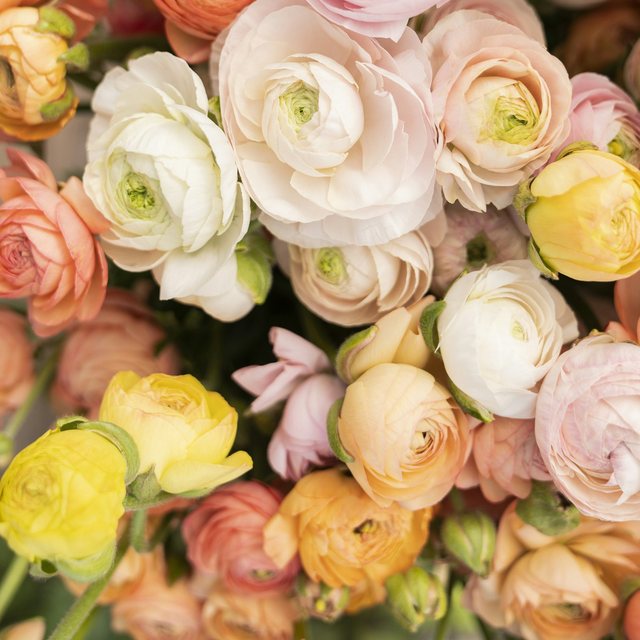
A 2024 study in The Horticulture Journal analysed 12 ranunculus cultivars and sorted them into six color groups: Red-Purple, White, Yellow-Orange, Orange, Red and Violet. That split is not cosmetic. The yellow-orange cultivars carry carotenoids as their flower pigments, while the pinks, reds and purples depend on three anthocyanins — cyanidin 3-O-sambubioside, delphinidin 3-O-(6”-malonylsambubioside) and cyanidin 3-O-(6”-malonylsambubioside) — plus eleven flavonols acting as copigments. A yellow ranunculus and a red one are colored by different chemistry.
The dramatic colors people assume are treatments turn out to be bred traits with registered codes. The near-black ‘ABUMBREON’ is patented with petals rated RHS Black 202 fading to Purple N77A as the flower opens, becoming Red Purple 59A fading to Purple N79C when fully open. Picotee edging is genetic too: ‘ABUNICORNO’ is patented as pale yellow petals, RHS Yellow 2D, with orange-red margins at RHS Orange-Red 35B. Stripes and flecks are cultivar traits as well — Cornell’s 2015 trial described ‘Elegance Bianco Striato’ as white with a black rim and stripes, and ‘Elegance Rosso 232-03’ as dark red flowers, some flecked with white.
One thing to know before ordering by color: ranunculus color is not stable across the life of the flower. Cornell noted that ‘Ponpon Aurora’ had an unusual flower color, with older flowers looking bleached, and the Italian patents specify separate RHS codes for opening versus fully-open petals. If a color has to match something exactly on a fixed date, say that when you order, and our page on substitutions sets out how we handle it when a named cultivar is not available that week.
Petal counts, and one hybrid that branches
The Italian ranunculus a buyer meets come from one breeding house: Alberto Biancheri of Camporosso Mare, Italy, whose patented cultivars include ‘ABUMBREON’, ‘ABUNICORNO’, ‘ABALCHERA’ and ‘ABULANJI’, all with a stated bloom season of winter to spring and self-cleaning blooms. The petal counts in those patents are precise and extraordinary: ‘ABUMBREON’ carries approximately 200 petals at 8.5 to 9.5 cm across on a plant 50 to 60 cm tall, and ‘ABUNICORNO’ carries more than 100 petals at 6 to 8 cm, producing 12 to 15 flowers per plant.
The Fielding cortusifolius hybrids are a structurally different flower. ‘ROCORANGE’ and ‘ROCPEACH’ carry branched stems with several flowers per stem rather than one bloom per stem, on plants 65 to 75 cm tall, and their patents state the cut flower will last in water for 12 to 14 days with all flowers opening — a figure describing a whole branched spray finishing, not one bloom holding. Petal count separates them even from each other: ‘ROCORANGE’ is semi-double with more than 50 petals at 6 cm, while ‘ROCPEACH’ carries more than 85 petals at the same diameter. Cultivar choice is a real risk rather than a preference, incidentally: in Cornell’s 2015 New York trial, two of the nine ranunculus entries were recorded outright as crop failures, while ‘Ponpon Aurora’ gave the best stand and was very vigorous and high yielding.
What ranunculus is supposed to mean, and what nobody can source
Here the trail is unusually good and unusually funny. Kate Greenaway’s Language of Flowers gives ‘Ranunculus’ the meaning “You are radiant with charms” and ‘Garden Ranunculus’ the meaning “You are rich in attractions”, so the phrase florists repeat is genuinely traceable to a 19th-century floriography dictionary. The same dictionary hands the opposite meaning to this flower’s own relatives: Wild Ranunculus is Ingratitude, Crowfoot is Ingratitude, and Buttercup is Ingratitude and Childishness. Whether ranunculus flatters or insults depends entirely on which entry you read.
Two things printed alongside that could not be traced to any source in our research. The per-color symbolism — pink for grace, white for purity, orange for energy — has no traceable origin, and Greenaway assigns ranunculus one meaning with no color breakdown at all. Nor could the “little frog” etymology, or the story of Pliny naming the flower for damp places among frogs, be confirmed from a botanical or classical primary source. What NC State Extension does record is that the epithet asiaticus is Latin for “Asian” while the species is native to the areas around the eastern Mediterranean, and that garden plants are cultivars and hybrids rather than the species — so even the common name Persian buttercup sits oddly with the botany.
Ranunculus month by month, and where each figure was measured
December. Under glass the crop starts here: a Michigan greenhouse cited by MSU produces ranunculus cut flowers from the end of December to mid-May, using succession plantings to hit Valentine’s Day, Easter and Mother’s Day. In Cornell’s New York trial this is the planting month — corms soaked on 2 December, planted in the high tunnel on 22 December.
January and February. Greenhouse production, on the Michigan schedule above. Valentine’s Day falls inside that greenhouse window and outside every field harvest window in the record we hold.
March. California’s Carlsbad display, the Giant Tecolote strain, is in bloom for approximately six to eight weeks from early March through early May. In Ithaca, the low tunnel over the Cornell planting stayed in place until the end of March.
April. The first protected harvests land. In the Utah State trials, high-tunnel November plantings began harvest on 8 April and peaked on 15 April.
May. The broadest month in the record: Carlsbad runs to early May, the Michigan greenhouse to mid-May, and Utah’s field November plantings began harvest on 13 May.
June. Utah’s field November plantings peaked on 1 June, and its field April plantings began harvest on 15 June and peaked on 30 June. This is the last month with a documented peak in any trial we hold.
July. All the Utah plantings tapered by the second week of July. Spring-planted ranunculus reaching bloom at 90 to 110 days arrives here in Zones 3 through 7, at the point where sustained heat above 70F may trigger dormancy and bloom quality degrades.
August through November. No harvest window in the sources we hold falls in these months. If your date sits in this stretch, call 631-612-6156 before you plan around the flower — we would rather find out what we can genuinely get that week than print a figure we cannot stand behind.
Roses at the door tonight
Call 8 hours ahead. Made in our shop and ready with 8 hours’ notice.