

Daisy varieties: gerbera, Shasta and English daisy are different plants
Gerbera, Shasta and English daisy are different plants sold under one name. Gerbera vase life ran 5.5 to 13.3 days across 14 varieties in one trial.
Call 631-612-6156 with the town, the date and what the flowers are for. We make it in our Port Jefferson shop and go through it with you by phone before anything is made.
One name, more than one plant
One of the plants sold under the daisy name is the gerbera, Gerbera hybrida. What reads as a single flower is not one: the University of Helsinki’s Asteraceae research group describes the gerbera head as a capitulum carrying three distinct floret types, showy female ray flowers around the margin, hermaphrodite disc flowers in the centre, and intermediate trans flowers in between. A three-type head of that kind is unusual even inside the daisy family.
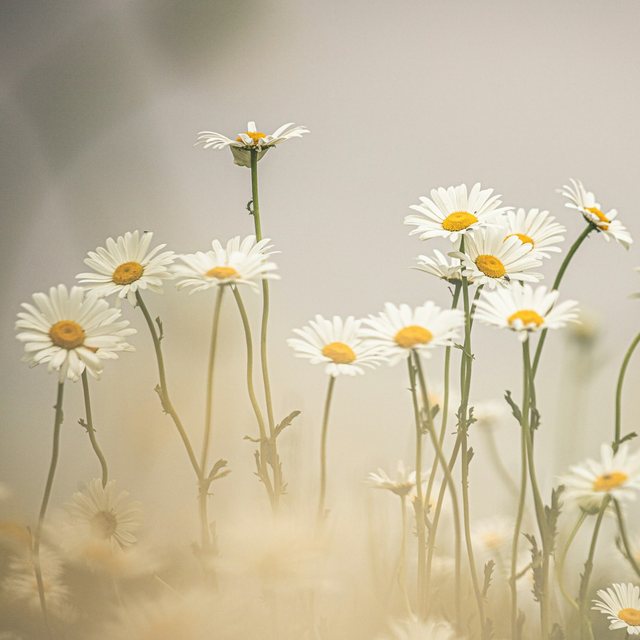
The English daisy is Bellis perennis. NC State Extension puts the plant at 3 to 6 inches tall, with heads up to 2 inches across, blooming May through July and hardy in zones 4a to 8b. That is far too short-stemmed for florist work, which is why the true daisy of the English lawn is almost never what arrives in a delivered arrangement.
Linnaeus named Gerbera in 1758 after Traugott Gerber, a German botanist and physician who lived from 1710 to 1743, travelled in Russia and was a friend of his; UC Davis notes the name was originally spelled Gerberia. The Helsinki group places gerbera among the most important ornamental crops in the world, together with rose, chrysanthemum, carnation and tulip. The further line, that gerbera is specifically the fifth most used cut flower worldwide, rests on a single secondary citation, so we do not assert it.
With gerberas, the cultivar name is the specification
UC Davis counts well over 300 gerbera cultivars in commerce and says they vary greatly in vase life, which is why it tells florists to order gerberas by cultivar name. With gerbera, the variety name, not the colour, predicts how long the flower lasts.
The size of that spread has been measured. American Floral Endowment Research Report #454, run at the University of Florida in 2013, tracked 14 cut gerbera varieties and found vase life running from 5.5 days for the white ‘Teresa’ to 13.3 days for the orange ‘Mistike’ after two days of wet storage at 42 degrees Fahrenheit.
The same report separated the 14 varieties on scape bending. Half of them recovered within 24 to 48 hours once they were placed in room conditions. The other half never recovered, and the report named them: ‘Guarda’, ‘Fiction’, ‘Pink Elegance’, ‘Primrose’, ‘Sonata’, ‘Teresa’ and ‘Testarrosa’. ‘Teresa’ sits on both lists, the shortest vase life in the trial and no recovery from bending.
The report traced that difference to the anatomy of the stem. ‘Solero’ took up more phloroglucinol stain than ‘Testarossa’, indicating higher lignin content and larger vascular bundles in the scape.
Questions people ask before ordering daisies
Why does the variety name matter more for gerberas than the color?
Because the numbers attach to the variety. UC Davis records well over 300 cultivars in commerce varying greatly in vase life and advises ordering by cultivar name, calling it a species where the variety name, not the colour, predicts how long it lasts. The University of Florida trial behind AFE Report #454 found 5.5 to 13.3 days across just 14 varieties.
What is a Shasta daisy, and is it the same thing as a gerbera?
No. A Shasta daisy is Leucanthemum × superbum, a garden perennial: its cultivar ‘Becky’ grows 40 inches tall with 3-inch single white flowers. A gerbera is Gerbera hybrida, a different genus entirely.
Are the small daisies in a lawn the same flower a florist sends?
They are a different plant. The lawn daisy is Bellis perennis, which NC State Extension describes as 3 to 6 inches tall with heads up to 2 inches across, blooming May through July. That is too short-stemmed for florist work, so it is almost never what turns up in a delivered vase.
Is a white gerbera a different plant from a pink one?
Not necessarily. The white cultivar ‘Ivory’ is a sport of the pink, pelargonidin-containing ‘Estelle’, carrying a mutation that inactivates one dihydroflavonol 4-reductase allele. Bashandy and colleagues published that in Planta in 2015. The white and the pink are the same plant lineage.
Shasta daisies, and the one cultivar with a paper trail
Leucanthemum ‘Becky’ was the Perennial Plant Association’s 2003 Perennial Plant of the Year, selected for bright white flowers, sturdy stems that resist lodging, and long bloom. It reaches 40 inches with 3-inch single white flowers, opens at the end of June or in early July, when other Shastas are finishing, and carries on through August and often into September in zones 4 through 9.
It entered commerce as a pass-along plant. Ida Mae spotted it in an Atlanta-area garden in the 1960s, and her florist and nursery business sold it both as a garden plant and as a cut flower. It circulated under the names ‘Ida Mae’ and Ryan’s Daisy before it was finally catalogued as Leucanthemum ‘Becky’.
NC State Extension names these Shasta cultivars a buyer may run into: ‘Aglaya’, ‘Alaska’, ‘Becky’, Carpet Angel Daisy, ‘Crazy Daisy’, ‘Daisy May’, ‘Lancaster Darling Daisy’, ‘Little Miss Muffet’, ‘Marconi’, ‘Seventh Heaven’, ‘Snowcap’, ‘Snow Lady’, ‘Whitecap’ and ‘Whoops-a-Daisy’. If a particular one of those is what you want, say the name when you order rather than saying white daisies, and see how substitutions are handled for the weeks when the florist’s cooler holds a different cultivar.
Colour is not the same as lineage
‘Ivory’ and ‘Estelle’ are the clean example: one white, one pink, one lineage, separated by a single inactivated dihydroflavonol 4-reductase allele. Naming a colour describes what you want to look at, not which plant you are getting. The idea that blue gerberas on a shelf have been dyed is an inference; nothing in our file states the practice for gerbera, so we do not assert it.
Working out which daisy you actually want
If what you want is the longest life in the vase
Ask for gerberas by cultivar name, the way UC Davis tells florists to order them. In the University of Florida trial the range across 14 varieties was 5.5 to 13.3 days after two days of wet storage at 42 degrees Fahrenheit. Tell us longevity is the priority and we will check which named cultivars are in our cooler that week.
If what you want is heads that stay up
Scape bending splits the crop. AFE Report #454 found half of its 14 varieties recovered within 24 to 48 hours in room conditions and half never did, naming ‘Guarda’, ‘Fiction’, ‘Pink Elegance’, ‘Primrose’, ‘Sonata’, ‘Teresa’ and ‘Testarrosa’ among those that did not. That list is the thing to have in front of you if a bent stem would spoil the gift.
If what you want is tall, white and single
That is Shasta territory, and ‘Becky’ is the cultivar with the record behind it: 40 inches, 3-inch single white flowers, sturdy stems that resist lodging, blooming from late June or early July into September in zones 4 through 9. Ask for it by name.
If the picture in your head is the little lawn daisy
Say so before the order is made, because Bellis perennis is a 3 to 6 inch plant and far too short-stemmed for florist work. Describing the look you are after gives the florist something to work toward, and a custom order is where that conversation belongs.
If the colour is the whole point
Name the colour and leave the cultivar to the florist, since colour predicts neither lineage nor vase life. If you would rather weigh daisies against the other stems we route, start from the flower guides.
Roses at the door tonight
Call 8 hours ahead. Made in our shop and ready with 8 hours’ notice.