

Freesia is sold as the fragrant stem, and whether yours is fragrant depends on the cultivar
Whether freesia smells of anything depends on the cultivar. What the trials found, what hospital policy actually says, and how to buy a spike that opens.
Call 631-612-6156 with the town, the date and what the flowers are for, and say whether scent is something you want or something you need to avoid. Or call 631-612-6156 and we will make it in our shop.
What a good freesia spike looks like before anyone smells it
Freesia has no standard grades. There is no size classification to ask for and no grade stamp on the box, so the quality test is the stem itself. UC Davis Postharvest sets it at a minimum of seven florets per spike on long straight stems, and notes that freesia is sold in bunches of ten, usually all one colour. That last detail is why freesia so often arrives as a block of a single shade rather than scattered through a mixed vase.
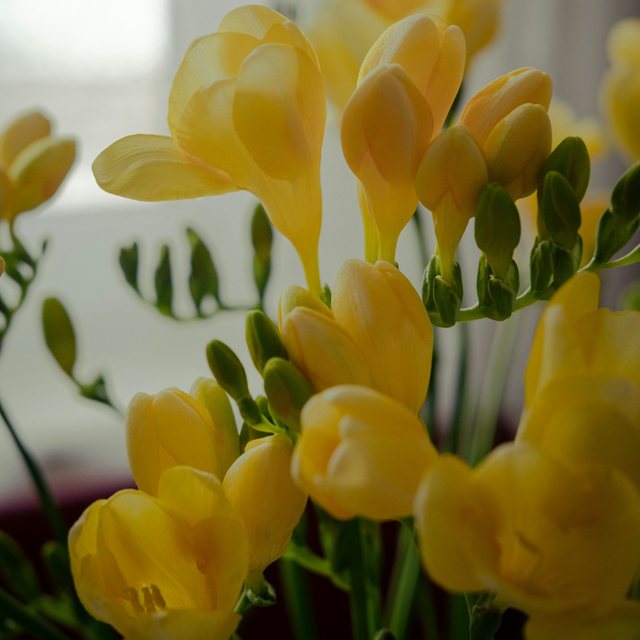
The spike opens from the bottom upward, several funnel-shaped blooms at a time, all along one side of the stem. So a freesia that looks half-finished on the doorstep is behaving correctly. What matters is where it was on that sequence when it was cut. One or two florets should be just beginning to open at harvest, and therefore at purchase; Mississippi State Extension puts it as the first floret puffy and starting to open with at least two more buds well coloured. Cut tighter than that and a good number of florets may never open at all unless preservative solutions are used properly.
Handling is the other half. The trade describes freesia blooms and stems as extremely fragile and prone to breaking and bruising, and warns against over-packing the boxes for that reason. The stem is also highly sensitive to drying out. FloraLife gives it an average vase life of four to twelve days and says it will hold about three days maximum in cold storage at 34-38°F even where the cold chain is kept strictly. Freesia is not a stem that sits in a cooler waiting for a date.
Why the top of the spike stays shut
The freesia failure that reads as a fault is not wilting. It is the tip of the spike drying up with three or four buds still shut. Some of that is built into the plant. Mansour’s Wageningen work found that a freesia main inflorescence can lay down as many as twenty-four flower primordia, and that the uppermost ones wither away rather than developing. The same trials found that plants grown under long days left about half their buds blind, against only ten to twenty per cent under short days.
The rest is ethylene, and freesia’s response to it is unusual enough to be worth knowing. Ethylene does not damage the florets that are already open. The damage lands on the young unopened buds, which simply fail to develop. FloraLife lists the signature as bud drop, transparent petals, petal shatter and colour fade, which is a different picture from a flower that has drooped. One more freesia-specific note: its foliage is sensitive to fluoride, which burns the leaf tips, so fluoridated tap water is the wrong water for this stem in particular.
The scent, and why nobody can promise it
Freesia’s reputation rests on its smell, and the honest position is that the smell is a property of the cultivar rather than of the flower. UC Davis states plainly that only some freesia cultivars retain the delightful fragrances common in garden freesias. Manning and Goldblatt go further in the SANBI monograph: very few cultivars have ever been developed primarily for fragrance, and many commercial varieties have lost their scent during breeding and selection, a stated cause of concern among Chinese and Japanese growers. They describe the range across cultivars as scarcely to strongly fragrant.
A scent survey of nine Freesia species and sixteen cultivars, published in Acta Horticulturae, puts numbers on the spread. The yellow-flowered ‘Gold Flame’, ‘Rijnvelds Golden Yellow’ and ‘Aladdin’ emitted volatile compounds abundantly. ‘Rose Marie’, ‘Blue Heaven’ and ‘Volcano’ showed hardly any emission at all. Those are sixteen named cultivars out of a very large field, not a rule about every yellow or every blue freesia in existence, but it is the clearest published evidence that two spikes labelled freesia can differ enormously.
The chemistry itself is not exotic. Commercial freesia scent is dominated by linalool, alpha-terpineol and the ionones, and none of those is unique to freesia. In Givaudan’s survey of 2,800 fragrant plant species carried out over thirty years, linalool turned up in 76 per cent of species, alpha-terpineol in 30 per cent, beta-ionone in 21 per cent and dihydro-beta-ionone in 11 per cent. The freesia smell is a particular combination of very common compounds, not a novel chemical. There is also no commercial freesia essential oil or absolute anywhere, because Givaudan’s own chemist recorded that extraction generates “disturbing olfactory artefacts” that ruin the product. Every freesia candle and freesia soap on a shelf is a reconstruction of something nobody has managed to bottle from the flower.
Scent also runs on a clock. In the fragrant gullet-flowered freesia species, scent production is highest during the day and diminishes markedly or stops entirely at night. F. andersoniae is the exception, fragrant around the clock, and F. viridis is unique in the other direction: unscented by day, strongly fragrant at dusk. A vase judged at ten at night is not being judged fairly.
Fragrance-restricted wards: what is actually written down
Freesia is the stem people ask about when the destination is a hospital ward, and the reason given online is fragrance. That reason is worth checking before you plan around it. The claim that hospitals ban strongly scented flowers traces back to florist blogs rather than to any hospital’s own published policy we could find. What Stony Brook Medicine actually publishes for visitors is a restriction on fresh flowers and plant-based items in many units on infection-control grounds, an outright prohibition on potted plants, and a statement that it does not currently accept external deliveries for patients, including from local florists. Infection control and delivery acceptance, not perfume, are the terms the policy is written in.
That cuts both ways for freesia. You cannot promise a recipient a fragrant room, because the cultivar decides that, and a same-day order is made from what is in the cooler rather than chosen by cultivar name. You equally cannot promise a scent-free stem for someone who reacts to fragrance. If either direction genuinely matters, the thing to do is say so on the call rather than pick the stem and hope, and to check the unit’s own rules first. Our hospital delivery notes cover which Long Island units take deliveries at all, which is the question that settles the order before scent ever comes up.
Roses at the door tonight
Call 8 hours ahead. Made in our shop and ready with 8 hours’ notice.
Common questions
Will the freesia I send actually smell of anything?
Possibly, and nobody can tell you before it arrives. UC Davis says only some cultivars keep the fragrance of garden freesias, and the SANBI monograph describes commercial cultivars as ranging from scarcely to strongly fragrant, with many having lost scent through breeding. Tell us if scent is the point and we will pass that on, but treat it as a preference rather than a specification.
Is freesia safe to send into a house with a cat or a dog?
The ASPCA names freesia, Freesia corymbosa, as non-toxic to dogs and cats, noting only the potential for an upset stomach if it is eaten. Worth knowing where that comes from: freesia does not appear in the ASPCA’s searchable toxic and non-toxic plants database under F, so the non-toxic listing rests on ASPCA editorial guidance rather than a database entry.
The top few buds on my freesia never opened. Was it a bad bunch?
Not necessarily. A freesia spike can set as many as twenty-four flower buds and the uppermost ones wither rather than develop, so a tip that stays shut is partly normal. If open florets look fine but unopened buds dropped, went transparent or shattered, that is the ethylene signature rather than a fault in the bunch.
How long should freesia be expected to last?
FloraLife’s figure is an average of four to twelve days in the vase. That is a wide band because so much depends on how open the spike was when it was cut. Keep it out of fluoridated tap water, which burns freesia leaf tips, and away from ripening fruit.
Freesia looks like a spring flower. Can it be had in November?
Dutch supply is engineered to run year-round through controlled corm storage rather than following a natural season, so freesia is not confined to spring in the way it once was. Availability on any given day is a wholesale question, and what is in season now is the better place to ask it.
Varieties: hundreds of names, a short working list
More than 340 freesia cultivars have been listed and described in the International checklist for hyacinths and miscellaneous bulbs, with many more registered since. The number actually in production at any one time is relatively small, which is the gap that catches people out. A cultivar name found in a reference work is not a stem you can order.
Single and double, roughly seven to three
The split that matters at the buying end is single-flowered against double-flowered. Of the 167 million freesia stems traded annually at Royal FloraHolland, 118 million are single-flowered and 49 million double-flowered, close to a 71/29 divide. Singles are the open funnel shape people picture; doubles carry more petal per floret. Both are freesia and they read differently in a vase, so it is a fair thing to name when you order.
The names currently being pushed
Recent Dutch introductions include the pure white double ‘FreGanzia’, the deep red single ‘Red Passion’, the soft pink single ‘Monaco’, the red single ‘Merci’ on 70cm stems, the soft pink double ‘Rosario’, and the still-rare ‘Strawberry Swirl’, a double in pink and cream with mauve veining. Naming one of these when you order is a request, not an order line, and it is the sort of thing our substitutions guidance exists to handle.
Why the modern ones are bigger
The first polyploid freesia, ‘Buttercup’, appeared in 1911. Manning and Goldblatt record that most registered cultivars today are polyploid, with diploid strains remaining important mainly where plants are grown from seed each season. The florist freesia is a long way from the wild species in more than colour.
Colour, and what the pigment work found
Freesia petals contain all six of the anthocyanin aglycones common in plants: cyanidin, delphinidin, petunidin, peonidin, malvidin and pelargonidin. The authors of the 2021 study in Frontiers in Plant Science state that this was the first proof of all six occurring in the genus, which is a large part of why freesia covers the colour range it does.
The same five-cultivar comparison found the red ‘Red Passion’ at the top with 1,334.09 micrograms of anthocyanin per gram of fresh weight, and no anthocyanin detected at all in the yellow ‘Gold River’ or the white ‘White River’. It is tempting to line that up against the scent survey, where yellows emitted heavily and blues barely at all, but those are two separate studies on different cultivars and neither claims one explains the other. What holds is the practical version: colour and scent are not independent enough to ignore, and not linked tightly enough to order by.
Where freesia comes from, and how it reaches a Tuesday in August
Freesia is a Cape plant on a Cape calendar. SANBI’s account describes most freesia species as winter-growing, starting root and vegetative growth in autumn at temperatures no higher than 15°C, flowering anywhere from four weeks to six months later, then going dormant for around five months through the hot dry Cape summer. Nothing about that suggests a stem you can buy in any week of the year.
Year-round supply is manufactured, and specifically through corm storage. Holding corms at 30°C for six weeks and then dropping them to 20°C promotes root emergence and cuts the dormant period by up to 30 per cent, about a month, with no loss of flower quality; a soil temperature of 13°C held for seven weeks straight after planting gives early initiation and good flower development. From planting to flowering runs an average of 110 to 120 days, and growers stagger plantings seven to fourteen days apart to keep a succession coming.
The supply base behind that has shrunk hard. Dutch glasshouse freesia has fallen from 450 hectares in the mid-1990s to about 50 hectares today. Royal FloraHolland still trades 167 million freesia stems a year, and the average auction price across all freesia categories was 23 euro cents in 2023, up from 21 cents in 2022. A smaller, more specialised crop is the backdrop to every freesia order placed here.
What freesia does not mean
Freesia is described as one of the most important ornamentals in the flower trade, particularly in Europe and Japan, where its arrival in florists’ shops is welcomed as a harbinger of spring; F. leichtlinii subsp. alba reached Japan in the 1910s. That is the real cultural weight the flower carries, and it is worth more than the symbolism attached to it in gift copy.
Because that symbolism does not survive a look. The claim that freesia means friendship or trust in the Victorian language of flowers is untraceable: Kate Greenaway’s Language of Flowers of 1884, the standard Victorian reference, has no freesia entry at all, and the flower only entered European horticulture between 1872 and 1878, after most floriography dictionaries were compiled. The seventh-wedding-anniversary claim has no issuing body or dated source behind it either. If you want freesia to say something, say it on the card. Nothing in the flower’s history says it for you.
Questions to ask before you choose freesia for an occasion
Does this order depend on scent in either direction?
If a fragrant room is the whole point, or if the recipient reacts badly to fragrance, freesia is the wrong stem to bet on. Cultivars run from scarcely to strongly fragrant and the cultivar is not something a same-day order specifies.
Will anyone be there to see it open?
Freesia arrives part-open by design and works up the spike from the bottom. An empty office over a long weekend gets the least of it. Somebody in the room across four to twelve days gets the most.
Is the destination a hospital unit, and does it take deliveries?
Ask the unit before choosing the stem. Stony Brook Medicine’s published guidance restricts fresh flowers and plant-based items in many units on infection-control grounds, bans potted plants and states it does not currently accept external deliveries for patients. That decides the order regardless of what freesia smells like.
Is a specific colour or a specific cultivar load-bearing?
Freesia comes in bunches of ten, usually one colour to a bunch, so a colour request is realistic. A cultivar request is not: a few hundred names exist and only a small number are in production at any time.
Is anyone going to be upset by a shut tip?
A spike that never opens its last few buds is normal freesia behaviour, not a defect. If the recipient is the sort to read that as a poor delivery, a stem that arrives finished may serve the occasion better.