

Orchids by Season on Long Island: The Calendar Is Set Somewhere Else
USDA counts cut orchids in blooms, not stems. California grew about 96 percent of the 2019 domestic crop, and Hawaii’s Dendrobium peaks in August.
Call 631-612-6156 with the town, the date and what the flowers are for, or order red roses by phone. With orchids, the timing question is worth raising when you call.
Counted in blooms, and grown somewhere else
In the USDA National Agricultural Statistics Service Floriculture Crops survey, the other cut crops in the table are counted in stems, spikes or bunches: chrysanthemums, dahlias, gerberas, gladioli, iris, lilies, peonies, roses, snapdragons, sunflowers. Orchids are counted in blooms. They are the only cut flower in that survey measured that way.
In 2019, 23 US operations sold 3,047,000 cut orchid blooms for $5,536,000 wholesale, an average of 181.7 cents per bloom, up from 169.4 cents the year before. US cut roses in the same survey year averaged 77.1 cents per stem. A cut orchid bloom wholesaled for roughly 2.4 times a domestic cut rose stem.
Of those 3,047,000 blooms, California grew 2,941,000, about 96 percent of domestic production. Any cut orchid a Long Island florist handles has almost certainly crossed the country or an ocean.
New York’s own numbers in the same survey are small. The state had 2 operations growing cut orchids, with the volume withheld to protect individual growers, and 9 operations producing potted orchids at the $100,000-plus sales threshold, down from 12 the year before. Statewide, New York reported 680 floriculture operations and $236 million in floriculture sales in 2023.
Suffolk County is farm country on the wider measures. The 2022 Census of Agriculture counted 578 farms there, 33,821 acres in farms and $364,160,000 in market value of agricultural products sold, equal to 5 percent of New York State’s agricultural sales, with 93 percent of that value coming from crops rather than livestock. No orchid-specific county figure exists.
Hawaii’s Dendrobium year, and the trip east
Hawaii’s cut Dendrobium crop has a pronounced annual shape. The University of Hawaii CTAHR production manual puts the heavy flowering period from early summer through late fall, generally peaking in August, with scattered light flowering through the winter and spring months.
That crop reaches mainland US markets by air freight, remaining in transit for one to three days. The sprays are bundled in sets of 5, 6, 10 or 12, with a water-soaked cotton ball around the stem ends inside a small clear polyethylene bag.
The same manual names the import seam directly: Hawaii’s Dendrobium cut-flower growers have felt the influence of foreign competition, primarily from Thailand.
Questions people ask about orchid timing
Is any cut orchid actually grown on Long Island?
The published figures point elsewhere. New York State had 2 operations growing cut orchids in the 2019 USDA survey, with the volume withheld to protect individual growers, and no orchid-specific figure exists in Suffolk County’s 2022 agricultural profile. California grew about 96 percent of the domestic cut crop that survey year.
How much did a cut orchid bloom cost wholesale compared with a rose stem?
In 2019 the average US cut orchid bloom went for 181.7 cents, up from 169.4 cents the year before, while the average US cut rose stem went for 77.1 cents. That puts a single cut orchid bloom at roughly 2.4 times a domestic cut rose stem at the wholesale level.
When does Hawaii’s cut Dendrobium crop flower most heavily?
The CTAHR production manual gives a heavy flowering period from early summer through late fall, generally peaking in August, and scattered light flowering through the winter and spring months. Sprays travel to mainland markets by air freight, one to three days in transit.
Where is the nearest large orchid display to Nassau and Suffolk?
The New York Botanical Garden’s Orchid Show runs 6 February to 25 April 2027 in the Enid A. Haupt Conservatory in the Bronx. It is the nearest major orchid exhibition to the two counties, and it sits inside the winter-into-spring window when Phalaenopsis and Cymbidium are in season.
The bloom window belongs to the genus
Bloom seasons and durations differ from genus to genus. Clemson’s horticulture extension gives Phalaenopsis flowering in winter or early spring and holding for several months; Cattleya in spring or fall for two to six weeks; Dendrobium in fall and winter for three to four weeks. NC State Extension adds Cymbidium in winter, early spring and summer depending on variety; Oncidium in fall; Vanda in all four seasons, with blooms lasting a little over a month; and Paphiopedilum flowers lasting one to two months.
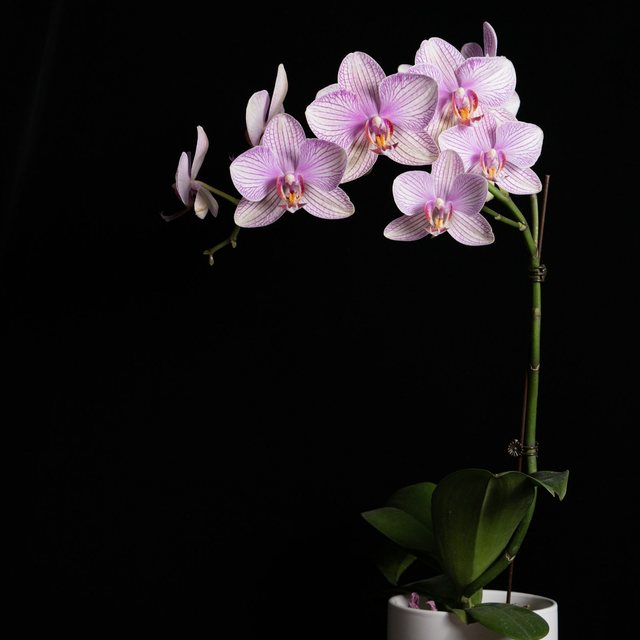
Phalaenopsis splits internally. Spring-flowering large-flowered Phalaenopsis require cool autumn conditions to initiate flower spikes, while modern dwarf hybrids do not require chilling. A gift plant reblooms on a schedule set by the room it sits in.
If a specific genus matters to you, say so when you order. Our substitutions page covers how a florist handles the gap between what was pictured and what came off the truck, and what’s in season now tracks the wider list week by week.
New York’s wild orchids keep their own calendar
The Department of Environmental Conservation’s survey of New York’s native orchids gives bloom months: pink lady’s-slipper (Cypripedium acaule) in May and June, which NC State widens to April through June; grass-pink (Calopogon tuberosus) in June and July; Loesel’s twayblade (Liparis loeselii) in June and July; large yellow lady’s-slipper in June and July; lesser purple fringed orchid from June through August; spotted coralroot from July through September; and nodding ladies’-tresses (Spiranthes cernua) in August and September.
DEC describes pink lady’s-slipper in sphagnum bogs and highly acidic forests with pine or hemlock, and NC State gives dry to mesic, acidic forests and woodlands, often under pines, other conifers, or oak. DEC also notes that grass-pink, rose pogonia and white fringed orchid are found most often in coastal dune sands and in bogs and fens. Those are the habitat types of Long Island’s pitch pine-oak barrens and its coastal wetlands. Neither source names Nassau or Suffolk County, so this is a description of habitat and not a claim about county records.
Where the volume sits
In 2019, 152 US operations sold 37,677,000 potted orchids worth $298,889,000 wholesale, about $7.93 a pot, against 23 operations selling 3,047,000 cut orchid blooms worth $5,536,000. Domestic potted-orchid wholesale value was roughly 54 times the domestic cut-orchid value. One caveat belongs with that figure: USDA counts US production only, not imports, so the cut side is understated.
Potted orchids also outsold poinsettias by value in the same survey, $298,889,000 against $153,113,000, which made orchids the highest-value single named potted flowering plant category USDA tracks.
What changes if the import timing changes
Run the date you have against the origin the flowers are likely to come from.
- If your date is in August and Hawaiian Dendrobium is what was pictured: that sits inside the heavy flowering period CTAHR describes, early summer through late fall, generally peaking in August.
- If your date falls in winter or spring: CTAHR describes scattered light flowering through the winter and spring months. Ask on the confirmation call what the wholesaler has that week.
- If the sprays come from Hawaii by air freight: CTAHR gives one to three days in transit, with the sprays bundled in sets of 5, 6, 10 or 12 and a water-soaked cotton ball around the stem ends inside a small clear polyethylene bag.
- If your date falls between February and April and you want Phalaenopsis or Cymbidium: Clemson gives Phalaenopsis flowering in winter or early spring and holding for several months, and NC State gives Cymbidium in winter, early spring and summer depending on variety. The New York Botanical Garden’s Orchid Show runs 6 February to 25 April 2027.
- If the date is fixed but the genus is not: NC State gives Vanda flowering in all four seasons with blooms lasting a little over a month, and Paphiopedilum flowers lasting one to two months.
- If a potted plant would do instead of cut stems: spring-flowering large-flowered Phalaenopsis require cool autumn conditions to initiate flower spikes, while modern dwarf hybrids do not require chilling, and a gift plant reblooms on a schedule set by the room it sits in.
Roses at the door tonight
Call 8 hours ahead. Made in our shop and ready with 8 hours’ notice.