

Tulips keep growing after they are cut — what that means for the vase they land in
Tulips on Long Island: how they keep growing in the vase and what that means for an arrangement. Same-day roses from our Port Jefferson shop.
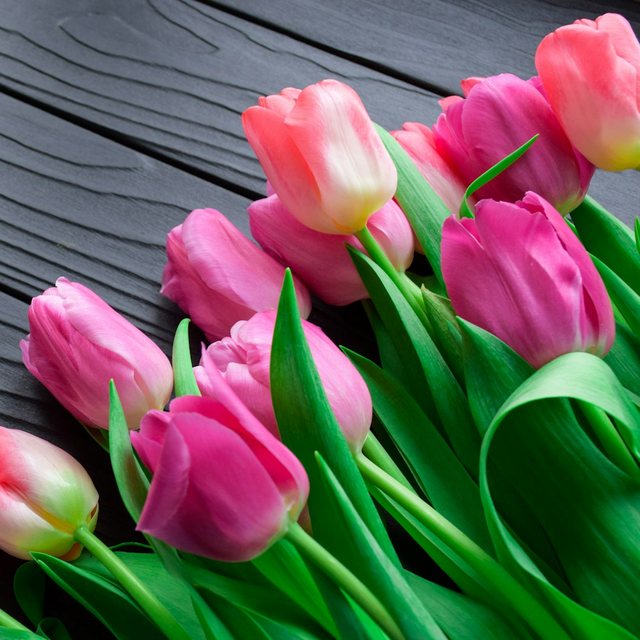
Order online or call
Order red roses online, or call 631-612-6156 with what you want and where it is going.
Same day on Long Island
Tulip orders that reach us early enough go out on that day’s run.
We will say no
If tulips are wrong for the week, the room or the recipient, we will tell you on the phone and suggest something else.
Care is one line
Cold water, an inch or two of it, not on a sunny windowsill. That is the whole method.
Most cut flowers are, in every meaningful sense, finished by the time they reach a vase. A rose is the size it is going to be. A tulip is not finished. It is a bulb flower picked mid-job, and it carries on with that job in your water: the stems lengthen, often by close to an inch, and the heads swing toward whatever light is in the room. Deliver a neat dome of tulips on Tuesday afternoon and by Wednesday morning it is taller, looser and leaning at the window. Nearly every complaint we hear about tulips is a description of exactly that, from someone nobody warned.
That is not the flower failing, that is the flower working
Two things happen at once. The stem is still elongating, which is why a tulip arrangement rises after delivery instead of settling. And the stem is phototropic to an unusual degree, so it bends toward a window — and if you turn the vase, it spends the next day bending back the other way. Florists who like tulips design for this on purpose: cut a little shorter than looks right on day one and let the whole thing open out across the week. If the recipient wants them standing to attention, tell them to give the vase a half-turn each morning or move it away from one strong light source. If they like the sprawl, they do nothing. Both outcomes are correct, and neither one means the flowers are dying.
Cold water, and not much of it
Here is where tulips break the rule you have been taught everywhere else. Warm water speeds uptake in most stems and is standard advice for roses. For tulips it is the wrong instruction: warmth pushes them open and pushes them taller, faster. Cold water slows all of it down. Keep the water shallow as well, an inch or two, because tulip stems left standing in deep water go soft. Recut the ends on a slant and take off the pale white section at the very base, which drinks poorly. Change the water every couple of days, because tulips drink hard and the level drops faster than people expect. Keep them off the radiator, out of direct sun, and away from the fruit bowl, since ripening fruit gives off ethylene and ethylene ages flowers. If you need them to hold for a party, put them somewhere cold overnight; an unheated porch does more for tulips than any additive.
Do not put daffodils in the same vase
This is the most common way a home-made spring arrangement gets wrecked, and it involves the two flowers people most want to buy together. Cut daffodil stems leak a sap that shortens the life of other flowers sharing the water, and tulips are the classic casualty. If you want both, condition the daffodils alone in their own jar for several hours first, then move them across without recutting the stems. If that sounds fussy, it is — two vases is the easier answer, and if you are ordering a mixed spring arrangement from us, ask and we will build around the problem rather than into it.
Order them closed
A tulip that arrives fully open is a tulip near the end of its run. Tight buds with a little green still showing are what you want: not underripe, just the days you paid for still in front of you. Worth knowing before you hold a delivery up against a photograph, because a good tulip delivery looks quieter and tighter than the picture for the first day or two, and then becomes the picture.
The spring window, and the rest of the year
In the ground, tulips are a spring flower. In the trade they run far longer than that, greenhouse-grown and imported, which is why an October tulip is not a strange request. What narrows outside the peak is choice rather than availability: fewer colours, shorter stems, and prices that move. Late winter through spring is when tulips are at their best and their most sensible, which is why they carry Easter so well and why they are such a natural Mother’s Day stem. Outside that stretch we would rather tell you what is genuinely good this week than take an order for a colour we cannot get. Longer notes on tulip care and on how the season runs sit deeper in this section; the colour and the meaning are below, on this page.
Bringing a floppy tulip back
Tulips flop. It is not always terminal, and the repair is a sheet of newspaper rather than anything you buy.
- Recut an inch off the stems on a slant.
- Wrap the bunch snugly in newspaper from just under the heads down past the middle, so the stems are held straight.
- Stand the wrapped bunch in a few inches of cold water for an hour or two, somewhere cool.
- Unwrap. The stems rehydrate straight and tend to hold that shape.
If they collapse again within a day, the stems have stopped drawing water and no amount of wrapping will change it.
Six tepals, no blue, and a stripe that was a virus
A tulip does not have petals in the strict sense. It has six tepals in two whorls of three — three petals and three sepals so nearly identical that the flower is described by the single word, and tepal is the term the postharvest literature uses. Those tepals come in reds, yellows, purples and whites, and they do not come in pure blue. Every cultivar sold with blue in its name is a faint violet. If a colour scheme genuinely turns on blue, tulips will not supply it, and that is worth saying out loud before a custom order gets built around a swatch.
What is there instead is a fairly short list of pigments. Analysis of tulip flowers identifies four major anthocyanins: pelargonidin 3-rutinoside, cyanidin 3-rutinoside, delphinidin 3-rutinoside and their acetyl derivatives. Delphinidin 3-rutinoside and its acetyl forms are what make a tulip purple; the pelargonidin and cyanidin rutinosides produce the reds, the oranges and the pinks. The pigment is laid down tissue by tissue rather than all over, so one tulip can carry different anthocyanin in the face of the tepal, at the base of the perianth, in the anthers and in the pollen. That is what puts the contrasting dark or pale blotch at the bottom of the cup when you look down into it. The cultivars examined in that work included Ben van Zanten and Ile de France.
The striped and feathered tulips in the Dutch paintings were sick plants. Those bars, stripes, streaks, featherings and flame effects are caused by aphid-transmitted potyviruses — tulip breaking virus, tulip top-breaking virus, tulip bandbreaking virus and Rembrandt tulip-breaking virus — which alter how pigment is distributed through the tepal. The infection also degenerates the bulb, which weakens over successive generations until it can no longer flower. That is why most of the historic broken lines, Semper Augustus among them, no longer exist. The striped tulips of the Dutch paintings are literally extinct.
Rembrandt is not a marketing word either. It is a formal KAVB horticultural division, Division 9, and modern Rembrandt-type tulips are bred for stable striping rather than carrying a virus. So a stripe is orderable. It is simply a bred stripe rather than the sick one.
What tulips mean, and which of those meanings can be traced
The colour meanings that circulate — yellow for sunshine, purple for royalty, white for apology, pink for affection — have no primary source behind them that we have been able to find, and neither does the line about tulips standing for perfect love and spring renewal, which would be equally true of any spring flower. The one Victorian text you can pull up and read for yourself is Kate Greenaway’s Language of Flowers, published by George Routledge and Sons in London in 1884. Its tulip entries run: Tulip, fame; Red Tulip, declaration of love; Yellow Tulip, hopeless love; Variegated Tulip, beautiful eyes. The yellow entry is the exact reverse of the cheerful reading sold today.
Cornell University Library’s floriography exhibit puts that book at the end of the tradition rather than at its height: by 1884 the serious, detailed flower language had been reduced to simple lists stripped of the poetry of the earlier works, and the practice had effectively disappeared by the First World War. The tulip meanings quoted hardest now were printed as a commercial parlour fashion was going out.
The older meanings, which are not Victorian at all
In Islamic tradition the lale came to stand for remembrance of Allah, and Ottoman artisans painted lale petals on mosque tilework in a form that evoked the calligraphic shape of the word itself. In Shia narrative the lale blooms red because Husayn’s blood rained on the desert after his martyrdom at Karbala, and that is the root of the tulip’s association with martyrdom. In Persian and Urdu poetry the red lale is burning love, its black corolla read as the heart of the lover burnt to ashes and obliterated by passion; Mughal tulip gardens were called lal-zaar, ruby-coloured petal gardens, a phrase used idiomatically in Kashmiri for one’s beloved.
None of that is Dutch, and the tulip reached Western Europe late and by a documented route. Ogier Ghiselin de Busbecq met them in Constantinople in 1554. Conrad Gessner described tulips flowering in Augsburg in 1559. Carolus Clusius planted them at the Vienna Imperial Botanical Gardens in 1573 and at Leiden University in 1593, and 1594 is taken as the tulip’s first flowering in the Netherlands.
Tulipmania is largely a story about a book from 1841
The drowned investors, the ruined merchants, the whole cautionary tale: the archival research of the historian Anne Goldgar found that trading peaked in late 1636 and the market collapsed in February 1637, but that few people were involved, that the economic repercussions were minor, and that she could not find anybody who went bankrupt. The canal stories trace to Charles Mackay’s 1841 book and to Dutch Calvinist propaganda pamphlets rather than to the record. Useful to know when somebody raises it over the vase; bad to repeat as history.
The meaning with a paper trail
Princess Juliana of the Netherlands sheltered in Ottawa during the Nazi occupation, and part of the Ottawa Civic Hospital was declared Dutch soil for the birth of her daughter, Princess Margriet. In 1945 she sent Canada 100,000 tulip bulbs in thanks. The Dutch royal family has sent bulbs every year since, the first Canadian Tulip Festival was held in 1953, and over a million tulips bloom in Ottawa each spring. In that tradition the tulip works as a symbol of gratitude and liberation rather than a romantic one, which fits the way people here actually use them: a thank-you, a welcome, an occasion that does not want to sound like a proposal.
What tulips are good for, and what they are not
Tulips read as spring, plainly, without much freight attached. That makes them a better choice than roses in every situation where roses would say too much: a new home, a thank-you, an apology that is not meant to be a grand gesture, a birthday for somebody who hates fuss. Most varieties carry very little scent, which matters more than people realise when flowers are heading for a hospital room or to someone in treatment where fragrance is unwelcome. They are not a traditional sympathy stem — they are short-lived and they read as celebration, so we usually steer that request somewhere steadier. Several of the mixed arrangements in our bouquet range use tulips as the spring backbone, and in season we will happily put together straight tulip bunches by colour instead.
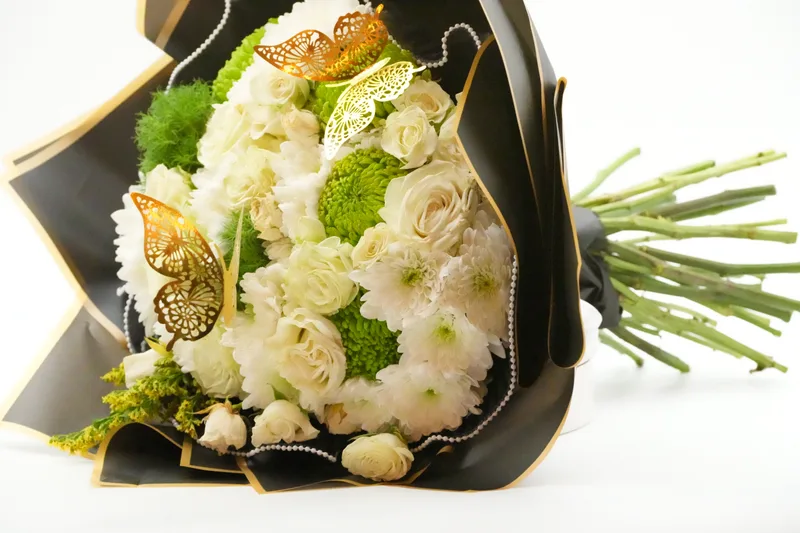
Roses at the door tonight
Call 8 hours ahead. Made in our shop and ready with 8 hours’ notice.
Common questions
Why are my tulips taller than when they arrived?
Because they are still growing. Cut tulips can add close to an inch of stem in the vase, which no other common cut flower does. Cold, shallow water slows it down; nothing stops it, and nothing has gone wrong.
Does flower food help tulips?
Less than temperature does. Use the sachet if one came with the arrangement, but if you are only going to do one thing, keep the water cold and change it every couple of days. Food will not slow the elongation and it will not stop them leaning.
Are tulips safe around cats and dogs?
The bulb is the toxic part, so cut stems are a much smaller concern than a potted bulb garden, but tulips still sit on the toxic-to-pets lists. If there is an animal in the house that chews flowers, keep the vase out of reach and tell us when you order. It is also the reason we ask about cats before anyone sends lilies, which are a genuine emergency rather than a caution.
How long will cut tulips last?
Usually somewhere around five days to a week from delivery, longer in a cool room, shorter in a warm one or if they turned up already open. That is less than carnations or roses give you, and it is the honest trade for how they behave in the meantime.
Can I ask for a specific colour?
Often, yes, though colour availability moves week to week and moves most outside spring. Ask before you commit to a colour scheme and we will tell you what is actually coming in rather than what appears on a chart.
Can you deliver tulips today?
If your request reaches us in time for that day’s Long Island route, usually yes. We confirm by phone before anything is charged, and if the timing will not work we would rather say so on that call than after the money has moved.