

Flowers at Stony Brook University Hospital: permitted in the building, refused at the door
Stony Brook University Hospital turns away couriers, not bouquets. Who may carry flowers in, and how to get yours to the right floor.

Carried in, not delivered
The hospital turns away couriers rather than bouquets, and every other rule on this page hangs off that one distinction.
Eleven prefixes to check
Hold the room label a relative texted you against the restricted code prefixes printed further down.
Ask before you pay
Give us the unit and we will tell you whether anything can reach that bed, before you spend a cent with us or with anyone else.
The shop already inside
Nurture Gift Shop trades from the main lobby on (631) 444-3133, past the point where deliveries stop.
Two people can walk up to the same entrance of Stony Brook University Hospital holding the identical wrapped bouquet, and only one of them takes it upstairs. The visitor does. The driver paid to bring it does not. Nothing about the flowers changed between those two arrivals — the hospital’s rule reads whose hands are on the stems, not what is in them.
Get that backwards and you write the page most florists have written about this address: they find the sentence permitting floral arrangements, sell a delivery against it, and leave the buyer to discover the refusal at the lobby desk. Both sentences are published, both are true, and they answer different questions.
The refusal names couriers, and Stony Brook publishes it twice
“We do not accept deliveries for patients. This includes but is not limited to deliveries from: food deliveries, door dash, uber eats, local florists, Amazon, and UPS to name a few.”
— Stony Brook Medicine visitation guidelines
Look at the company the florists are keeping in that sentence. Meal apps. A parcel carrier. A second parcel carrier. It is a roster of strangers turning up at a door with a package for a person they have never met, and a florist’s van qualifies for the list on exactly those grounds. No clause in it says a patient may not have flowers. It says nobody will take them off you on the patient’s behalf.
The same refusal appears in a second wording elsewhere in the hospital’s own visitor material, which is worth knowing if you are comparing pages and wondering which quote is the real one. They are both real, and they say the same thing.
“At this time, we do not accept external deliveries for patients. This includes deliveries from local florists, Amazon and UPS, to name a few.”
— Stony Brook Medicine patient and visitor information
Our side of this is easy to state: we would rather tell you this than sell you an arrangement the ward will turn away. Ask us to have flowers delivered to a patient at this address and the honest reply is that the order travels as far as the lobby and stops.
What a visitor’s own hands may carry past the lobby
“In most areas of the hospital, Mylar ballons (maximum of 5 – we do not allow latex) and floral arrangements (we do not allow potted plants as per the CDC guidelines), are permissible”
— Stony Brook Medicine visitation guidelines
Three rules are compressed into that one line, and they are not the same kind of rule. Cut arrangements clear most of the building. Mylar balloons clear it as well, five being the ceiling rather than a suggestion, while latex is refused everywhere on allergy grounds and not because anyone dislikes the look of it. Potted plants are excluded on infection-control grounds, and note that the hospital attributes that one to the CDC rather than to house preference.
Spend a moment on the potted-plant clause before you buy, because it draws its line around the container rather than the bloom. Orchids are the usual casualty, since they are nearly always sold rooted in soil — the gift chosen precisely because it outlives a bouquet is the one this building will not admit. Wrapped cut stems are the shape that travels. Something low-scent that does not demand a wide-based vase does best on a crowded windowsill, which is why a hand-tied bunch of daisies beats a tall pedestal piece in a shared room.
Eight named wards, eleven code prefixes, and no published map between them
“Many areas of the hospital have strict safety restrictions that prohibit fresh flowers and certain plant-based items.”
— Stony Brook Medicine visitation guidelines
Most hospitals name a handful of restricted departments and leave you to work out which floor that means. Stony Brook goes one better and publishes the code prefixes as well, which turns a vague caution into something you can hold against a room number. What it does not publish is which prefix belongs to which ward, and we are not going to invent that pairing to make the page tidier. Treat the two lists as two separate tests, and fail either one and the answer is the same.
The prefixes published as restricted are 05NN, 6W1, 6W3, 7W1, 08N, 8W1, 9W1, 17N, 17S, 19N and 19S. If the label on the wristband or the door starts with any of those eleven, stop shopping for stems and shop for something that is not plant material.
The eight named wards follow, one at a time. The hospital lists them without explaining itself; where a reason is given below it is our reading of why a bouquet does not fit that particular ward, not a quotation from the policy.
Behavioral Health Units
This is the one ward on the list where the objection is not biological. Everything crossing the threshold is weighed as an object first: glass vase, wire stem supports, ribbon, the plastic fork holding the card. Rewrapping does not get a bouquet through that assessment, and a balloon on a weighted string does not either. A written card handed to the unit clerk is the version of the gesture that arrives.
Burn Unit
Here the problem is the water, not the vase. Burn patients have lost the skin barrier that keeps ordinary environmental organisms on the outside of a person, and a vase of standing water sitting warm in a room is the sort of thing a unit like this designs itself around. It also means the usual substitution fails: swapping a potted plant for cut stems changes nothing, because both are refused for the same reason on this ward.
CDU, the Clinical Decision Unit
The CDU hangs off the Emergency Department and exists to settle a single question — admit or send home — usually inside a day. A patient there has no settled room, so an arrangement carried up has no surface to stand on and nobody to inherit it when the decision comes. If the answer turns out to be admission, wait for the ward code and check it against the eleven.
Emergency Department
In the ED there is no room in the sense the word normally carries. A patient may be behind a curtain now and two floors up within the hour, and whatever you brought stays in your arms the whole time. Flowers are close to the worst object to be holding while staff are working around a stretcher, which is reason enough before any infection argument is made.
Intensive care units
The surface beside an ICU bed is not a shelf; it is working space for equipment and for the people using it. Add the immune state of most patients in those beds and the permission covering “most areas” simply stops at the door. The five-balloon allowance is irrelevant here rather than reduced — there is no smaller number that works.
Oncology and transplant units
Patients on these units spend stretches deliberately immunosuppressed, which is where the CDC line the hospital cites does its heaviest work. Soil is out of the question and cut stems get no further than the corridor either. This is also the ward where a long admission makes people want to send something repeatedly, so it is worth deciding early on a non-plant gift you can send more than once.
Pre-Operative
Pre-op is a holding area running to a theatre schedule. Belongings are bagged and tracked because they have to follow the patient to another part of the building, and a vase of water is the one item that cannot make that journey. Anything you bring here is really being handed to whoever is waiting, not to the patient.
PACU, the recovery area
Recovery is a room of beds under continuous observation, with people passing through in hours and visiting kept deliberately brief. Nothing decorative belongs in that space. The useful move is to hold the flowers for whichever ward the patient wakes up on afterwards, then check that ward’s code before you carry anything in.
Why the hospital asks for a phone call even when the code clears
“We strongly encourage visitors to call the unit in advance to confirm what items are allowed.”
— Stony Brook Medicine visitation guidelines
Notice that the permission was granted for “most areas” and never for all of them, and that the hospital is telling you itself where the gap sits. A patient on an unrestricted ward can still be under an individual precaution — an allergy, an isolation order, a neighbour in the next bed who reacts badly to pollen — and no published list will ever carry that. Patients also change floors mid-stay, so a code that cleared on Tuesday may describe a bed the patient no longer occupies by Thursday. A transfer to another site is a fresh question rather than a continuation of this one: check the receiving hospital on its own terms in our Long Island hospital directory, because the hospitals in this system do not run identical balloon and delivery rules.
Two routes that end at a bedside
Nurture Gift Shop, main lobby
- Phone: (631) 444-3133
- Weekdays 7:00 am to 8:00 pm; weekends 10:00 am to 6:00 pm
- Fresh flower arrangements, balloon bouquets, stuffed animals, puzzles, books and simple necessities
The shop’s advantage is geographic rather than commercial: it is already past the threshold where the delivery rule applies, so nothing it sends to a room has to survive the conversation at the entrance. Ward restrictions still bite, so the eleven prefixes matter here as much as anywhere. We earn nothing by naming it and it is not our sale, but it is the route that works, so there it is.
Addresses a courier may knock on
- The family home, where somebody is usually in to take them and the household has been running on hospital-canteen hours for days.
- The patient’s own address, timed for a few days past discharge, when the crowd of well-wishers has thinned and a delivery is not competing with five others.
- A visiting relative’s hotel or a colleague’s office, if the point is for the flowers to travel in with them on the next visit — which is the courier rule turned to your advantage rather than broken.
Which of those suits depends on how long the stay is likely to be, and our get well and new baby guide works through the difference between a two-night admission and a long one.
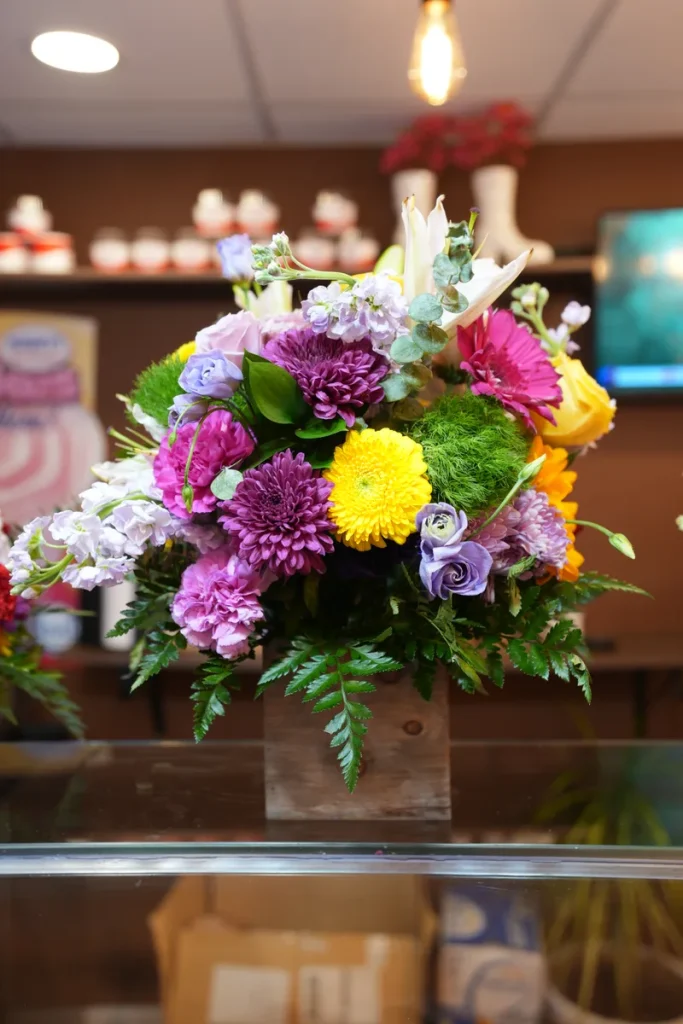
Roses at the door tonight
Call 8 hours ahead. Made in our shop and ready with 8 hours’ notice.
Common questions
Can a florist work around the refusal by leaving the flowers at the front desk?
No, because that is the refused act described precisely. The published wording is about accepting parcels and arrangements for patients from people delivering them, and a desk handover is the plainest possible example. A shop that agrees to try is selling you a trip to the lobby.
If a visitor carries it in, which rules still apply?
The ward rules, all of them. Carrying in clears the courier problem and nothing else: five Mylar balloons remains the ceiling, latex stays barred throughout the building, potted plants stay barred on CDC grounds, and a restricted ward is restricted no matter who is holding the stems.
The room label starts with one of the eleven prefixes — does a visitor’s hands change anything?
Not on that ward. The prefix is the hospital telling you flowers and plants do not go in there, and a person is not a loophole in it. Switch the gift rather than the delivery method: a card, a book or a soft toy passes where a bouquet is turned back.
Can I send flowers to a visitor’s address so they arrive with her?
Yes, and it is the cleanest use of the distinction. A courier delivers to a house, a hotel or an office where deliveries are welcome, and the flowers finish the journey in the hands of somebody with visiting rights. Time it to the visit rather than to the order.
Does the potted-plant ban apply to a gift carried in by hand?
It does. That clause is written about what is in the room, not about how it got there, and the hospital rests it on CDC infection-control guidance rather than on preference. Orchids and succulents are the two people most often try, both being chosen for lasting longer than cut flowers. Keep the plant for the home the patient returns to.
The ward is not on the restricted list. Is there still a reason to phone?
Yes, and the hospital says so in its own guidance. The unit clerk can confirm two things a website cannot: whether this particular patient is under an individual precaution, and whether they are still on that floor at all. Two minutes on the phone is what stands between a bouquet on a windowsill and one handed back at a nurses’ station.
Quotations above are taken from Stony Brook Medicine’s published visitor and visitation guidance. Hospital rules change without notice — confirm with the unit before you order.