

Christening and baptism flowers on Long Island — check the church calendar before you order anything
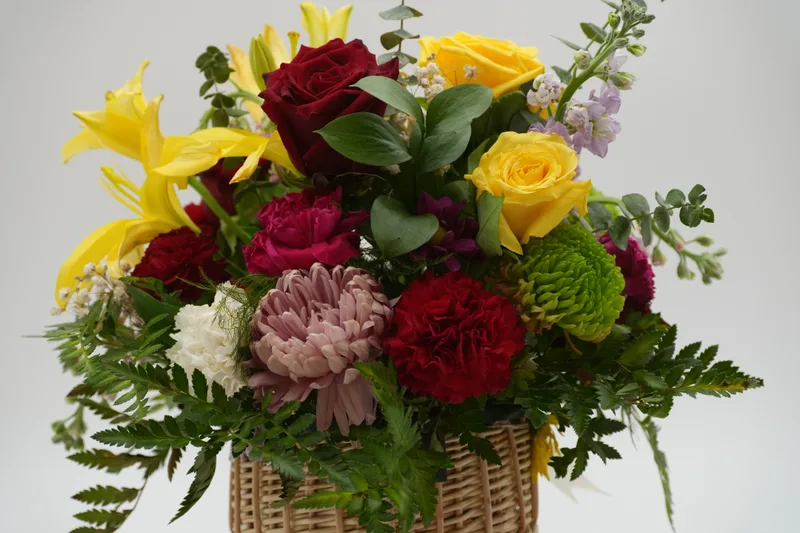
Christening and baptism flowers on Long Island, including the Lent rule for altar flowers. Ordered from our Port Jefferson shop.
Lent is a flat prohibition
Inside Lent the altar is not decorated with flowers at all, and the exceptions are named days rather than a favour a parish grants.
The font fixes the address
Baptisms take place at a parish church’s own font, so that building is the delivery address regardless of where the party is.
Nothing to buy to check
Every question on this page is answered by the parish calendar and the parish office, and none of it requires an order first.
We drop, we don’t install
Arrangements arrive at the door rather than being set up inside.
For one long stretch of every year the answer for a Roman Catholic baptism is not a smaller arrangement or a plainer colour — it is none on the altar at all. The stretch is Lent, it is fixed to Easter rather than to any date on the ordinary calendar, and it is set out in a single paragraph of the General Instruction of the Roman Missal, quoted here verbatim:
“During Lent it is forbidden for the altar to be decorated with flowers. Exceptions, however, are Laetare Sunday (Fourth Sunday of Lent), Solemnities, and Feasts. Floral decoration should always show moderation and be arranged around the altar rather than on the altar table.”
Paragraph 305 decides more of the church half of a christening order than the florist does, or the budget, or how far ahead you book. A date that sits inside Lent and outside the named exceptions carries no altar flowers, however much a family was willing to spend and however early they called. The only thing that changes that outcome is a different date.
That single fact reorganises the order. The money that would have gone to the church usually moves to the reception, which is governed by an entirely different set of venue rules covered across the rest of our party and event flower guidance, and to the people rather than the room. Read the calendar first and the rest of the decisions get easier.
The exceptions are named days, not a favour a parish can grant
Read the exceptions closely, because that is where people get caught. They are not categories a parish can extend to a family that asks politely. They are named days: Laetare Sunday, which is the fourth Sunday of Lent, plus Solemnities and Feasts, which are ranked days that appear on the liturgical calendar and can be looked up. If your baptism falls on a Lenten Saturday or on a Lenten Sunday that is not the fourth, the altar carries no flowers. There is no version of the order that changes that.
This is why the calendar has to come before the florist rather than after. A date that was completely unremarkable last year can sit squarely inside Lent this year, because Lent tracks Easter and Easter moves. A family choosing between two consecutive weekends in the same month can be choosing between full flowers and none, without anything about the church or the guest list changing at all. Outside Lent the same weekend can instead arrive with the sanctuary already dressed from a liturgy an hour earlier — that decoration belongs to the parish and stays where it is.
The placement rule nobody reads to the end
The last sentence of paragraph 305 is not seasonal. Floral decoration is to be “arranged around the altar rather than on the altar table,” and that applies in every season, including the ones where flowers are welcome. In practice it rules out the shape most people picture when they think of church flowers: a low, wide arrangement designed to sit on a flat surface. What works instead is a piece that stands on its own on the floor beside the sanctuary or at the font, built with enough height to read from the pews.
That pushes the order toward long, upright stems rather than compact heads. Lilies carry height honestly and hold a standing arrangement together, though anyone seated close by will be aware of the scent for the whole rite. Where the piece needs to be large without the cost climbing to match, carnations give you mass per stem and hold up through a long morning out of water.
Greek Orthodox parishes put the handling rules in writing
Orthodox sacramental guidelines are usually more explicit about physical handling than they are about season, and the published wording is short enough to quote directly.
Nothing on the pew ends
“No ribbons, decorations or flowers may be affixed to the ends of the pews,” and “all floral arrangements must be free standing.” That removes an entire product category from the order before you start: no aisle markers, no clip-on posies, no bows down the centre aisle. Everything you bring has to hold itself up.
Everything leaves the same day
“All flowers, candlelabra, etc. must be removed from the Church immediately following your sacrament.” This is the line that causes the most trouble on the day, because it is a job rather than a restriction. Somebody has to physically carry the arrangements out while the family is still being congratulated on the steps, and that person is almost never nominated in advance. Two consequences follow. Name the person before the day, and choose pieces two people can lift between them rather than one showpiece that needs a trolley and a second trip.
No balloons in the sanctuary
“No balloons are permitted in the sanctuary.” Worth knowing early if the balloons were bought as part of a package with the flowers, because they will have to wait in a car or go straight to the hall.
The address is settled before you choose it
The Diocese of Rockville Centre states that baptisms take place only at the dedicated font of a parish church, not in school or college chapels. For a delivery that is unusually helpful: the address is not a matter of preference, and a chapel address handed to you by a relative who assumed otherwise is simply the wrong building. Confirm the parish church, and the flowers go where the rite is.
One limit on our side is worth stating plainly here. We deliver flowers to the door. If your venue needs a vendor’s certificate of insurance or set-up inside, call 631-612-6156 before you order. Flowers can be dropped at a church or a hall; they cannot be installed inside one. For a christening that is rarely a problem, since standing arrangements set down by the font need no rigging, but it does mean somebody from the family carries the piece the last few feet.
What the reception can carry that the church cannot
When the date rules out altar flowers, the flowers do not disappear from the day — they move to a room with no liturgical calendar attached to it. Tables at the hall sit outside every rule quoted above, and so does an arrangement handed to the godparents at the end of the meal. A gift for the parents themselves usually reads better as congratulations flowers than as ceremony decoration, and it is the one part of the order that is genuinely yours to design.

Work the date against the documents, in the order they have to be settled
Each line below is settled against something published — a calendar, an ordo, a diocesan policy, a parish’s own written guidelines — rather than against a conversation with a florist.
Locate the date on this year’s Lenten span
Lent moves with Easter, so a weekend can fall outside the span one year and inside it the next, and only the current year’s span governs the christening you are planning.
Where it is written: the liturgical calendar for the current year.
Rank the day before assuming the prohibition holds
Laetare Sunday, a Solemnity and a Feast are the three ranks that lift it, and rank is something the calendar assigns to a day rather than something a parish decides for a family.
Where it is written: the ordo for the current liturgical year.
Read the parish’s own calendar beside the general one
A patronal day or the anniversary of a church’s dedication can carry a rank in one building that the general calendar does not show, so the diocesan answer and the local answer are worth establishing separately.
Where it is written: the parish’s published calendar of liturgies for that month.
Take the last sentence of 305 as binding in every season
Arranging flowers around the altar rather than on the altar table is a year-round instruction, which settles the shape of the piece — standing, tall enough to read from the pews — before anyone chooses stems for it.
Where it is written: paragraph 305 of the General Instruction of the Roman Missal, quoted in full above.
Identify which tradition’s published guidelines govern the building
The pew-end ban, the free-standing requirement and the balloon rule come from Greek Orthodox sacramental guidelines; the Missal governs the Catholic altar and its seasons and says nothing at all about pew ends.
Where it is written: the sacramental guidelines a Greek Orthodox parish publishes for families.
Set the removal deadline by what the sanctuary is next required to look like
Where removal immediately following the sacrament is stipulated, the deadline belongs to the next liturgy the calendar puts in that space and to the state that liturgy requires the sanctuary to be in, not to the moment the rite itself ends.
Where it is written: the removal clause in the parish guidelines, read against the same day’s schedule of services.
Verify the font against diocesan policy rather than against the invitation
Baptism is celebrated at the dedicated font of a parish church, so a school or college chapel written on an invitation is the wrong building for the rite and the wrong address for a delivery.
Where it is written: the Diocese of Rockville Centre’s policy on where baptisms may be celebrated.
Roses at the door tonight
Call 8 hours ahead. Made in our shop and ready with 8 hours’ notice.