

Orchid Meaning: Which Symbolism Has a Source Behind It, and Which Does Not
Orchid meaning with sources: the 1845 name, humility among the Four Gentlemen, and the colour symbolism that traces only to marketing.
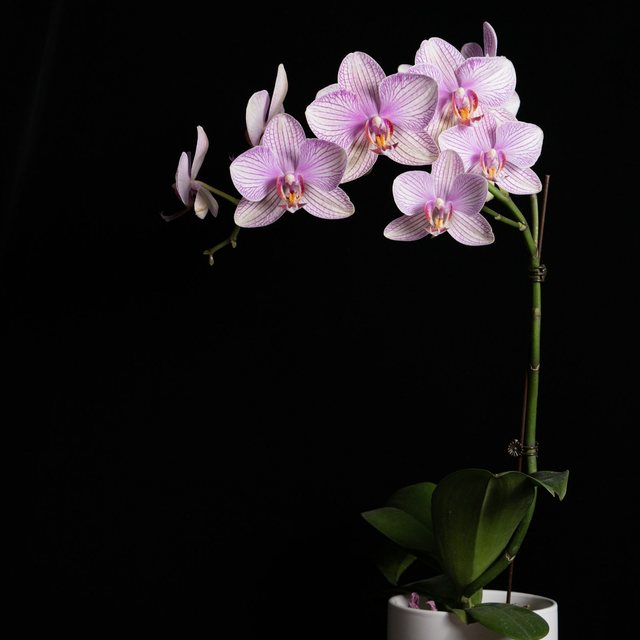
Call 631-612-6156 with the town, the date and what the flowers are for. We make it in our Port Jefferson shop and go through the details with you by phone before we start building it.
The name is anatomical, and it is precisely dated
John Lindley coined the English word orchid in 1845, in the third edition of School Botany, from the Greek orkhis — literally testicle — after the shape of the plant’s paired root tubers. The Latin form orchis had been in English since the 1560s, and before that the Middle English name for the plant was ballockwort, recorded around 1300.
The naming is credited further back still. Theophrastus, who lived from 372 to 286 BC, is credited with attaching the Greek orchis to the plant, which gives the etymology a second and independent line of support.
In Chinese and Korean painting the orchid carries a specific virtue: humility
In Chinese art the orchid is one of the Four Gentlemen, a set of four plants — plum blossom, bamboo, chrysanthemum and orchid — matched to the junzi, the gentlemen of Confucianism. The Cleveland Museum of Art’s curatorial text for Yamamoto Baiitsu’s 1834 painting Plums, Bamboo, and Orchid assigns each plant its virtue, and the orchid’s is humility. Bamboo is given open-mindedness, the plum strength in adversity. The same four plants map to the four seasons, and there the orchid is spring — plum winter, bamboo summer, chrysanthemum autumn. The theme became prominent among scholar painters in the Ming and Qing dynasties, though versions exist from as early as the twelfth century.
The University of Michigan Museum of Art, writing about an album leaf by Shitao, describes the painter as aspiring to be like the orchid, which in China has been a metaphor for a scholar of integrity and talent since the third century. The Four Gentlemen are said to stand for positive qualities because of their ability to endure unfavourable climates, their light fragrance and their understated beauty. The reading carried into Korea: the Smart Museum of Art’s Joseon-tradition hanging scroll by Gim Eung-won, from around 1915, values the wild orchid for its isolated mountain habitat and its solitary beauty, the orchid standing for scholarly integrity and authentic character.
The meanings most often sold with orchids could not be traced
Researching this page meant discarding more orchid symbolism than it kept. Each of the following is widely repeated, none of it could be traced to a primary or scholarly source, and so none of it is written here as fact.
- Colour-by-colour symbolism: pink for affection, purple for royalty or admiration, yellow for friendship, white for purity, green for health, orange for boldness. Every occurrence found traced back to florist marketing copy, which is why there is no colour chart on this page.
- The Victorian language of flowers — refined beauty, luxury, a rare and refined lover — and the older Greek belief attributed to Dioscorides that eating the larger or the smaller tuber decides the sex of an unborn child, along with the tubers’ career as an aphrodisiac under the names satyrion and salep. No Victorian floral dictionary could be traced for the orchid entry, and the one semi-scholarly source reachable here confirms the naming, not the beliefs.
- The saying about the orchid in the deep valley that does not withhold its fragrance for want of an audience. It is attributed to Confucius everywhere and could not be traced to a primary text in the Chinese Text Project’s classical corpus, so this page does not attribute it to him.
- The orchid as the flower of the fourteenth or the twenty-eighth wedding anniversary, and white orchids as the standard funeral flower in Chinese, Taiwanese, Japanese or Korean practice. We will not tell you orchids are required for a funeral, nor that they are wrong for one; if a sympathy order is what you are working on, the sympathy and funeral page deals with timing and delivery rather than with symbolism.
- Cattleya trianae as Colombia’s national flower and Vanda Miss Joaquim as Singapore’s, and the orchidelirium stories of named collectors and auction prices. None of it could be sourced to a government, botanic-garden or institutional record.
The documented American occasion for a cut orchid is the corsage
There is a documented American meaning for a cut orchid, and it is a use rather than a virtue. The UC Davis cut-flower handbook chapter records that demand increased for orchids prepared as a corsage and sold through mass-market outlets at Easter and Mother’s Day — pinned to a jacket or worn on a wrist, tied to a particular pair of dates, rather than standing in water on a table.
The genera follow the same story. Cattleya is known both as the Corsage Orchid and as the queen of orchids, and was so heavily collected in the nineteenth century that the genus is now protected under CITES Appendix II; most cultivated plants today are hybrids rather than wild species. NC State Extension describes Cymbidium as popular with florists for its sprays of long-lasting blooms and frequently used both as a cut flower and in corsages; Cymbidium plants stand one to four feet, and most of the flowers are fragrant. Which genus a florist actually has in the cooler on a given day is a separate question from what you want it to mean; the substitutions page covers how that gets handled.
Questions people ask about what orchids mean
Where does the word orchid come from?
John Lindley coined it in English in 1845, in the third edition of School Botany, from Greek orkhis, literally testicle, after the shape of the plant’s paired root tubers. The Latin orchis appears in English from the 1560s, and the Middle English name for the plant was ballockwort, around 1300.
What virtue does the orchid stand for in Chinese painting?
Humility. The orchid is one of the Four Gentlemen alongside plum blossom, bamboo and chrysanthemum, and the Cleveland Museum of Art assigns it humility specifically, with open-mindedness going to bamboo and strength in adversity to the plum. In the seasonal version of the same scheme the orchid is spring.
Is there a reliable meaning for each orchid colour?
Not one that could be traced. Every version of the pink, purple, yellow and white colour scheme found in research led back to florist marketing copy, with no scholarly or primary source behind it. Choose the colour for the room it is going into or the outfit it is worn with, rather than for a chart.
Why can a wild orchid not be picked in New York?
Because every orchid species in the state is on the protected plant list, and 6 NYCRR 193.3 makes it a violation for any person, anywhere in New York, to pick, sever, remove or carry away a protected plant without the owner’s consent. Each unlawful action counts as a separate violation.
New York’s native orchids are all on the state protected list
Nearly 60 species of orchid are native to New York State, plus one naturalised European species, and 20 of those are considered endangered or threatened and are tracked by the New York Natural Heritage Program. DEC’s guidance: all of the state’s orchid species are on the state protected list, it is a violation to remove or damage an orchid on state land, and an orchid may not be removed from private land without the landowner’s consent. The operative regulation, 6 NYCRR 193.3, makes it a violation for any person, anywhere in the State, to pick, pluck, sever, remove, damage by the application of herbicides or defoliants, or carry away any protected plant without the consent of the owner, and each unlawful action is a separate violation.
The lists name the plants individually. Endangered: Cypripedium candidum, Cypripedium parviflorum var. parviflorum, Platanthera ciliaris, Platanthera cristata, Platanthera hookeri and Platanthera leucophaea. Threatened: Arethusa bulbosa and Cypripedium arietinum. Rare: Calopogon tuberosus var. tuberosus. Exploitably vulnerable: Cypripedium acaule, Cypripedium reginae, the Platanthera and Spiranthes genera generally, Pogonia ophioglossoides and the Goodyera genus.
Digging one up is its own question. NC State Extension records that Cypripedium acaule seeds require the presence of a specific Rhizoctonia fungus to germinate and grow, and that the plants are difficult to transplant and grow and are best left to their native habitat. Orchid seed is dust-like and produced in enormous numbers, which is why isolated single plants turn up along trails. No source consulted records native orchid occurrences at the level of Nassau or Suffolk County, so no species is claimed here for any particular town. For the flower rather than the meaning, occasions works from the event end and the orchid guide collects the rest of what we have on the stem.
Questions to ask before choosing orchids for an occasion
- Is this being worn, or is it going in water? The documented American use of a cut orchid is the corsage, sold through mass-market outlets at Easter and Mother’s Day. A large table arrangement works against that rather than with it.
- Does the recipient need to read a meaning off the colour? If so, orchids are a poor vehicle: the colour meanings in circulation trace back to marketing copy rather than to any documented tradition.
- Would restraint be read as restraint, or as thrift? The documented orchid virtue is humility, and the Four Gentlemen are praised for enduring unfavourable climates, for light fragrance and for understated beauty.
- Does a specific genus matter, or only the look? Cattleya, the Corsage Orchid, is CITES Appendix II protected, and most cultivated plants today are hybrids rather than wild species. If a named genus is genuinely required, say so on the phone rather than after delivery.
- Is the idea coming from an orchid you saw growing wild? Leave that one where it is. All of New York’s orchid species are on the state protected list.
Roses at the door tonight
Call 8 hours ahead. Made in our shop and ready with 8 hours’ notice.